Ridin’ with Ricketts Day 5: Making history in special ways

(Follow veteran MTSU News and Media Relations staffer Randy Weiler’s daily blog as he traveled March 9-14 with alternative fuels researcher Dr. Cliff Ricketts and his team on their coast-to-coast trip using no gas.)

Happy to reach Long Beach, Calif., and reach a career goal of driving coast-to-coast using no gas, Dr. Cliff Ricketts exits the 2005 Toyota Prius on Thursday March 14. (Photos by MTSU News and Media Relations)

Happy to reach Long Beach, Calif., and reach a career goal of driving coast-to-coast using no gas, Dr. Cliff Ricketts exits the 2005 Toyota Prius on Thursday March 14. (Photos by MTSU News and Media Relations)

LONG BEACH, Calif. — Lasting impressions from March 14, 2013, the day an MTSU professor etched his name into history at the shores of the Pacific Ocean.

Lots to consider on a picture-perfect, albeit 90-degree day when School of Agribusiness and Agriscience professor Dr. Cliff Ricketts sped off into the sunset by achieving a monumental milestone: Without gasoline we purchase at the pump, he and co-driver Terry Young of Woodbury, Tenn., drove 2,600 miles from Tybee Island east of Savannah, Ga., to Long Beach.

MTSU professor Cliff Ricketts, left, and Travis Owen enjoy the cold water in the Pacific Ocean March 14 in Long Beach, Calif.

MTSU professor Cliff Ricketts, left, and Travis Owen enjoy the cold water in the Pacific Ocean March 14 in Long Beach, Calif.

When it’s all said and done, what will we recall years from now about Day 5 — the final day of the cross-country trip?

• the boom, boom, boom backfiring by the fire-engine red 1994 Toyota Tercel well after Team Ricketts’ arrival to the beach area behind the Long Beach Museum of Art, 2300 E. Ocean Blvd.;

• minutes later, because of the boom, boom, boom backfiring of the car as it was about to be loaded onto a trailer, a beach police officer arrived with, as he called it, lots of “silly questions.” After learning it was for a research project, it was not an event like the making of a movie (which would require a city of Long Beach permit) and that the group was about to leave, he understood and backed off;

• grown men, acting like teenagers, overjoyed with the success of the journey;

• hearing 64-year-old Ricketts belt out several loud roars. He just had finished the quest. He deserved being able to let ’r roar!;

• visiting and enjoying dinner on the awesome RMS Queen Mary, a retired ocean liner permanently moored in Long Beach. It had a personal twist: The late Millard Blankenship, my father-in-law, was among the thousands of World War II soldiers who returned home on the massive structure;

Ridin with Ricketts-cropped-new

Catch up on all five days of the trip by clicking on the photo.

• while dining on the RMS Queen Mary, an accident with overturned glasses sent water across one end of the table and onto the floor. Rick Presley, 53, of Orlando, Fla., nearly flipped out of his chair. It was quite a sight as it happened. Presley, an entrepreneur, took an agriculture class taught by Ricketts at Mt. Juliet High School in the mid-1970s. Funny how great teachers make superb role models and influence young minds;

• how for at least the second time this week, Ricketts does a good deed, buying  dinner for two people, both of whom are part of the 10-member team. Outside the Bartlett, Tenn., Cracker Barrel on March 11, a nicely dressed and articulate man approaches Ricketts with a barrage of questions about the two cars and the research while Team Ricketts was refueling hydrogen. Just as they are finishing refueling, the man suddenly shares how he and his wife have run out of gasoline nearby. Ricketts and another in the group give him $5;

• how from Friday, March 8, until today, March 15, there has not been the first detected cross word between team members. It’s amazing the mutual respect and collaboration all have for one another; and

• just past midnight Wednesday, as the team chose to skip spending the night in Kingman, Ariz., to carry its hydrogen into California under the cover of darkness, the maneuver worked (prayers answered) and the team sailed on to Needles, Calif.

— Randy Weiler (Randy.Weiler@mtsu.edu and follow on Twitter @WeilerRandy )

MTSU alternative fuels researcher and professor Cliff Ricketts stands next to a sign showing gas prices at a Mobil gasoline station just off an I-40 west exit near Newberry Springs, Calif., on Thursday, March 14. The Ricketts team was headed to Long Beach, Calif.

MTSU alternative fuels researcher and professor Cliff Ricketts stands next to a sign showing gas prices at a Mobil gasoline station just off an I-40 west exit near Newberry Springs, Calif., on Thursday, March 14. The Ricketts team was headed to Long Beach, Calif.


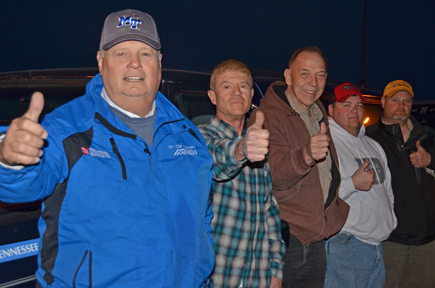
Co-driver Terry Young of Woodbury, Tenn., gives a thumbs-up to those watching Dr. Cliff Ricketts drive the final few feet to the edge of the Pacific Ocean on Thursday, March 14, in Long Beach, Calif. They combined to drive 2,600 miles using no gasoline.

Co-driver Terry Young of Woodbury, Tenn., gives a thumbs-up to those watching Dr. Cliff Ricketts drive the final few feet to the edge of the Pacific Ocean on Thursday, March 14, in Long Beach, Calif. They combined to drive 2,600 miles using no gasoline.


Ridin’ with Ricketts Day 4: Majestic views, late-night drama leads to Long Beach

(Follow veteran MTSU News and Media Relations staffer Randy Weiler’s daily blog as he travels March 9-14 with alternative fuels researcher Dr. Cliff Ricketts and his team on their coast-to-coast trip using no gas.)

Ridin with Ricketts-cropped-new

Catch up on the first four days of the trip by clicking on the photo.

NEEDLES, Calif. — The 10-member group traveling with Dr. Cliff Ricketts on his coast-to-coast journey (driving with no gas) weren’t exactly experiencing “California Dreamin’” when they awakened to a 25-degree temperature in Santa Rosa, N.M., Wednesday, March 13.

Or maybe they were.

California happens today for Ricketts and the crewmembers. Long Beach is the final destination. More precisely, a parking lot behind the Long Beach Museum of Art, 2300 Ocean Blvd., is where the crew plans to finish their 2,600-mile journey before Los Angeles and Long Beach rush-hour traffic have their daily snarl.

Santa Rosa, N.M., Tractor Supply Company store manager CJ Jones, left, is quite amused by something MTSU alternative fuels expert shared during a visit on March 13. (MTSU photo by Randy Weiler)

Santa Rosa, N.M., Tractor Supply Company store manager CJ Jones, left, is quite amused by something MTSU alternative fuels expert shared during a visit on March 13. (MTSU photo by Randy Weiler)

Rewinding 24 hours earlier to Day 4 of the expedition found many bumpy miles of Interstate 40 highway pavement. There are some 584 miles, far too many to count for road-weary travelers.

Before we even could shove off from Santa Rosa, the group encounters a mechanical bump in the road, so to speak. In refueling the 2005 Toyota Prius and 1994 Toyota Tercel before the day began, pressure from the hydrogen tanks making the trip made the valves ice over. Solution: Very slowly let the hydrogen seep into the holding tanks.

The mesas and mountains along Interstate 40 that parallel Historic Route 66 in New Mexico and Arizona seem to grow as we cross into Arizona, heading toward dinner for three of us in Flagstaff.

In Albuquerque, before a media interview with KOB Eyewitness News4, Ricketts goes down memory lane at the Kit Carson Park. “I used to watch Kit Carson when I was a kid,” he said.

We barely touched the surface of Navajo Nation in New Mexico and Arizona. Some very large petrified wood caught our attention at a tourist spot called Geronimo.

Hats off to a solid group of volunteers — engineers and mechanics — who not only are talented but also give their all for Ricketts. The crew includes Terry Young, Mike Sims, Travis Owen, Paul Ricketts, Aras Alexander, Duane Griffin and Rick Presley. Alexander is the lone MTSU student making the trip. Owen, a former MTSU student, now attends the Tennessee Technology Center at Murfreesboro. They all contribute to a safer trip, and, with Ricketts, it’s “safety first.”

At a refueling stop for the Cliff Ricketts team in a rural part of the Texas Panhandle, Americana literally was steps away.

At a refueling stop for the Cliff Ricketts team in a rural part of the Texas Panhandle, Americana literally was steps away.

Well, this story continues to take twists and turns.

It’s midnight PDT. We just passed Kingman, Ariz., where the group was supposed to spend the night and was to be the dateline for this blog post. Ricketts made an executive decision — with 100 percent support of the crew — to push on to Needles, a little more than an hour away.

Ricketts and his crew have hydrogen on board. They know they have to pass through an inspection station after they enter California. He feels there is a better chance of being cleared to go through at night than early in the day. Success: The truck with tanks is waved on through. All breathe a sigh of relief.

Ricketts still sweats the small stuff, such as worrying about having enough hydrogen to finish the journey. We will find out later today.

On deck for Thursday and Day 5: Long Beach.

— Randy Weiler (Randy.Weiler@mtsu.edu and on Twitter @WeilerRandy)

Team Cliff Ricketts crew member Rick Presley, left, of Orlando, Fla., and MTSU alternative fuels researcher and professor Cliff Ricketts are shown at an Edge of Plains official scenic historic marker in rural eastern New Mexico (elevation 6,500 feet) on March 13.

Team Cliff Ricketts crew member Rick Presley, left, of Orlando, Fla., and MTSU alternative fuels researcher and professor Cliff Ricketts are shown at an Edge of Plains official scenic historic marker in rural eastern New Mexico (elevation 6,500 feet) on March 13.

MTSU's Dr. Cliff Ricketts sits behind the wheel, enjoying a banana just after leaving Santa Rosa, N.M., on March 13. (Photos by MTSU News and Media Relations)

MTSU’s Dr. Cliff Ricketts sits behind the wheel, enjoying a banana just after leaving Santa Rosa, N.M., on March 13. (Photos by MTSU News and Media Relations)

Ridin’ with Ricketts Day 3: Coast-to-coast on no gas nears New Mexico

(Follow veteran MTSU News and Media Relations staffer Randy Weiler’s daily blog as he travels March 9-14 with alternative fuels researcher Dr. Cliff Ricketts and his team on their coast-to-coast trip using no gas.)

OKLAHOMA CITY — Believe me, MTSU’s Dr. Cliff Ricketts can hang in there with George Strait when singing “Amarillo by Morning,” even if it’s just a line or two.

Volunteer Duane Griffin of Murfreesboro finishes changing a rear trailer tire on Tuesday in Zian, Okla. A blowout along Interstate 40 forced driver Paul Ricketts to have to exit and change the tire during a refueling process. (MTSU photo by Randy Weiler)

Volunteer Duane Griffin of Murfreesboro finishes changing a rear trailer tire on Tuesday in Zian, Okla. A blowout along Interstate 40 forced driver Paul Ricketts to have to exit and change the tire during a refueling process. (MTSU photo by Randy Weiler)

It’s Tuesday, March 12. Ricketts has been singing/humming the famous song since we left Oklahoma City and then passed the halfway point in his quest to drive coast-to-coast 2,600 miles using hydrogen instead of gas. He’s also serenaded others with the “Ballad of Davy Crockett” and other tunes.

It hasn’t been in Ricketts’ thoughts — as CEO of the team joining him in what he continually calls “an expedition,” he has had much on his mind — he probably could belt out “… get your kicks on Route 66.”

Hopefully, we won’t be in Amarillo by morning. We will be there tonight, dining at the legendary Big Texan, Home of the Free 72-OunceSteak (if you can eat all six pounds of it). If all goes as planned on Day 3 of the cross-country trip, we will be sleeping tonight in Santa Rosa, N.M. Follow on Twitter @WeilerRandy.

After leaving Oklahoma City, where Ricketts had great interviews with Jay Marks of The Oklahoman daily newspaper and with KOCO, the ABC affiliate, we soon landed in Historic Route 66 country. Today’s history lesson: 2,500-mile U.S. 66 runs from Chicago to Los Angeles. It has been called The Main Street of America, The Mother Road and the Will Rogers Highway.

Enough history. We’re in the present, and Ricketts’ 2005 Toyota Prius, with a range of 260 miles, and the 1994 Tercel, with a range of 370, surpassed the halfway point of Clinton, Texas.

We’ve had about six fuel changes along the way. Finally, on Frontage Road and Texas Farm Road 453, we switch to the Tercel, the “Forces of Nature,” vehicle, with the venerable Ricketts behind the wheel.

Sometime tonight, we’ll cross into New Mexico and spend the night in Santa Rosa.

On deck for Wednesday and Day 4: Albuquerque, N.M., and Flagstaff and Kingman.

— Randy Weiler (Randy.Weiler@mtsu.edu and on Twitter @WeilerRandy)

Ridin’ with Ricketts Day 2: Refueling with hydrogen

(Follow veteran MTSU News and Media Relations staffer Randy Weiler’s daily blog as he travels March 9-14 with alternative fuels researcher Dr. Cliff Ricketts and his team on their coast-to-coast trip using no gas.)

MURFREESBORO to VAN BUREN, Ark. — You could call it a two-hour rain delay, like they have in baseball games and other sporting events.

Hydrogen expert Terry Young, left, and Mike Sims check settings during a hydrogen refueling process on Monday, March 11, as part of Dr. Cliff Ricketts' coast-to-coast trip using alternative fuel and no gas. (Photo by MTSU News and Media Relations)

Hydrogen expert Terry Young, left, and Mike Sims check settings during a hydrogen refueling process in Bartlett, Tenn., on Monday, March 11, as part of Dr. Cliff Ricketts’ coast-to-coast trip using alternative fuel and no gas. (Photos by MTSU News and Media Relations)

It was pouring down rain Monday morning, but that is not why it took Dr. Cliff Ricketts’ entourage more than two hours to leave Murfreesboro, as the group prepared to head west on Day 2 of the 2,600-mile, coast-to-coast drive from Tybee Island, Ga., to Long Beach, Calif.

Follow Ricketts’ quest on Twitter (@WeilerRandy).

They had to work through a mechanical issue on one of their vehicles, but it had nothing to do with hydrogen or solar, the two mainstays in their alternative fuel arsenal.

Credit Ricketts and common sense for thinking ahead and taking State Route 840 from north of Murfreesboro to the edge of Dickson. This totally avoided Nashville traffic, which might already have subsided by 10:30 but why ask for problems when you can drive past Castle Gwynn and pristineness of Leipers Fork in Williamson County.

Anyway, finally, we were good to go to begin the approximately 530-mile second leg of the journey, which is being made in a 1994 Toyota Tercel and 2005 Toyota Prius. We don’t need gas; we’ve driving on hydrogen from water separated by sun (solar). All of it is produced on campus in and around Ricketts’ shop, which has the more official Vocational Agriculture Building name attached to it.

Hydrogen expert Terry Young, left, connects the fill hose to the fuel tank connector as MTSU senior Arad Alexander, right, observes during a stop on Monday, March 11.

Hydrogen expert Terry Young, left, connects the fill hose to the fuel tank connector as MTSU senior Arad Alexander, right, observes during a stop on Monday, March 11.

The problem that hampered the Prius out of the gate just west of Savannah, Ga., on Day 1 continued to hamper the eight-member volunteer crew joining Ricketts on the journey. It has been a mystery ailment. Ricketts believes it has been a transmission-related issue; co-driver Terry Young has said it is a computer-related problem. But give it a few minutes for its “temper” to cool down and she’s good to go.

Just past 1 p.m., we reach Jackson, Tenn. We head for the Tractor Supply Company store. Because Ricketts has had TSC as a major sponsor for more than 20 years (they contributed an all-time high $25,000 in 2012-13), he agrees to stop at two stores every day. Manager Mike Austin and a woman (team lead Sylvia Ludolf) with “Sylvia” hand-written on her red vest provide warm-and-friendly greetings on an afternoon that has become bitterly cold because of the wind-chill factor.

The Jackson Sun and WBBJ-TV send reporters/photojournalists to capture Ricketts’ quest to achieve a 25-year goal of driving without gas.

Before reaching Memphis, we need to stop in Bartlett. The need is necessary because the Prius needs the first of three, two-hour energy drinks, a.k.a. refueling with hydrogen. Young, Mike Sims and the crew know what to do, and they can refuel in 15 minutes.

Ricketts, the CEO of the operation is more than relieved, when he sees Exit 2 in West Memphis, Ark. He knows we have eluded Memphis’ 4:30p.m. traffic congestion.

Driving Interstate 40 and into Arkansas turns bumpy, isolated (you can see for miles in the flat terrain) and then dark as nightfall arrives.

Because of the various stops along the way — not to mention getting out of Murfreesboro two hours late — we reach the overnight destination of Van Buren, Ark., next to Fort Smith. We are too late for a Tractor Supply stop (Ricketts phoned to say he would be there promptly at 8 a.m. Tuesday) and almost too late for dinner.

Chili’s Grill & Bar’s lights go out right at 11. One of the crew heads to Walmart. Three others walk about five blocks (and under both I-40 bridges) in 37-degree temperatures to Waffle House for a midnight “snack.” The rest head for bed at the Best Western.

So it’s 1,030 miles down, 1,570 to go to reach Long Beach, Calif., driving on empty with no gas.

Ricketts returns to the wheel Tuesday. Next up: Oklahoma City, Amarillo, Texas, and the overnight stay in Santa Rosa, N.M., a state where several of us have never entered.

— Randy Weiler (Randy.Weiler@mtsu.edu and on Twitter @WeilerRandy)

MTSU professor Cliff Ricketts travels Monday through Memphis in the 2005 Toyota Prius he's using during a coast-to-coast journey using hydrogen for fuel and no gasoline.

MTSU professor Cliff Ricketts travels Monday through Memphis in the 2005 Toyota Prius he’s using during a coast-to-coast journey using hydrogen for fuel and no gasoline.


Ridin’ with Ricketts Day 1: Roller-coaster

(Follow veteran MTSU News and Media Relations staff Randy Weiler’s daily blog as he travels with alternative fuels researcher Dr. Ricketts and his team on their coast-to-coast trip using no gas.)

TYBEE ISLAND, Ga. — What a roller-coaster day!

On the unofficial first day (March 9) of spring break for MTSU students and faculty, professor Cliff Ricketts began his quest to drive 2,600 miles coast-to-coast — from Tybee Island, Ga., to Long Beach, Calif. —without any gas.

All he needs is sun and hydrogen from water. That’s the easiest way to explain it, though it’s far more scientific and complicated than that.

MTSU alternative fuels researcher Dr. Cliff Ricketts tells a film crew documenting his 2013 quest to drive coast-to-coast without using any gas about an engine-related issue that slowed progress on Day 1 of the 2,600-mile trip. The 2005 Toyota Prius developed a transmission coolant heating problem just after leaving Savannah, Ga. (Photo by MTSU News and Media Relations)

MTSU alternative fuels researcher Dr. Cliff Ricketts tells a film crew documenting his 2013 quest to drive coast-to-coast without using any gas about an engine-related issue that slowed progress on Day 1 of the 2,600-mile trip. The 2005 Toyota Prius developed a transmission coolant heating problem just after leaving Savannah, Ga. (Photo by MTSU News and Media Relations)

A brilliant orange sunrise and a chilly morning greeted locals and tourists on Tybee Island, some 490 miles southeast of Murfreesboro. Reporter Raquel Rodriguez with WSAV-TV, the NBC affiliate in Savannah, Ga., arrives on time for an interview with Ricketts, a fixture at MTSU and the university’s expert in alternative fuels.

Later, just before leaving, Ricketts and his entourage of experienced and youthful engineers and mechanics emerge on Tybee’s sandy beach. It has become a rite of spring for him to remove his sneakers, roll up his pants legs, stroll out to the salt water and make a statement about the journey.

Ricketts and backup driver Terry Young of Woodbury, Tenn., hit the road just before 9 a.m. As Ricketts drives under and past the Spanish moss on the old oak trees in historic downtown Savannah, he learns some not-so-good news: A mystery problem, unrelated to the hydrogen process, comes 30 minutes into the trip.

Oh, brother. Ricketts, 64, who grew up and still maintains a cattle farm in neighboring Wilson County, Tenn., does not take kindly to this type of news. For a man on a mission, this kind of news stinks like cow manure on his farm.

Fortunately, with a little “mothering” of the car and situation by Young, the problem worked itself out by the time the seven-member group reached Macon, Ga.

Ricketts, who could be considered a media darling because of the entertaining way he explains his research process, met WMAZ-TV (NBC) reporter/videographer Claudia Taylor for his second media interview of the day.

Next stop: Atlanta. Only it wasn’t just stop. It was stop-and-go in thick traffic on Interstate 75 North until the group reached Marietta, Ga., where photojournalist Pat Moore with WAGA-TV/Fox5 Atlanta conducted the final interview. Oddly enough, a Fox5 colleague suggested we meet Moore at the highly popular Marietta Grill.

MTSU professor Cliff Ricketts, left, explains the hydrogen fueling process to Savannah, Ga., television reporter/videographer Raquel Rodriguez on March 8 in Tybee Island, Ga. A 2005 Toyota Prius and a 1994 Toyota Tercel use hydrogen from water separated by sun (solar), all produced on the MTSU campus, as the fuel sources.

MTSU professor Cliff Ricketts, left, explains the hydrogen fueling process to Savannah, Ga., television reporter/videographer Raquel Rodriguez on March 8 in Tybee Island, Ga. A 2005 Toyota Prius and a 1994 Toyota Tercel use hydrogen from water separated by sun (solar), all produced on the MTSU campus, as the fuel sources.

Just after Moore arrived and was about to start the interview, a group of people stood off to the side in the parking lot. Seconds later, we learn that two of them are proud MT alumni Krista (’01) and Barry (’00) Hall with their two beautiful daughters, Ansley and Marley, and some friends. Friends. All are from Calhoun, Ga., about an hour’s drive in north Georgia.

We learn that Krista was the first Lightning and Barry was part of a group of football players who played for former coaches Boots Donnelly and Andy McCollum. Both Krista and Barry teach at Gordon Central High School — and truly are True Blue Blue Raiders.

An hour later, we arrive in Calhoun to meet Lisa McAfee, a Tractor Supply Company team leader for a photo opportunity. TSC is Ricketts’ major sponsor, contributing a $25,000 grant for 2012-13. The MTSU Office of Research matched half of that amount ($12,500).

Driving his 1994 Toyota Tercel, Ricketts heads for a fast-food place to get-and-go. He wants to reach MTSU and he wants to get home. He safely makes it to both.

It’s 490 miles down; 2,100 to go. Fortunately, despite the springing forward of clocks for Daylight Saving Time, well-needed rest awaited the weary travelers. Day 1 ends quite nicely.

— Randy Weiler (Randy.Weiler@mtsu.edu; follow Randy’s trip updates on Twitter @WeilerRandy)

Ricketts plans ultimate road trip: coast-to-coast and gas-free

As an MTSU alternative fuels researcher, Dr. Cliff Ricketts believes he stands on the edge of history.

On Saturday, March 9, Ricketts will begin a five-day, 2,600-mile journey to drive coast-to-coast using no gas.

MTSU alternative fuels researcher Dr. Cliff Ricketts steps out of his Toyota Prius at the edge of the Pacific Ocean in Long Beach, Calif., on March 8, 2012at the end of a 2,600-mile journey. (File photo by David Bro for MTSU News and Media Relations)

MTSU alternative fuels researcher Dr. Cliff Ricketts steps out of his Toyota Prius at the edge of the Pacific Ocean in Long Beach, Calif., on March 8, 2012at the end of a 2,600-mile journey. (File photo by David Bro for MTSU News and Media Relations)

How can he do it? After driving across the country in March 2012 using only 2.15 gallons of gas, Ricketts has the solution: His fuel sources for the 1994 Toyota Tercel and 2005 Toyota Prius will be hydrogen from water separated by solar power, all produced on the MTSU campus.

“We’re showing how America could be energy independent if the need arises,” Ricketts said. “We don’t need any foreign oil. … What we achieved last year was less pollution and less dependent on foreign oil.

“Hydrogen can be made from natural gas,” he added. “Our hydrogen comes from water. With hydrogen, everything’s natural. The solar is all natural and it’s sustaining.”

Ricketts’ trip comes after gas prices rose significantly in February, passing $5 a gallon for regular in several states. As of March 7, AAA said the national average was $3.72 for a gallon of regular gas.

The journey — or “expedition,” as Ricketts refers to it — will begin March 9 on the beach at Tybee Island, Ga., near Savannah. It is scheduled to end Thursday, March 14, on the shores of the Pacific Ocean in Long Beach, Calif., a state where gas is more than $5 a gallon.

“If you were to ask me which is more significant to mankind — putting a man on the moon or driving coast-to-coast in five days with the sun and hydrogen from water as the only fuel sources — I believe the latter is more significant. … This has environmental implications, economic implications and world peace implications.”

Starting Monday, March 11, Ricketts and backup driver/hydrogen expert Terry Young of Woodbury, Tenn., will be navigating a route mostly across Interstate 40 through Tennessee, Arkansas, Oklahoma, Texas, New Mexico, Arizona and California.

If all systems are working properly with the two primary vehicles, Ricketts said he plans to refuel them overnight. The group is carrying hydrogen, because it is not available everywhere.

MTSU senior Arad Alexander of Houston, Texas, will be part of the travel team. He was in Ricketts’ alternative fuels class last fall, and his group’s class project involved turning a donated golf cart into a solar electric vehicle.

coast-to-coast Ricketts graphicIn addition to Young and Alexander, crew members include Travis Owen of Woodbury, Mike Sims of Jackson, Mich., and the professor’s youngest son, Paul Ricketts of Versailles, Ky.

Owen, who attended MTSU, is a student at the Tennessee Technology Center at Murfreesboro. Several of Ricketts’ former students, who were involved with his years of research, also plan to participate.

In 2012, Ricketts and Young combined to drive 1,700 miles using 95 percent ethanol, or 43 gallons of E95, and 5 percent gas. The remaining 900 miles was driven using hydrogen from water separated by solar power, all produced at MTSU.

On Nov. 1, 2010, Ricketts drove the Tercel, nicknamed “Forces of Nature,” approximately 500 miles from Bristol, Va., to West Memphis, Ark., fueled by solar and hydrogen from water, all produced on campus.

Ricketts, a native of Mt. Juliet, Tenn., has spent 37 years in higher education, including 35 in alternative fuels research. He teaches a variety of agriculture classes for the MTSU School of Agribusiness and Agriscience in the College of Basic and Applied Sciences.

In 2006, Ricketts was asked to testify before the 109thU.S. Congress’ Committee on Science and Energy regarding multi-fuel plug-in hybrids.

Brentwood, Tenn.-based Tractor Supply Company, the MTSU Office of Research and Louisville, Ky.-based Farm Credit Services of Mid-America are the primary sources of Ricketts’ 2012-13 funding.

— Randy Weiler (randy.weiler@mtsu.edu)

Students far exceed alternative fuels’ go-kart expectations

With the go-kart propped on a cinder block and Chris Morefield in the driver’s seat, Richard Hanson, right, uses a power drill to start their team’s hydrogen-powered go-kart before the Dec. 13 alternative-fuels class competition. (MTSU photos by News and Media Relations)

MTSU electronic media communication major Ryan Skelley may have discovered “the best way to end college.”

He and three research project teammates raced a propane-powered go-kart in competition against three other vehicles using different alternative fuels.

“Most people spend their last day doing an exam,” said Skelley, a senior from Murfreesboro, just minutes before finals and the last day of his last semester on Dec. 13. “This is pretty awesome.”

Four teams, comprising 19 of the 22 students taking an alternative-fuels class taught by Dr. Cliff Ricketts, competed in a drag race, a four-lap race and an endurance race.

The remaining three students worked on a special hydrogen peroxide-powered alternative-fuel vehicle that Ricketts called “the mystery car.” They have been performing research for entrepreneur Duane Griffin of Murfreesboro, who asked that the vehicle not be photographed.

Solar electric, ethanol and hydrogen were the other alternative fuels used in the unique final exam.

Ricketts said the propane vehicle was selected as a replacement for a planned biodiesel/cooking oil go-kart after the expense of the small diesel engine exceeded the team’s budget.

Drivers Aras Alexander, left, and Justin Dodd take off in their respective solar electric- and ethanol-powered vehicles as one of the alternative-fuels class races gets under way at the Tennessee Livestock Center.

“It went better than I thought it would, and more competitive than I thought,” Ricketts said of the hourlong competition.

“The kids were really excited. I’ll probably get two or three who will help me in the spring.”

In March, Ricketts plans another coast-to-coast trip of nearly 2,600 miles in a vehicle powered only by solar electricity and water-derived hydrogen.)

“The propane did as expected,” Ricketts added. “It had some structural problems that caused it to stop two or three times. The solar electric far exceeded expectations. The hydrogen go-kart never ran out of fuel. And the ethanol team had problems out of their control.”

Ricketts, who has called the class “the epitome of experiential learning,” said the ethanol team — made up of team leader Chris Coddington of Lebanon, Tenn.; Justin Dodd of Murfreesboro; Crystal Carney of Hendersonville, Tenn.; and Zach Hitchcock of Lewisburg, Tenn. — ordered badly needed parts that would not arrive until Dec. 14, the day after the class final.

Aras Alexander, top right, drives a solar electric-powered golf cart past a propane-powered go-kart driven by Adam Kaauwai Dec. 13 at the Tennessee Livestock Center.

“Too much horsepower is not a good thing,” Coddington said. “It needs a new carburetor. Once we put the ethanol in it, we got it to run. We just needed those parts.”

Senior Jonathan Prichard, a member of the hydrogen-peroxide team along with Dillon Hagewood of Murfreesboro and Skylar Daniel of Clarksville, Tenn., called the semesterlong class “an experience you cannot get anywhere else on a day-to-day basis.”

Prichard, a television production major in mass communication who planned to graduate Dec. 15, videotaped the competition. He will edit and upload it to YouTube.

Carney, a 2006 MTSU graduate, took the course as one of two continuing education classes this semester.

The single mom said the class showed the “fun of how to become independent.”

“When you look at all the possibilities, we don’t have to be dependent on foreign oil. And if a bunch of college kids can build alternative-fuel vehicles, the rest of the world can, too. The resources are out there.”

As a student at Beech High School, Carney took an agriculture class from Dale McDonald, who was one of Ricketts’ early alternative-fuels protégés.

— Randy Weiler (Randy.Weiler@mtsu.edu)

Ricketts, team achieve coast-to-coast goal

Long Beach, Calif.—MTSU Agribusiness Professor Cliff Ricketts is confident that his experience growing up on a dairy farm is at the core of the University’s recent achievement in alternative-fuels research: a 2,582-mile trek from coast to coast.

“On a dairy farm, you have to milk the cows twice a day without fail, no matter what, and no excuses,” said Ricketts, 63. “If there are problems, you have to figure it out and get it done, and it’s the same thing we’ve done at MTSU—get it done no matter what, and no excuses.”

Ricketts put his theory to work in the days leading up to his research team’s planned departure from Tybee Island, Ga., on March 4. Badly needed parts did not arrive in time to let his small crew of students and volunteers make some final preparations.

But, leading by example, Ricketts dipped his toes in the Atlantic Ocean on schedule, resorted to “backup plans two and three,” and left with three vehicles, instead of just one, to make the trip.

MTSU Professor Cliff Ricketts walks into the Pacific Ocean on March 8 to end a spring-break cross-country journey the same way he and his alternative-fuels research team started it at the Atlantic Ocean on March 4. (MTSU photo by David Bro)

The first two, a 2005 Toyota Prius and a 1994 Toyota Tercel converted to run on solar power and water-derived hydrogen, completed the first 900 miles of the trek. A 2007 Toyota Prius completed the last 1,682 miles on battery power and ethanol.

Even when a wheel bearing on a chase truck went out early on, the group transitioned to their remaining van and continued on, averaging around 60 mph over the course of the journey that finished in Long Beach, Calif., the afternoon of March 8.

The effort, spread across the three research vehicles, used solar power through energy credits supplied by solar panels arrayed on the roof of the University, which put power back in the grid of the Tennessee Valley Authority. That allowed the team to simply charge the 2007 Prius’s two large banks of batteries overnight, using a standard residential electrical outlet.

Ricketts said he used the University’s regular water supply from the Murfreesboro Water Department as the starting point for the alternative fuel. After electrolysis and filtering, the hydrogen provided power to the vehicle’s stock internal-combustion engine.

Dr. Cliff Ricketts, right, MTSU agribusiness professor, laughs with Dr. Warren Gill, chair of the School of Agribusiness and Agriscience after Ricketts returned to campus March 12 from a 2,582-mile coast-to-coast trip across America in alternative fuel vehicles. (MTSU photo by Andy Heidt)

he original plan was to use tanks pulled by a trailer to recharge the hydrogen-fueled Prius. When those parts did not arrive, Ricketts and his team decided to use three cars instead of just one.

In addition to the solar electric batteries and the hydrogen plant, the Prius also was outfitted to use an ethanol/gas mix, which accounted for about 90 total miles of the trip’s progress or about 2.15 gallons of fuel, according to Ricketts.

The group had estimated a total use of 10 gallons of gas, but road conditions allowed for much lower consumption. Technically, the ethanol/gas mix is not considered back-up power but is used when road conditions, like steep hills or heavy winds, would quickly deplete the batteries and hydrogen gas.

Ricketts said he hopes that the 50 or so students in MTSU’s agribusiness program and the half-dozen students that help out with alternative-fuel research each semester will pick up a concept that he calls fundamental to achieving any goal: never give up.

Ricketts was the only one to put his toes in the Atlantic before the trip began. The entire crew, students and volunteers, joined him in the shallow waters at the Pacific Ocean’s edge in Long Beach at the journey’s end.

Watch a video about the trip below, and get more facts about the trip at mtsunews.com/ricketts-coast-to-coast-facts.

– David Bro and Randy Weiler (Randy.Weiler@mtsu.edu)

‘Tale of the tape’ of Ricketts’ cross-country journey

Here are facts and figures about MTSU School of Agribusiness and Agriscience Professor Cliff Ricketts’ March 4-8, 2012, quest to drive coast-to-coast across the southern tier of the United States on 10 gallons of gasoline or less.

Trip details

Length of trip: About 2,532 miles
Trip start: Tybee Island, Ga.
Trip projected end: Long Beach, Calif.
Trip route: Interstate 16 in Georgia; I-75 through Georgia and Tennessee; I-24 in Tennessee; I-40 through Tennessee, Arkansas, Oklahoma, Texas, New Mexico, Arizona and California; and California Route 210 West, I-210 west, I-605 south, I-105 west and I-710 south
Alternative-fuels vehicles in use: 2005 Toyota Prius hybrid, 1994 Toyota Tercel, 2007 Prius hybrid

Traveling Support team members: Terry Young, hydrogen expert, Woodbury, Tenn., and Mike Sims, electrical expert, Jackson, Mich.; MTSU agriculture students Travis Owens of Woodbury, Brett Harris of Manchester, Tenn., and Steve Foe of Murfreesboro; agriculture student teachers Hayley Box of Murfreesboro and McEwen, Tenn., and Dawn Baker of Tipton, Ind.; and Austin Peay State University student Sonya D’Archangel of McEwen

Sponsors: Tractor Supply Co. (20-plus years); Farm Credit Services of Mid-America  ($15,000 and $1,500 grants); MTSU Office of the Provost and Office of Research and the College of Basic and Applied Sciences

Media contact: Randy Weiler, 615-898-5616 (o), 615-785-1196 (c) or Randy.Weiler@mtsu.edu


In the rear-view mirror

Day 1 (March 4) details
Depart from: Tybee Island, Ga., 8 a.m. ET
Destination: Murfreesboro (7:09 p.m. CT arrival)
Approximate distance: 521 miles
Alternative-fuels vehicle in use: 2005 Toyota Prius hybrid, 1994 Toyota Tercel
Fuel sources: Solar power and hydrogen from water
Amount of gas used: 0 gallons

Day 2 (March 5) details
Depart from: Murfreesboro, 8 a.m. CT
Destination: Fort Smith, Ark. (8 p.m. CT arrival)
Approximate distance: 521 miles
Alternative-fuels vehicle in use: 2005 Toyota Prius hybrid, 1994 Toyota Tercel and 2007 Toyota Prius hybrid
Fuel sources: Solar power and hydrogen from water
Amount of gas used: 0.125 gallons (Note: In the 900 miles driven from Tybee Island, Ga., to Conway, Ark., no gasoline was used)

Day 3 (March 6) details
Depart from: Fort Smith, Ark., 7:30 a.m. CT
Destination: Santa Rosa, N.M. (7 p.m. MT arrival)
Approximate distance: 610 miles
Alternative-fuels vehicle in use: 2007 Toyota Prius
Fuel sources: E95 (5 percent ethanol/5 percent gas) and electric

Day 4 (March 7) details
Depart from: Santa Rosa, N.M., 7:30 a.m. CT
Destination: Kingman, Ariz. (7 p.m. MT arrival)
Approximate distance: 511 miles
Alternative-fuels vehicle in use: 2007 Toyota Prius
Fuel sources: E95 (5 percent ethanol/5 percent gas) and electric

Day 5 (March 8 ) details
Depart from: Kingman, Ariz., 7 a.m. MT
Destination: Long Beach, Calif.  (3:15 p.m. CST/1:15 PT arrival time)
Approximate distance: 342 miles
Alternative-fuels vehicle in use: 2007 Toyota Prius
Fuel sources: E95 (5 percent ethanol/5 percent gas) and electric

Amount of gas used for total trip: 2.15 gallons

(Source: Dr. Cliff Ricketts; all times approximate)

Alt-Fuel Team Going Coast-to-Coast on 10 Gallons of Gas

MTSU alternative-fuels researcher Dr. Cliff Ricketts and his seven-member travel team began their mission March 4 to drive coast-to-coast on 10 gallons of gasoline or less. They’ll travel four days across the country until reaching their long-anticipated final destination of Long Beach, Calif., late Thursday, March 8. The entire length of the trip is approximately 2,532 miles. Learn more about the team’s journey at mtsunews.com/ricketts-coast-to-coast.