

MURFREESBORO, Tenn. — About 20 Middle Tennessee State University students gathered recently to put their analytical, research and collaborative skills to the test in a competitive, real-world scenario that included financial rewards for the winners.
Held inside the Business and Aerospace Building, “The Call of Data” 24-hour analytics challenge was hosted by the student-led MT Economics Club and the Data Science Club. MTSU’s Data Science program, the Department of Economics and Finance and the Jones College of Business partnered to sponsor the interdisciplinary event in collaboration with corporate partner Cooper Steel.
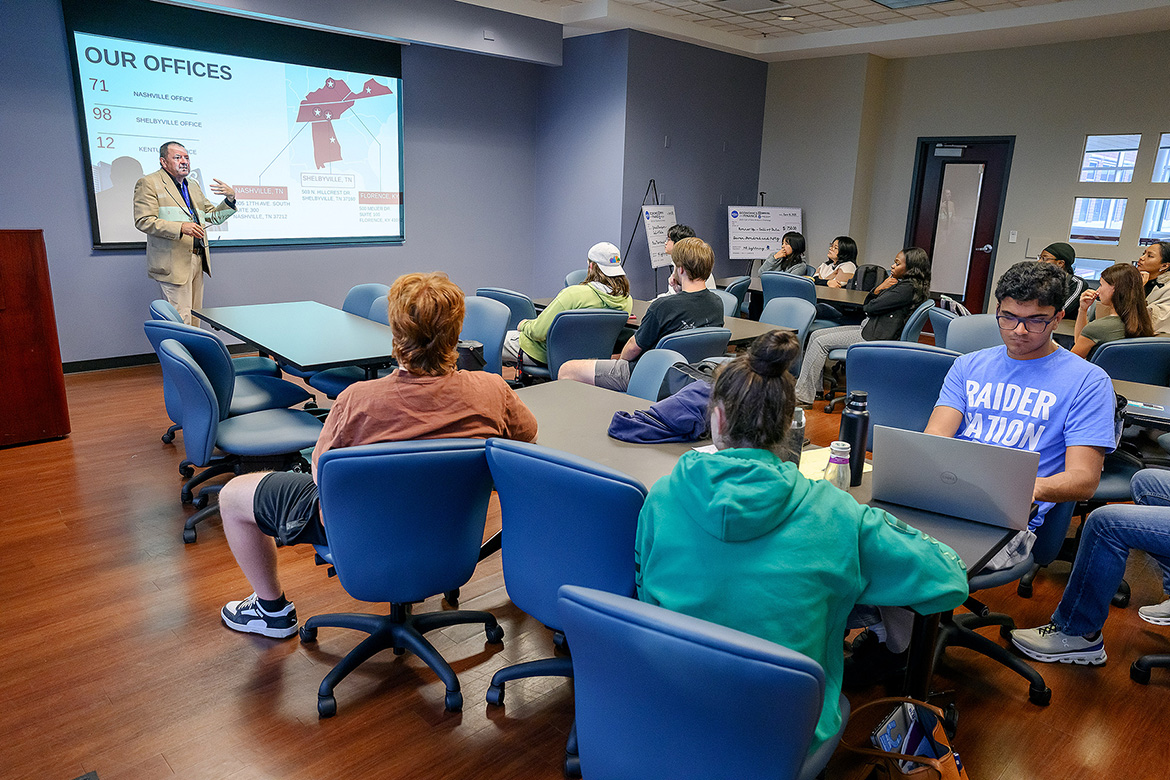
“This is the first time our department has hosted a 24-hour analytics challenge of this scale, and it’s a great example of how Jones College continues to blend experiential learning, industry engagement, and student leadership,” said Stuart Fowler, chair of the Department of Economics and Finance.

Cooper Steel presented the business challenge that put students majoring in finance, economics, data science, and related fields on four teams to see who could develop the best location options for the company’s expansion plans. The student teams were formed on-site to blend different disciplines, mirroring a professional consulting environment.
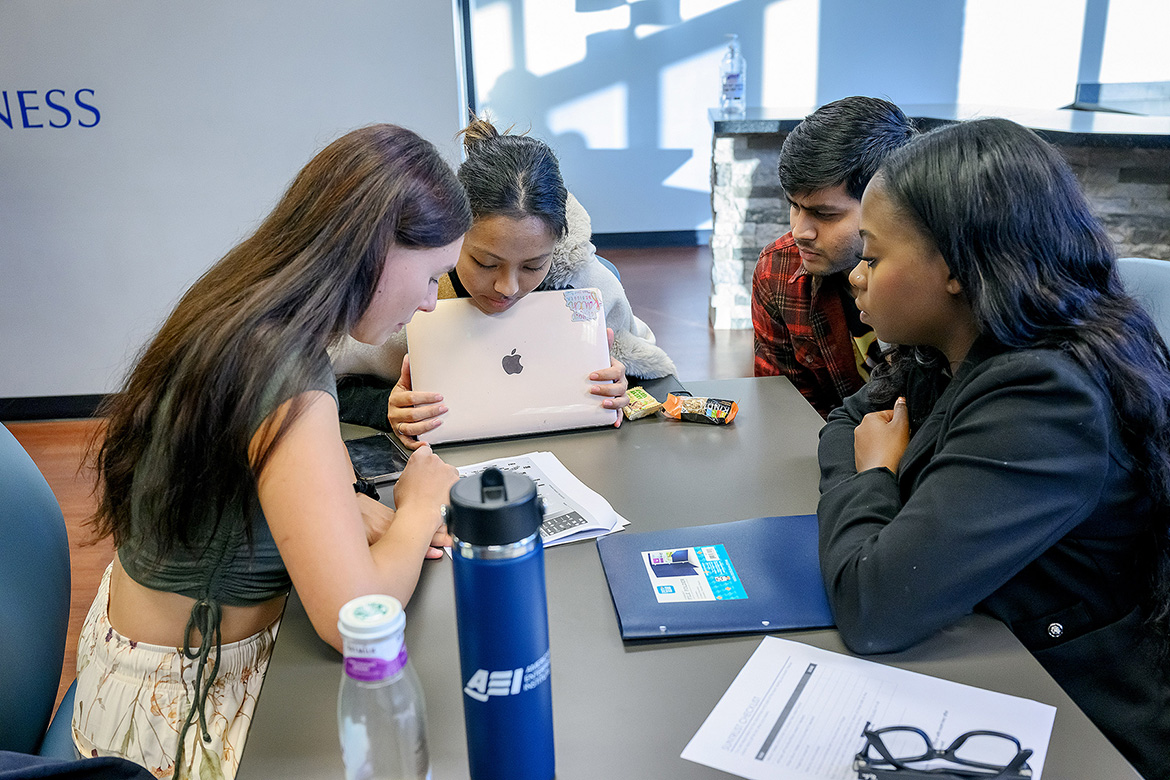
“The students aren’t just hearing about analytics; they’re doing it with real data and real business partners,” Fowler continued. “This is an initiative we’re especially excited about because it aligns with several MTSU priorities; it’s student-led, industry-engaged, experiential, and cross-disciplinary.”
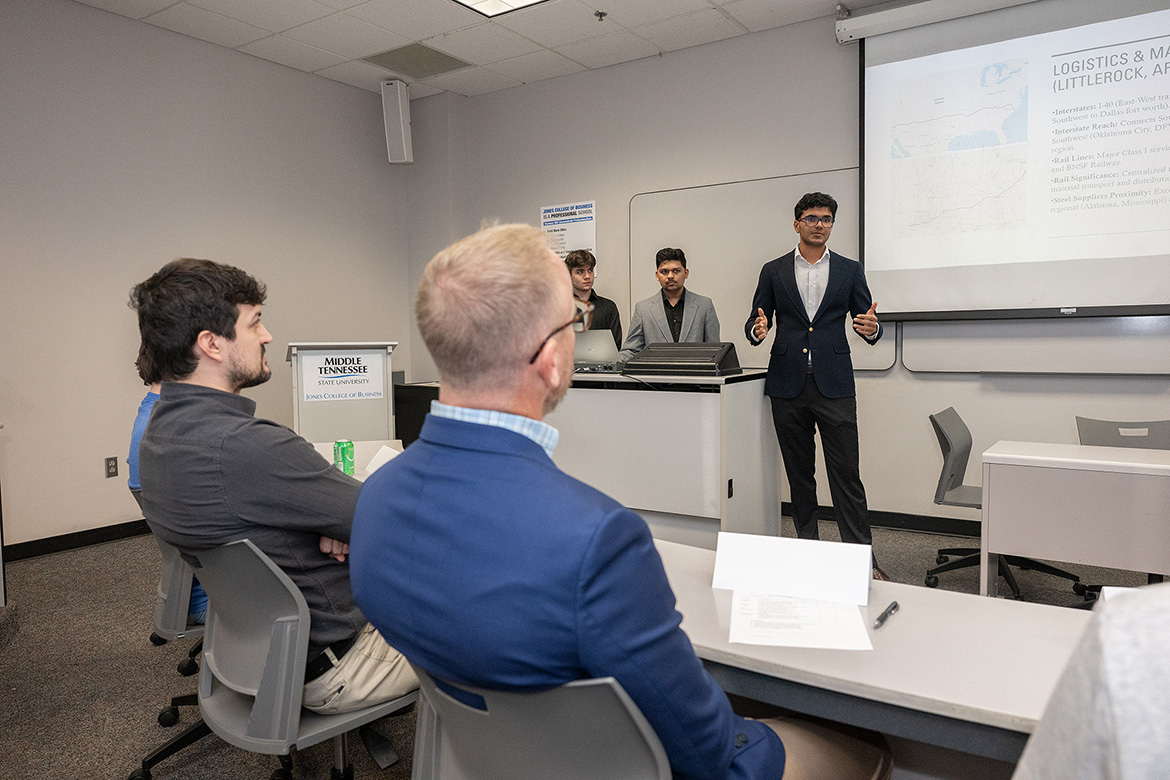
The student teams created PowerPoints and presented their findings to a panel of Cooper Steel professionals and MTSU faculty, with the winning team receiving scholarships — $1,500 to the winning team and $750 to the second-place team. The Nov. 7-8 event was also used to help identify students to represent MTSU at the national Econ Games in Spring 2026.
Capturing first place was the team of Sayuri Shrestha, Kris Patel, Masha Bystritskii, and Kendahl Franklin. The second-place team included Sreehari Sreejith, Victoria Voronkina-Yitzchaki and Bennie McTier.
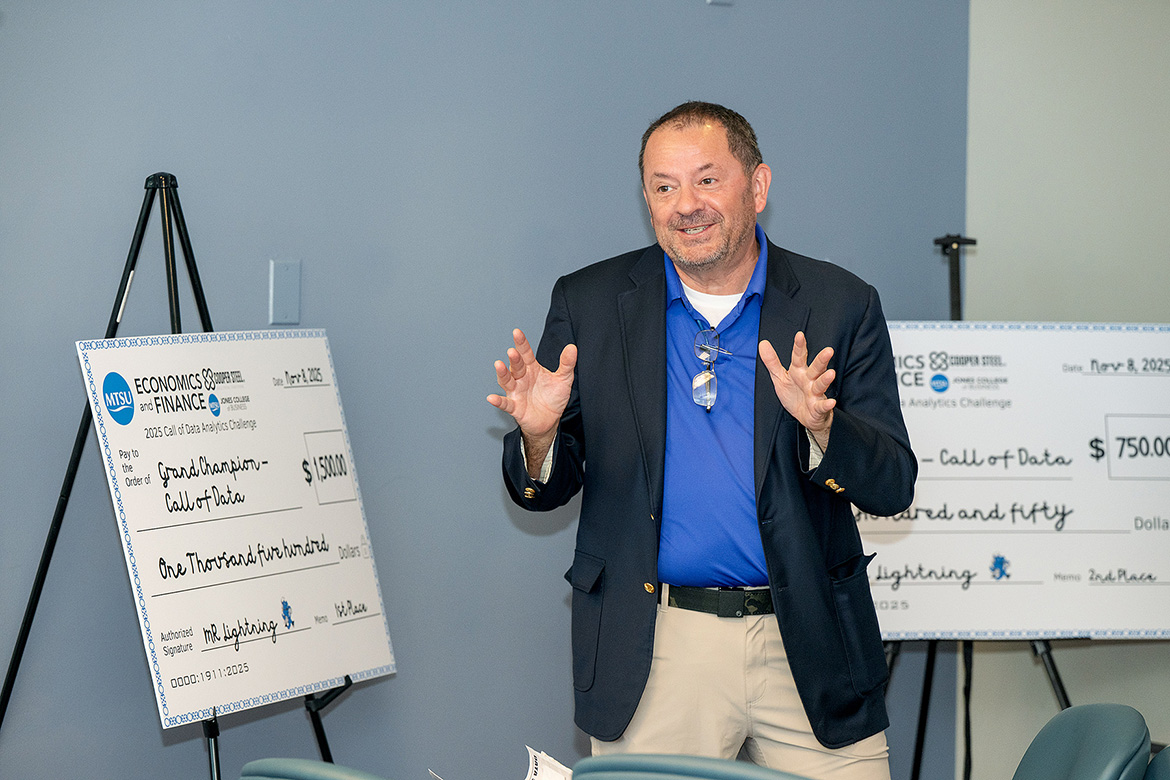
Bringing nearly two decades of experience at Cooper Steel and more than 25 years in the industry overall to challenge judging, Chad Johnson, executive vice president of business development for the company and an MTSU alumnus, said he was impressed by the students’ ability to develop well-crafted presentations in such a short time period.

“I would have never guessed that any of those teams would have been limited to 24 hours. They all did an exceptional job with their research and their preparation, as well as their delivery. They did a really good job with evaluating the market,” said Johnson, adding that the company did not want to provide too much information up front that might steer students in a particular direction in their analyses.
“But at the end of the day, the collective responses mimicked what we had come up with internally as far as options for expansion and speaking specifically to location,” Johnson said. “And so it was pretty neat that in the limited capacity that they had, in both time and information and knowledge, that they picked the same kind of areas that we were hoping that they would support. I was very impressed.”
‘A little bit nerve-wracking’
Once the student teams were formed and the challenge presented, the teams then decided how to conduct their work — some spending more time in the reserved space inside BAS to work in person, while others took more of a come-and-go approach, using messaging apps or teleconferencing to continue their work throughout the night before regathering in person the next day.
Part of the four-member first-place team, Data Science Club President Sayuri Shrestha, a computer science major with a minor in data science from Nepal, said participating in the challenge was eye-opening for her.
“We were hoping to use a lot of our technical skills here; however, I think we used more of our research skills. We did, of course, make graphs and stuff, but I feel like that wasn’t the biggest challenge,” Shrestha said. “I think the biggest challenge was delegating, at least for me, with my leadership roles.
“I think that was the main thing, that I got to practice hands-on, delegating tasks. Because we’re all from a very technical background, but we had to lean back and be like, ‘OK, what can we really do? How can we be efficient and not overdo anything? … But still meet the rubric of what the judges expected out of us.”
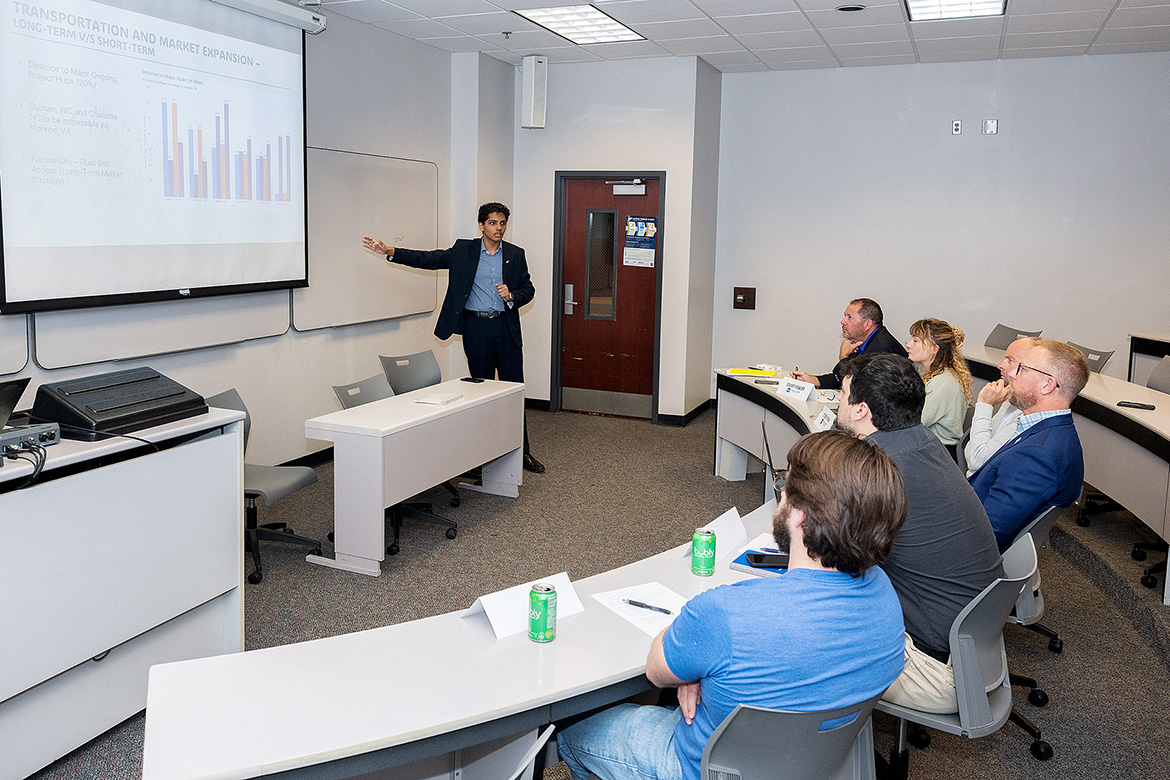
Economics Club President Sreehari Sreejith, a senior finance major from Hyderabad, India, said that students initially thought they would be provided with company data, but that wasn’t the case.

“They laid out the problem up front, but they were like, ‘Hey, here are some reliable, publicly available data sources that you could use.’ But then it would be entirely up to you to find out what data you wanted to use, how you wanted to go about it, so it was very open-ended,” Sreejith said. “There wasn’t one right way to go about this, but there were things that they would look at. So the analytical part would be something that they would look at, and how you put forth your ideas and your recommendations, that would be part of the grading criteria.”
Economics Club Vice President Victoria Voronkina-Yitzchaki, a senior finance major from Franklin, said challenge participants were able to put their classroom knowledge to use through tools like Microsoft Excel and business analytics platform Power BI, also from Microsoft, to better visualize the data they compiled.
The challenge reinforced her expectation that the skills learned through her finance coursework would be highly transferable to the challenge; yet, the overall experience was new to her and quite rewarding, she said.
“I think just the process of presenting in front of a lot of important people was a little bit nerve-wracking. I’d really never done something like that before,” she said. “So it was a very insightful experience. I don’t think something in the classroom could replicate what this challenge gave us.”
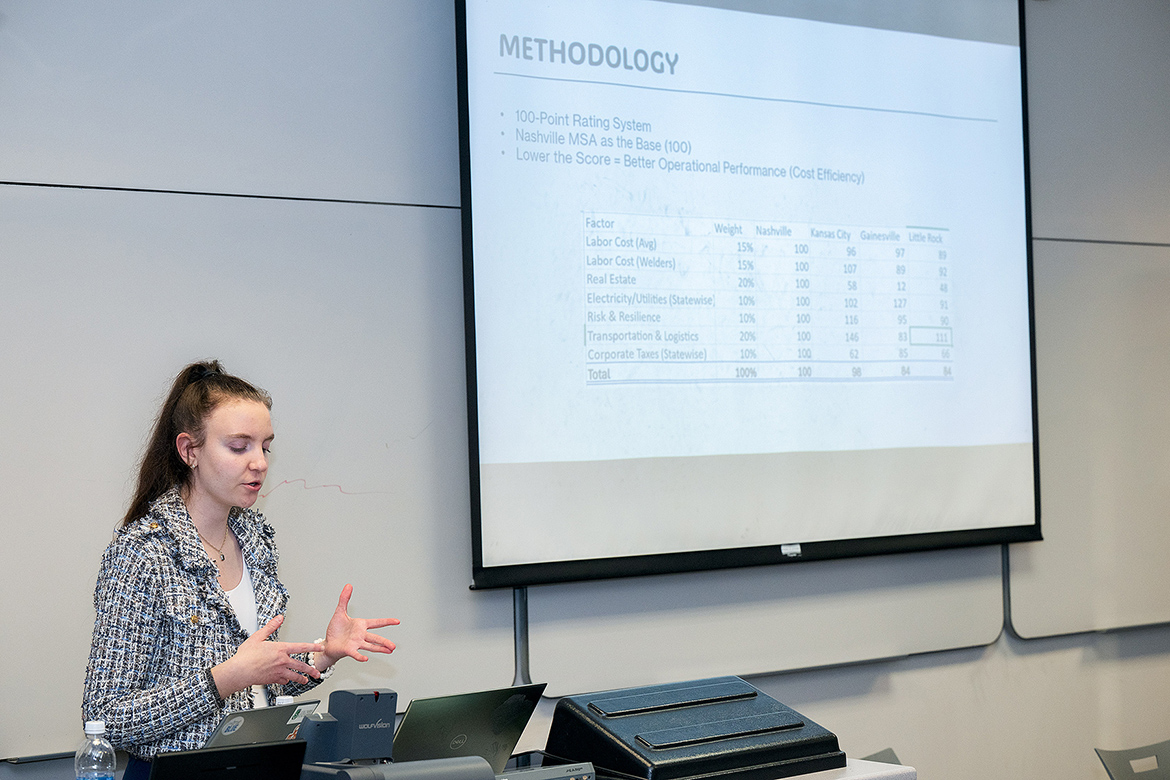
Date Science Club social media manager Nwamaka Obianwu, a junior data science major from La Vergne, captured the teams’ activities throughout the challenge with photos and videos for social posts.

“All the teams were planning to combat this challenge, especially with a lot of research without having any physical data there and having to find a way to really figure out how to get to answer the business prompt correctly. And I found that interesting between all the teams,” she said.
Although not a participant this time, Obianwu said that being able to watch the dynamics unfold piqued her interest, and “I would participate in one of these in the future.”
Meanwhile, Cooper Steel’s Johnson said he found that a number of participating students appeared to be “a great fit” for the company’s internship program.
— Jimmy Hart (Jimmy.Hart@mtsu.edu)




COMMENTS ARE OFF THIS POST