
By Mike Davis
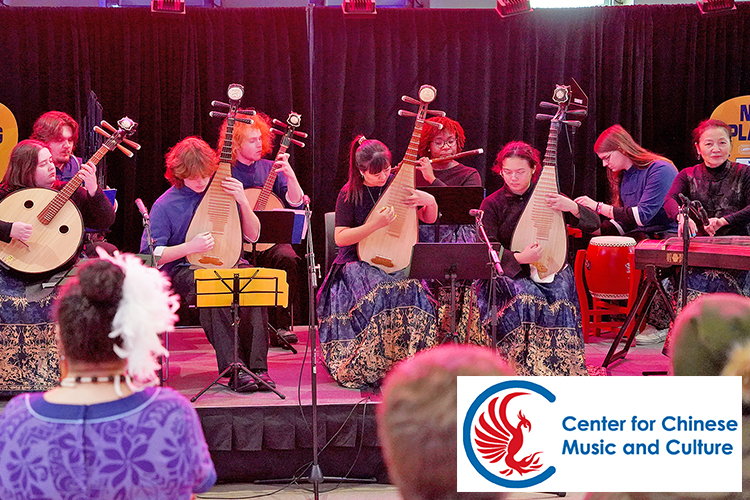
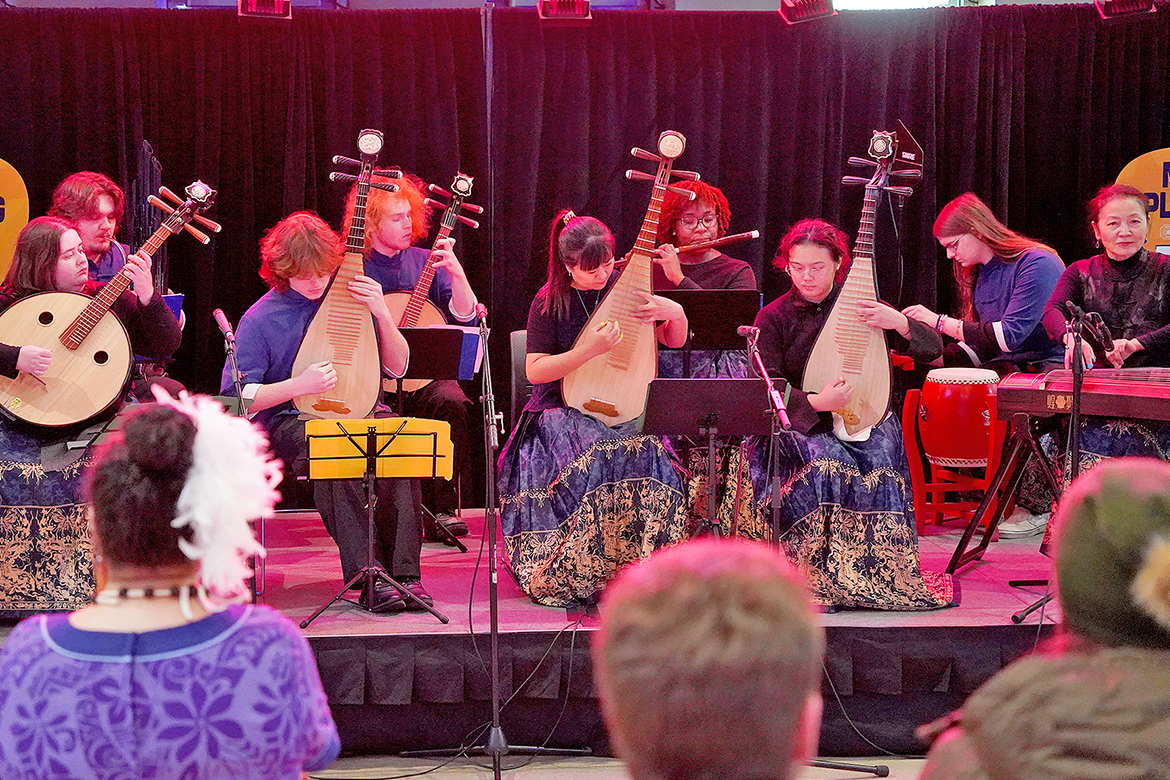
NASHVILLE, Tenn. — Middle Tennessee State University’s Chinese Music Ensemble stepped into the concourse of Bridgestone Arena in Nashville and filled the space with the sound of traditional Chinese instruments.

As thousands of hockey fans arrived for the Nashville Predators’ Asian Pacific Islander music heritage night recently, Center for Chinese Music and Culture Director Mei Han led nine musicians to perform a four-piece set featuring “Dry Thunders,” “Colorful Clouds Chasing the Moon,” “Jujube Harvesting,” and “Flowers Blooming and the Full Moon.”
Their music carried through the arena as visitors gathered to watch, many experiencing Chinese instruments for the first time. The ensemble opened the evening’s cultural performances, which included dance and musical groups from across the Asian Pacific region.
For Han, the invitation that led to the Dec. 9 performance represented an important milestone.
“We have played in symphonies, libraries, and community spaces for years, but never for a stadium crowd,” Han said. “This allowed us to reach people far beyond the arts community. It was an important moment for the Center for Chinese Music and Culture and for MTSU.”
Small ensemble, powerful presence
The musicians performing with Han that night included Kylei Loh, Bo Capistrant, Jingyi Zhan, Ani Heng, Henry Wright, Jake Capistrant, Jaida Anthony and William Sprayberry.
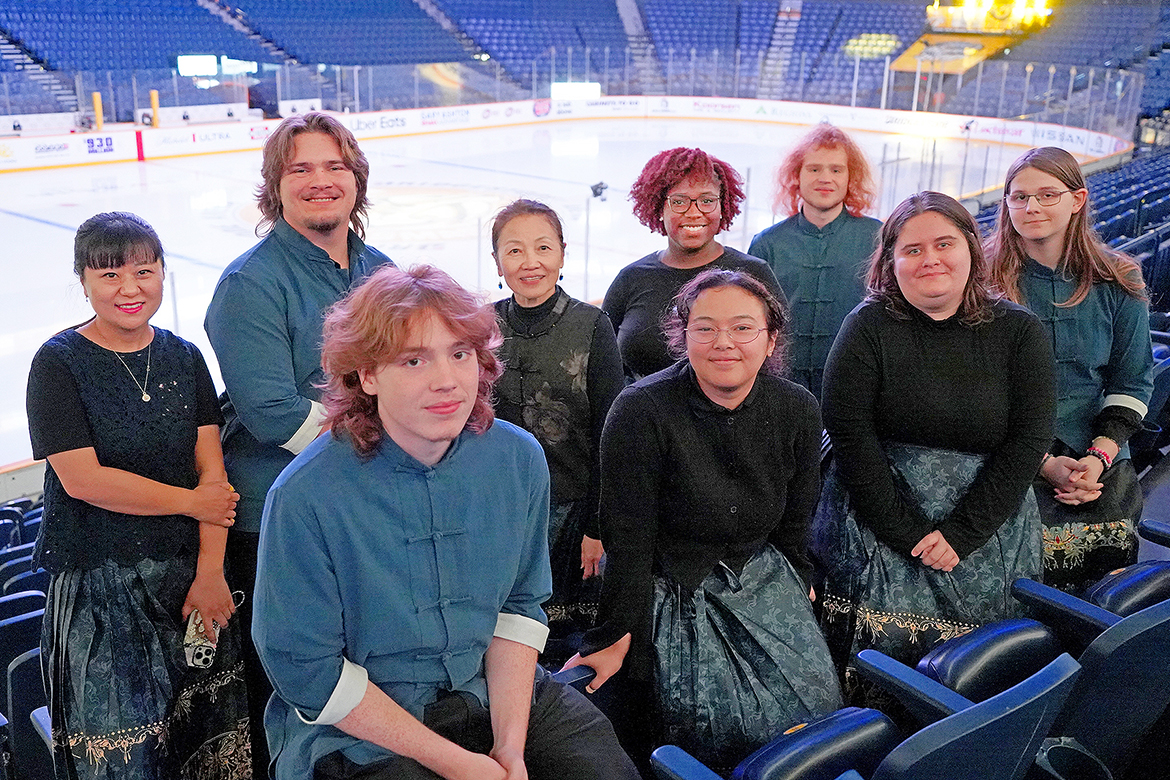
Some are music majors while others study fields outside music, and two former students, Bo and Jake Capistrant, volunteer their time performing with the ensemble. Jingyi Zhan, a visiting scholar from China, joined the group as part of her residency at the center.
Preparing for the event required Han to rework ensemble parts to fit the smaller concourse stage as well as the skill levels of the performers.
“It was a challenge to balance the experience of returning members with the needs of new players,” she said. “Every semester I rewrite arrangements based on who I have. Chinese music is flexible, but the goal is always the same. Students must learn to listen, to sense, to feel.”
What students gain
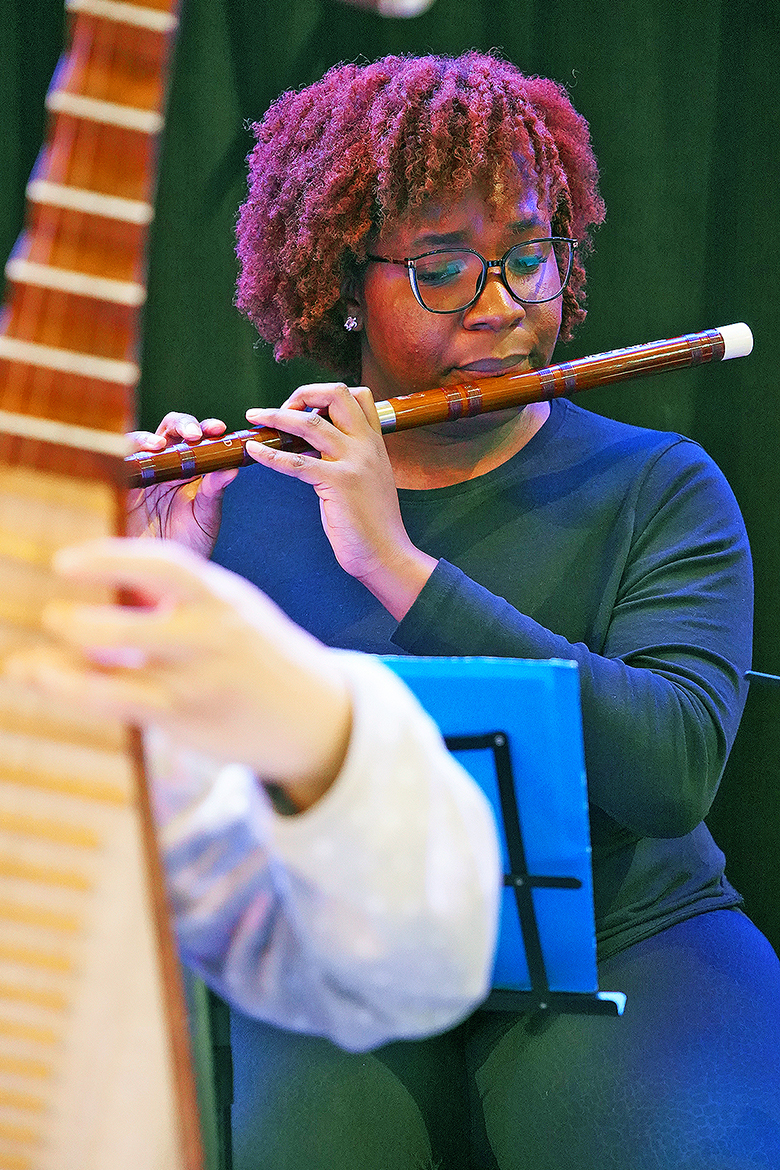
Junior music major Henry Wright, who played sheng and ruan at the Bridgestone performance, said the ensemble changed how he understands musicianship.


“In Western classical tradition, someone is always leading,” Wright said. “Here you learn to coordinate by listening. It changes how you think about ensemble work.”
He said the experience has strengthened his confidence more than any other performance setting.
“I used to be anxious on stage. This ensemble taught me how to put everything I have into a performance. I’m a better musician because of it,” Wright said.
For senior William Sprayberry, a film and video production major, the ensemble offered a different kind of learning environment.
“I came from a small town,” Sprayberry said. “This pushed me to think differently, meet people unlike myself, and connect with a culture I didn’t know. Being part of this ensemble teaches commitment, leadership, empathy. You learn how to work with people and how to understand them.”
A transforming cultural exchange
The ensemble’s reach extends far beyond campus. Last year, the group traveled to China for a series of performances and educational exchanges that reshaped expectations for both MTSU students and Chinese audiences.
Han said many Chinese faculty and students were surprised by the MTSU ensemble’s focus and enthusiasm.
“They expected something different because of what they see in media,” Han said. “Instead, they saw students who were polite, focused on music, and excited to learn. It changed how people saw American students.”
Reflecting on the experience, Han recalled how quickly the atmosphere shifted during joint rehearsals in China.
“The first day, the Chinese students were very tight and serious. That is how they are taught,” she said. “But our students were friendly and smiling. By the second day, the atmosphere changed. By the third day, the Chinese students were more relaxed and smiling too.”
After returning from China, Han said she received a message from one of the Chinese students saying she realized she was focusing on the wrong things, and that watching the American students and their joy for playing music helped her look inside herself again.
It wasn’t just the Chinese students impacted by the visit. Wright said playing alongside Chinese students and interacting with the people of China helped him understand cultural perception in a new way.
“You forget people everywhere want the same things,” Wright said. “They want to live a good life, help people, and so on. When we played together, it wasn’t about politics or stereotypes. It was musicians connecting through music.”
That is the power of cultural exchange, said Han, adding, “Music can shift how we see each other.”
Why ensemble matters at MTSU
The Center for Chinese Music and Culture, now in its 10th year, is the only university-based Chinese music center in the United States. It supports cross-cultural scholarship, hands-on music training, and global learning opportunities that students cannot find elsewhere in the region.

“This is not only about teaching Chinese music,” Han said, “it is about opening students to the world. You cannot understand global culture or develop critical thinking without experiencing perspectives beyond your own.”
MTSU School of Music Director Jennifer Snodgrass said the ensemble fills a unique role in student development.
“The Chinese Music Ensemble offers something transformative,” Snodgrass said. “Students enter a completely new world, discovering unfamiliar sounds and traditions. Everyone begins as a beginner. There is no hierarchy, no intimidation. Students learn side by side, grow together, and experience discovery as a community. It is a shared journey in every way.”
A resource ready for campus
Through weekly rehearsals and public performances, the ensemble models the kind of cultural immersion and experiential learning central to the mission of the College of Liberal Arts.
Many MTSU classes already visit the center, such as those in early childhood education, but Han hopes more departments will explore how the center can support teaching across various disciplines, including history, political science, anthropology, culture, and global studies.
“You can talk about borders, identity, diversity, and historical change through instruments,” Han said. “Music is connected to everything.”
Why this work matters
During the Bridgestone performance, several of the performers noticed an Asian father and young son who stayed for the ensemble’s entire set. Their attention reinforced what the students already knew.
“Everyone deserves to see their culture represented,” Wright said. “If we can offer something authentic, even for a few minutes, that matters.”
For the musicians, the evening was a reminder of why they commit their time, energy and heart to the ensemble.
For MTSU, it was a clear demonstration of the extraordinary value the Center for Chinese Music and Culture brings to students, the campus community, and the broader region.
And for a crowd gathering to watch a hockey game, it was a rare opportunity to encounter a musical tradition that stretches back centuries, brought to life by students who now carry a piece of that tradition with them.
— Michael Davis (Michael.Davis2@mtsu.edu)




COMMENTS ARE OFF THIS POST