
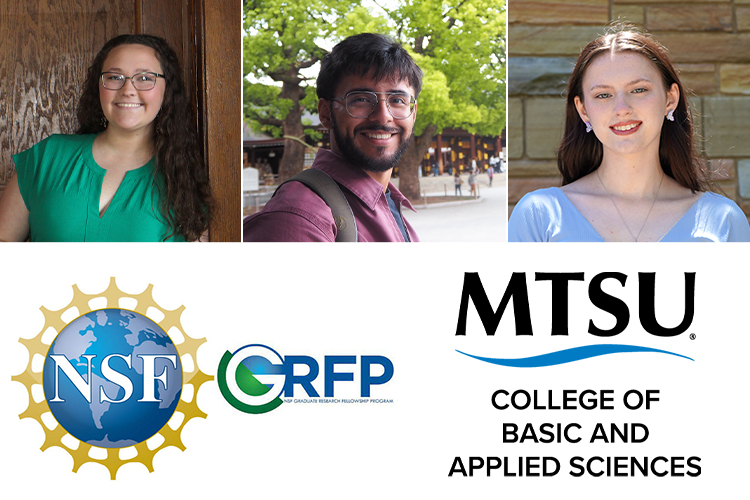
MURFREESBORO, Tenn. — Middle Tennessee State University alumni and students continue to distinguish themselves on the national stage, with four MTSU-affiliated scholars awarded National Science Foundation Graduate Research Fellowships for 2026.
The recipients are J. Hayes, a current MTSU biology undergraduate who will begin a Ph.D. in math and science education at MTSU this fall; Carlos Aldana Lira, a 2025 computer science graduate and former Honors student who is currently pursuing graduate study at the University of Illinois at Urbana-Champaign; Emily Foster, an incoming MTSU doctoral student in molecular biosciences who had been selected for the fellowship prior to beginning the program; and Hannah Morgan, a 2021 anthropology graduate of MTSU and former Honors student.


The NSF Graduate Research Fellowship Program is one of the nation’s most competitive and prestigious awards for graduate students in the STEM fields of science, technology, engineering, and mathematics, including STEM education. Established in 1952, the program supports individuals who demonstrate exceptional potential to advance knowledge, innovation, and education in STEM disciplines while contributing to a diverse and vibrant scientific workforce.
The fellowship provides a five-year award period with three years of financial support, including an annual stipend of $37,000, a $16,000 cost-of-education allowance to the institution, no post-graduate service requirement, and access to supplemental funding during medical leave.

“Being offered an NSF Graduate Research Fellowship is a significant national accomplishment that highlights your potential to make significant contributions to STEM and STEM education,” said Charisse Carney-Nunes, EDU deputy directorate head, overseeing STEM Workforce and Talent Development with the NSF Graduate Research Fellowships Program.
‘Unreal, but … validating’
Hayes, who will remain at MTSU for doctoral study, sees the fellowship as both an opportunity and a responsibility to improve STEM learning and access. “For me, the NSF GRFP award is life-changing. It’s evidence that people believe in me, even if I sometimes struggle to believe in myself. More than that, it means people believe in me enough to invest in me.”

MTSU biology education associate professor Elizabeth Barnes noted that Hayes “has grown from a smart and passionate student to a true professional.”

“She has always been motivated to do the work, but now she is truly integrating into the professional community by presenting at conferences, taking leadership roles in our professional science communication network, and serving as a role model for other students aspiring to become impactful researchers,” Barnes said.
“While most students at her stage would be hesitant, I have seen her confidently present her ideas among groups of faculty members who later comment on how professional she is and how her ideas are great. I can’t wait to see how much further she comes as a graduate student!”
Barnes added that Hayes’ research reflects the perfect combination of intellectual merit and broader impacts that the STEM education community at MTSU strives toward.
“She will be building fundamental new knowledge on how to teach science students trust-building communication, which will have a rippling impact on the relationship between science and society,” she said.

For Aldana Lira, the award underscores the impact of his MTSU education as he continues his studies at a leading research institution.
“It feels unreal, but it also feels validating. It’s common in undergraduate and graduate research to question whether your approach to a problem, or the problem itself, is worthwhile,” said Aldana Lira. “Receiving the GRF, though, reminds me that other people think those things are worth pursuing too.”

Foster, who recently graduated from Cumberland University, has been working as a laboratory technician at MTSU with associate professor of biology Donald Walker and will begin doctoral study this fall. Her selection highlights the growing strength of MTSU’s graduate research pipeline and the university’s commitment to supporting emerging scholars in STEM disciplines.

“The role of the Fellowships Office is to support students in partnership with faculty who guide them,” said Laura Clippard, director of the Undergraduate Fellowships Office. “We complement this mentoring by helping students think through essays and application materials, and we promote opportunities such as the NSF GRFP by engaging with a variety of campus groups.”
Students interested in learning more about the NSF Graduate Research Fellowship Program and future application opportunities can visit nsfgrfp.org, and can seek assistance from MTSU’s Undergraduate Fellowships Office at honors.mtsu.edu/ufo.
— Robin E. Lee ([email protected])




COMMENTS ARE OFF THIS POST