
MURFREESBORO, Tenn. — Students at Middle Tennessee State University’s Jones College of Business enjoyed a front-row seat to the future of artificial intelligence during a recent guest lecture by a product marketing manager for Google Gemini.

Alessandro Cannas was invited to campus by MTSU’s Gaia Rancati, assistant professor of marketing and neuromarketing in the Jones A. College of Business and coordinator of the Neuromarketing and AI Lab. Rancati said she brought Cannas to campus to provide students with “a behind-the-scenes look at how Google is shaping the future of marketing and customer experience through AI innovation and product strategy.”
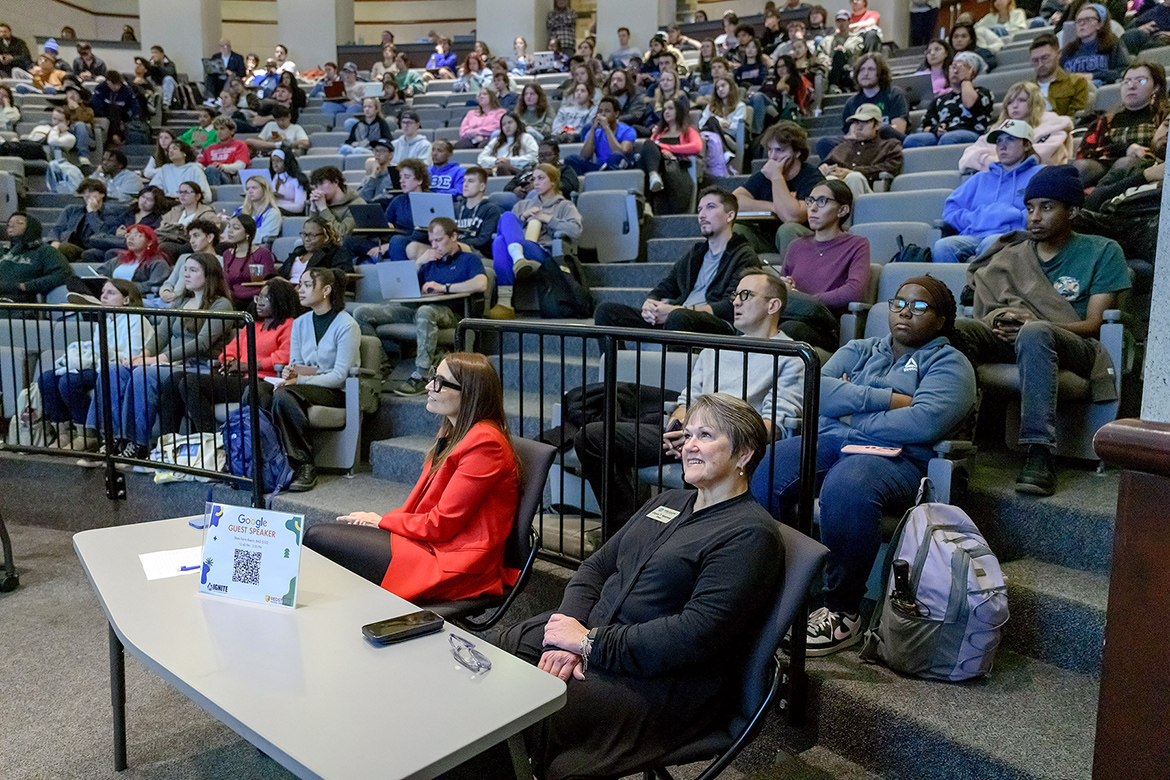
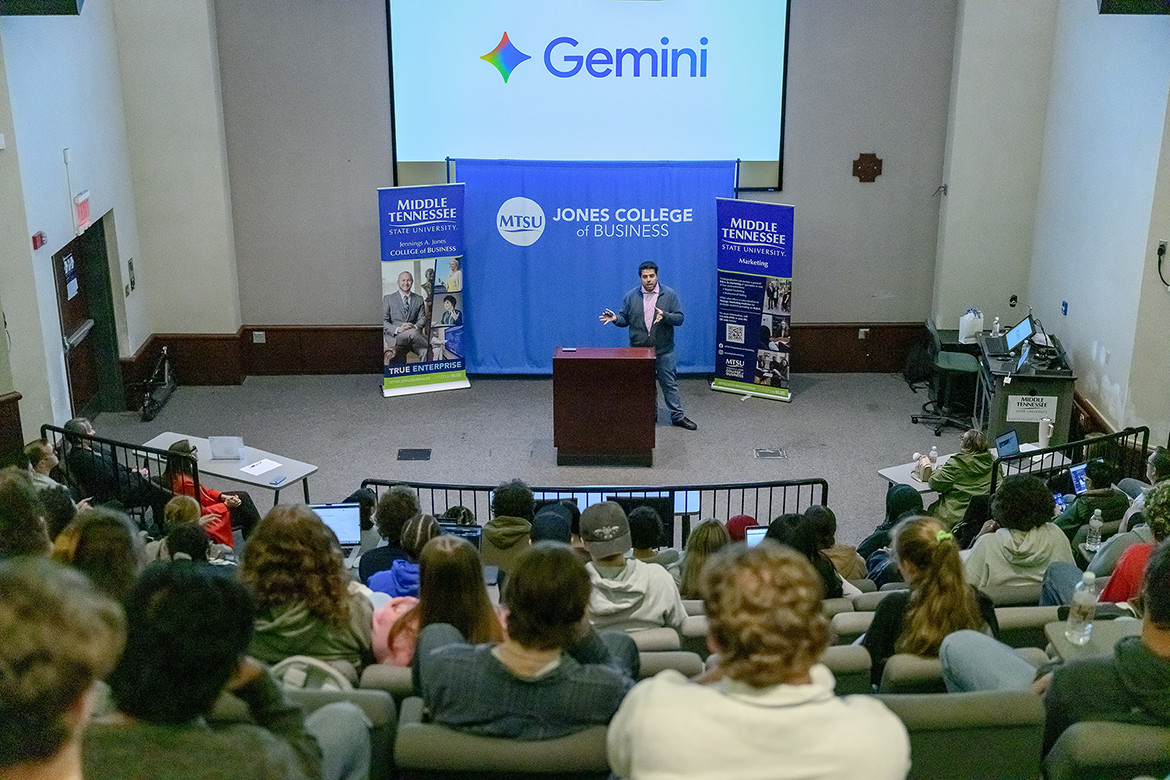
Cannas’ Oct. 27 presentation, held in the State Farm Room of the Business and Aerospace Building, highlighted Google’s Gemini platform and its transformative impact on marketing, education and innovation. Cannas shared his personal journey from Italy to Google, detailing his work on Gemini, Google’s multimodal AI model.
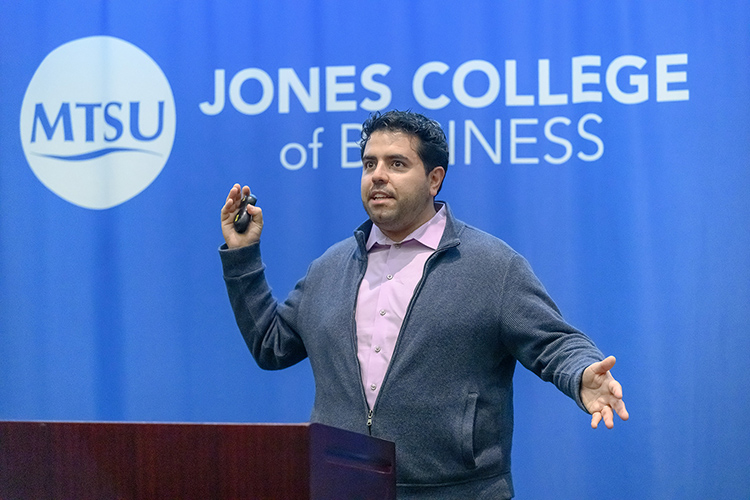
Cannas landed his first job in the U.S. seven years ago working on Google Assistant, the virtual assistant that uses voice commands through devices such as smartphones and speakers to perform tasks. But the product “was unpredictable at times,” Cannas said, adding that “the AI was there … but it was missing a few steps.”
He then noted the speed at which AI went from an experimental sector to an increasingly popular consumer product with products like ChatGPT and other new Large Language Models, or LLMs, that moved AI technology forward.
“It was exciting to be in a moment where the entire industry was changing before our eyes,” said Cannas, who then moved over to work on Google Gemini, not knowing where that would lead for him professionally. “It was cool for me to go from a product that has zero users to one that today has more than 650 million monthly users.”
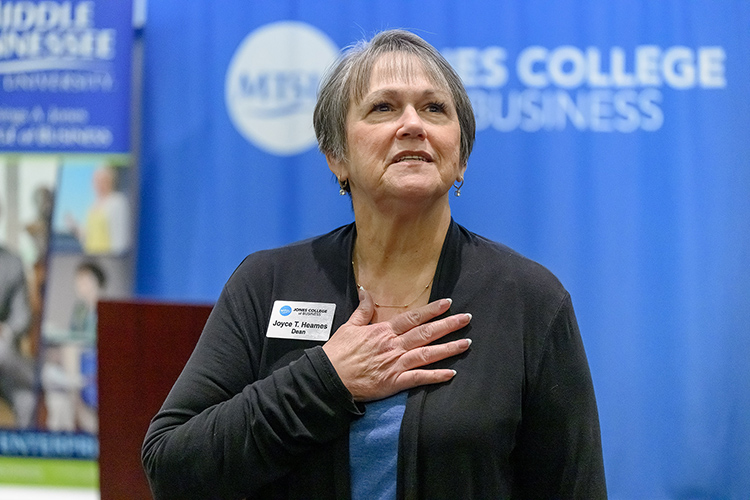
Jones College of Business Dean Joyce Heames opened the session by encouraging students to embrace AI as a vital tool for career readiness, noting that “AI is not going away — and those who fall behind will be the ones who ignore it.” She emphasized Jones College’s commitment to integrating AI into the curriculum to prepare students for a rapidly evolving workforce.

“We are having an industrial revolution in the form and the development of AI at this point. So we, as educators, have to be embracing and learn more about it,” Heames said. “At the Jones College, we are making sure that you get a chance to learn about AI, to use AI, and that you are ready to go out into the workforce.”
In introducing Cannas — with an assist from Google Gemini, of course — Andrew Oppmann, MTSU’s vice president for marketing and communications, applauded Jones College for its emphasis on bringing in numerous professionals from specific fields and industries to share insights with MTSU students soon to join an ever-changing workforce.
“I love how the faculty are constantly looking for ways to get you guys exposed to things that are cutting edge and give you the opportunity and the advantage of hearing from people who are innovators in this field,” Oppmann said.
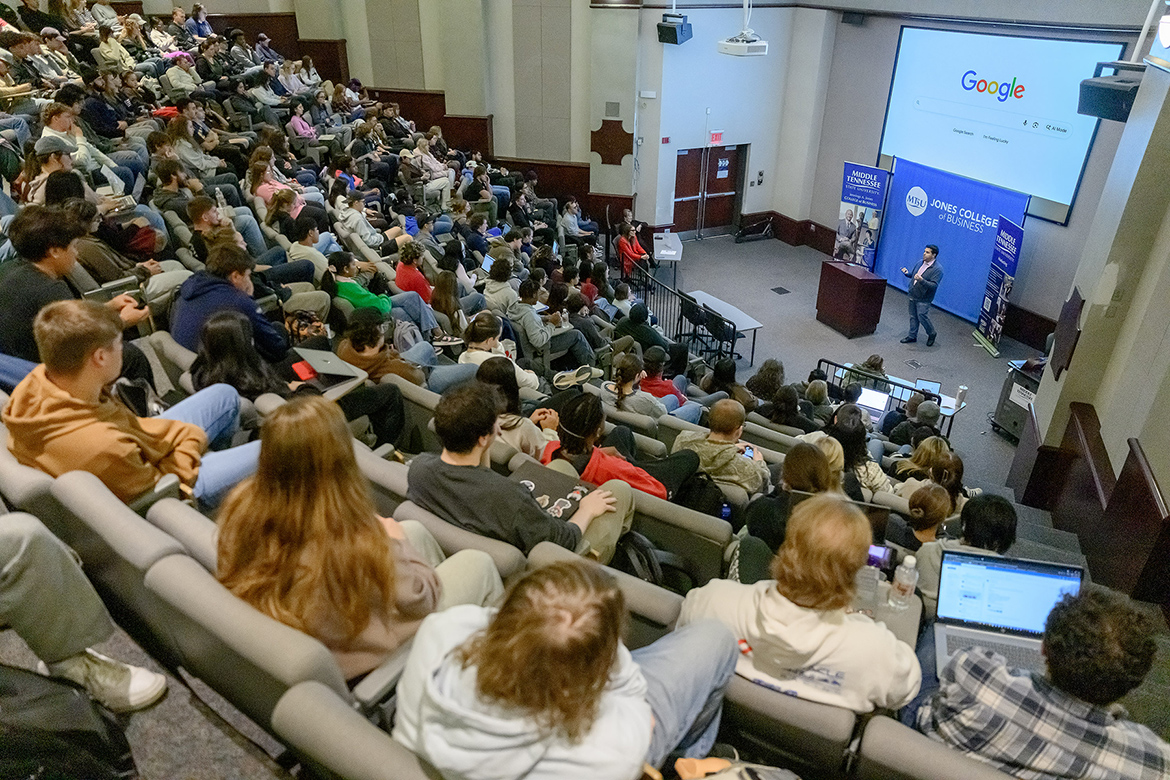
Originally launched as Bard, Gemini now powers tools across Google’s ecosystem, including Gmail, Maps, Docs, and the Gemini app on iOS. Cannas showcased features like Deep Research, Quiz Generator, and AI-powered app prototyping, all designed to enhance learning and productivity, he noted.
Following Cannas’ presentation, students engaged in a lively Q&A, asking about intellectual property, User Interface, or UI, personalization, and AI’s role in future careers. Cannas concluded his visit with a live demo of Gemini’s capabilities.
MTSU student Nicholas Dix, of Clarksville, was one of the students who engaged Cannas during the Q&A, asking him if Gemini user information that is input into the platform would be used to further Google’s AI interface training. (The answer is yes, though users can opt out or limit the use of such information, Cannas explained.)
A transfer student exploring his major options, Dix said his current use of AI is somewhat limited. As someone with an animation background, if he were interested in creating a special visual, “I would tend to do it myself, if I wanted to video edit or make a picture.”
Cannas’ presentation also explored Google’s marketing philosophy — “Know the user. Know the magic. Connect the two.”— and how user feedback, surveys, and data-driven insights shape product development. Cannas emphasized the importance of ethical AI, user privacy, and accessibility, noting that Gemini is built to be proactive, personalized, and globally inclusive.
“I’m super passionate about all the tools. As a marketer, you have to have a very open mind and learn from every different tool,” he said.
— Jimmy Hart (Jimmy.Hart@mtsu.edu)




COMMENTS ARE OFF THIS POST