
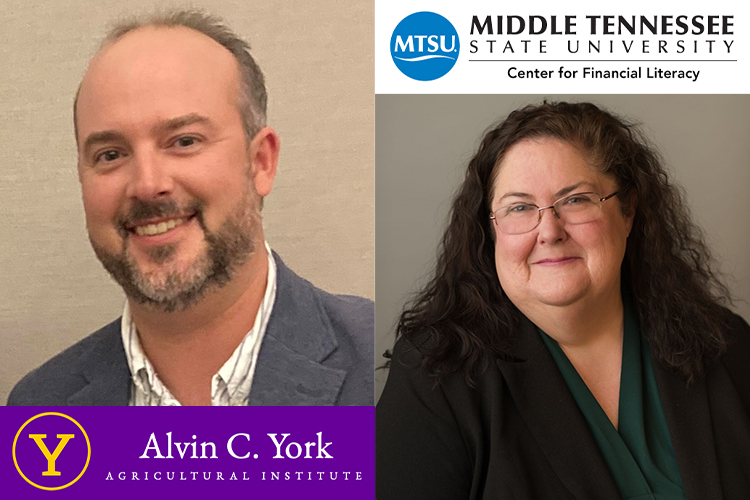
MURFREESBORO, Tenn. — Josh Hurst, a longtime educator at Alvin C. York Agricultural Institute in Jamestown, has been named the 2025-26 Economic Education Teacher of the Year by the Center for Financial Literacy at Middle Tennessee State University.

Hurst was presented with the prestigious Lighthouse Award, which celebrates teachers who illuminate the path of economic education for their students and community.
For the past 19 years, Hurst has taught students the power of economics through dynamic, hands-on projects that mirror real-world decisions. His classroom is known for pushing students to think critically, problem-solve, and prepare for life beyond high school.
“My favorite thing about teaching is helping students to prepare for what’s to come in their future and working to inspire them to achieve more than they thought they could,” Hurst said.
York Institute is a public high school in Fentress County that was founded as a private agricultural school in 1926 by World War I hero Alvin York. It was later transferred in 1937 to the state of Tennessee, which continues to operate it as a public high school.

“It is a privilege to work with an educator who brings such passion, creativity, and purpose to the classroom,” said Maria Edlin King, director of the Center for Financial Literacy within the Jones College of Business. “Watching the way Josh equips his students with tools to navigate their economic and financial futures is truly inspiring, and his impact will be felt for years to come.
“He has set a high standard for economic education, and his impact will ripple through the lives of his students long after graduation.”
Highlights of Hurst’s curriculum include:
• Business project — Over the course of a week, students design their own business located in Fentress County, completing a 10-part plan that challenges them to think like entrepreneurs.
• Personal budget project — In just one class period, students choose a career, calculate taxes, plan expenses, and role-play a month of financial life by writing checks and balancing a register.
• Buying a home — Students compare three homes within budget, calculate down payments, mortgages, and final costs, revealing the long-term impacts of interest rates.
• Renting an apartment — Students research three apartments, determine rent and yearly costs, and even fill out a lease, gaining a clear picture of rental realities.
• Job interview simulation — With resumes and applications in hand, students complete six- to eight-minute interviews in front of their peers. Hurst calls this the most powerful activity he conducts, as it gives students the confidence they need for future employment opportunities.
• Auto insurance brochure — Students create their own “insurance company” brochures, breaking down complex insurance terms while building understanding of risk management.
Each of these projects reflects Hurst’s philosophy: teaching students not only economic theory but also how to apply it to real life.
In addition to teaching Economics and Honors Economics, Hurst’s teaching career has also spanned AP World History, U.S. History, Contemporary Issues, Algebra I, ACT Prep, and specialized courses such as the History of WWI and WWII, which he designed.
His influence extends beyond the classroom as well — he has coached golf, cross country, and track and field, instilling discipline, teamwork, and perseverance in his student-athletes.
About the Center
Led by King, the Center for Financial Literacy at the Jones College of Business at Middle Tennessee State University is dedicated to equipping Tennessee teachers, students, and communities with the tools and knowledge needed to thrive in today’s complex financial world.

Through innovative programs, teacher training, curriculum development, and statewide outreach, the Center promotes economic and financial literacy as a cornerstone for lifelong success. Learn more at https://econed.mtsu.edu.
— Jimmy Hart (Jimmy.Hart@mtsu.edu)




COMMENTS ARE OFF THIS POST