
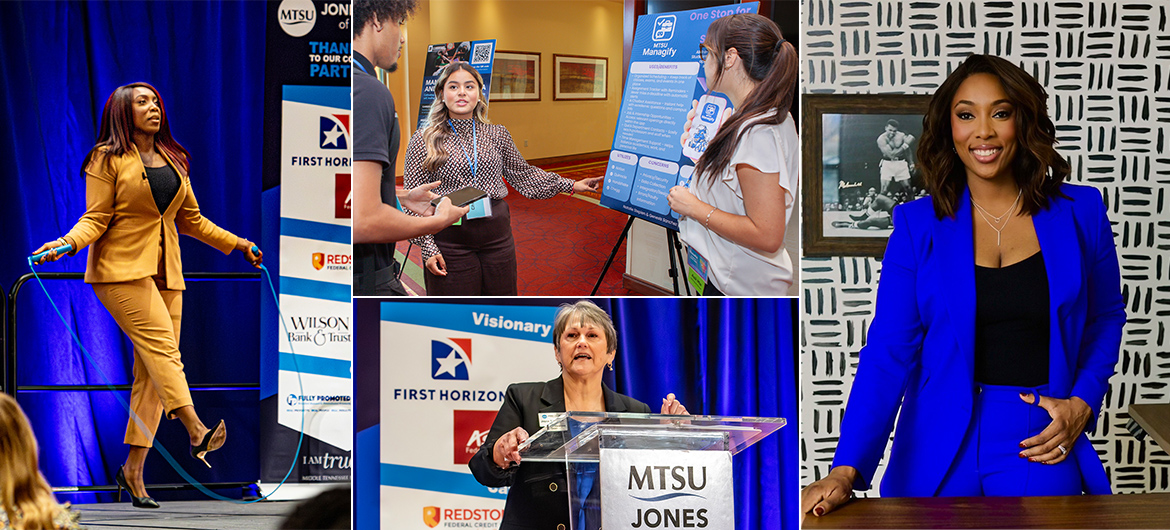
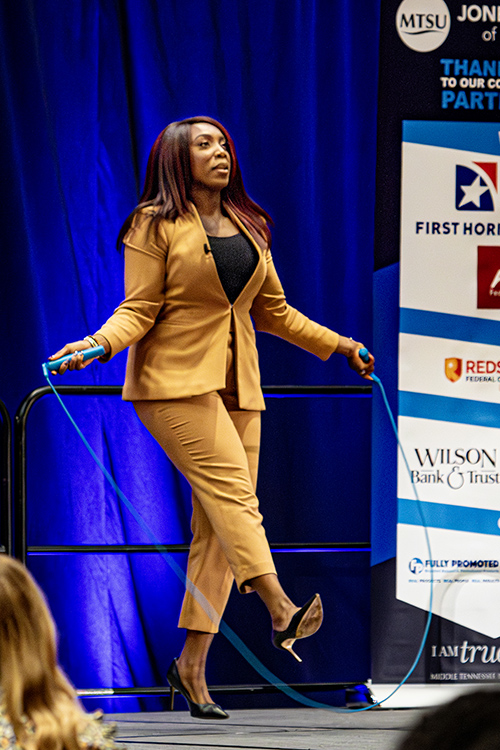
MURFREESBORO, Tenn. — Jumping rope on stage in 3-inch heels is impressive in its own right, so throw in also continuing your engaging public talk to an audience of hundreds, and you quickly understand why inventor, CEO and entrepreneur Jessica O. Matthews thinks a bit differently than most.
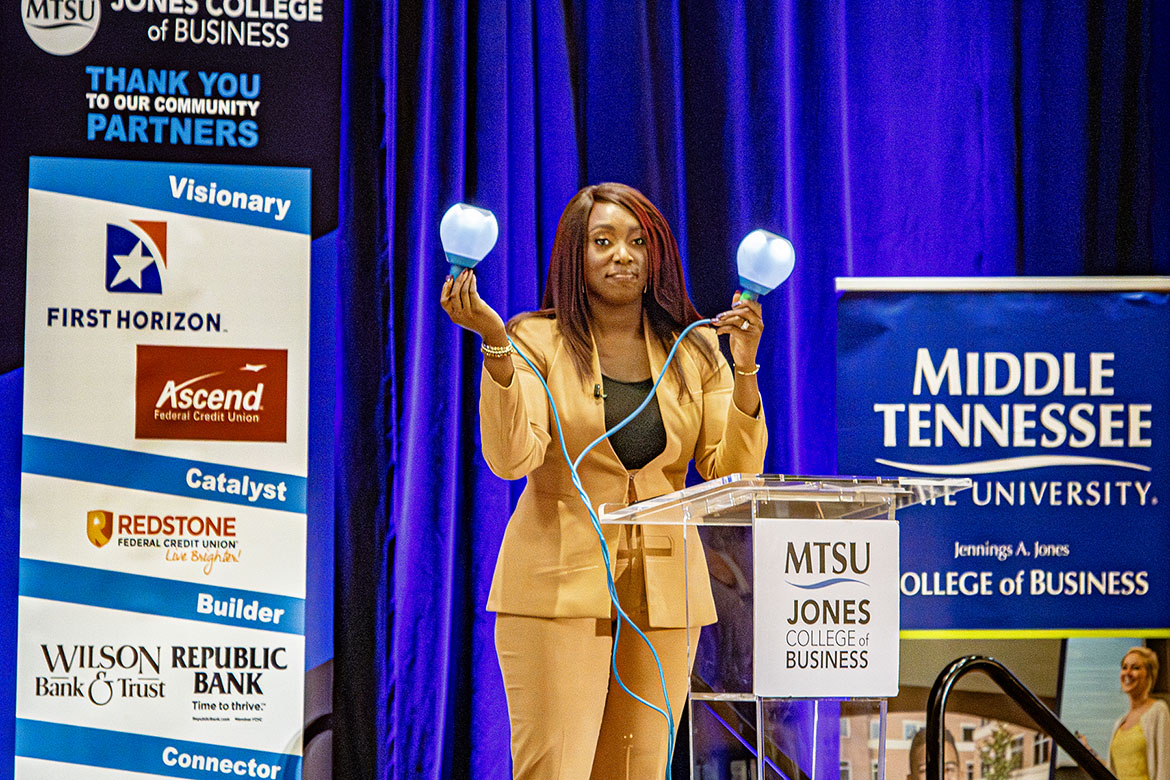
As this year’s keynote speaker for the 2025 Leadership Summit hosted by the Jennings A. Jones College of Business at Embassy Suites-Murfreesboro, Matthews urged those attending her presentation to fully embrace artificial intelligence and its many benefits in propelling innovation — while also acknowledging the ecological, ethical and other challenges that come with it.
The jump rope Matthews deftly used toward the end of her presentation was actually an invention she helped develop a few years ago, following a visit to a refugee camp on the border of Syria and Jordan. The jump rope includes rechargeable batteries embedded in the handles that tap the kinetic energy generated by spinning the rope, not only allowing young girls in the camps to play and exercise but also becoming a source of electricity in remote areas with infrastructure challenges.
Matthews’ featured presentation was part of this year’s Sept. 26 summit, carrying a theme of “The AI Revolution at Work: Leading Change and Overcoming Fears in a Rapidly Evolving World.”
“When you think about how you prepare and how you engage with these technologies, it’s really more about your approach to how to move when things are moving,” she said, “… how you think about this, not only as something that’s a challenge and an opportunity, but more than anything, a tool you need to achieve your vision, professionally and personally.”

Now in her late 30s, Matthews developed a vision early in life when she invented the SOCCKET — a soccer ball that creates energy while kids play with it — at only age 19. A few years later, at 22, she launched Uncharted, a company helping cities build smarter, more affordable infrastructure.
A dual citizen of Nigeria and the United States, Matthews has a degree in psychology and economics from Harvard University and an MBA from Harvard Business School. Her patents have been cited over 40 times, influencing innovative products from companies like Qualcomm, Philips, Intel, IBM, Sony, and Toshiba.
For Matthews, embracing AI isn’t really an option. “There’s a quote that I love: ‘You can’t stop the waves, but you can learn to surf,’” she said. “… So if we recognize that, yes, AI is not perfect. … But we also recognize that we can’t stop AI. How do we then position ourselves to ride that wave?”
AI ‘can’t live your life’
Matthews, who considers herself a “blend of Beyoncé and Bill Nye the Science Guy,” told the audience that while AI tools have been around for quite some time, they have become much more acceptable to average citizens — meaning greater opportunities for young creatives and entrepreneurs.
“And so around AI, you have efficiency and automation, right? AI is streamlining all competitive tasks. You have augmented creativity and problem-solving. It’s helping you (develop) different ideas and designs faster, cheaper. And there are new business and career opportunities coming up,” she said.
“So it’s not just about thinking about the job that AI might be taking away. It’s also about thinking about the job that AI is now actually creating and having to be prepared for it. ”
Matthews talked through the “green flags, yellow flags, and red flags” of AI, such as the positives of tremendous advances to innovation and efficiencies, the gray areas surrounding bias and ethical concerns, and greater dangers of misinformation and deep fakes, as well as potentially severe environmental impacts.
However, Matthews also encouraged the audience to tap into the unique human perspectives and passions that each individual brings to both their personal and professional development journey to maximize AI’s potential.
“There are a lot of things that AI can do … but what AI cannot replace is your perspective. The only view that you have with the life that you’ve lived, your personal experience, your personal background, that you can project into everything that you do, that is your sustainable differentiation,” she said. “That is the thing that AI can never replace because no matter what AI does, it can’t live your life. It hasn’t lived your life.”
Matthews suggested that people use “strategic AI assistance” to take their vision and tap into AI tools to help analyze, explore, adapt and polish that vision, hopefully resulting in the desired impact.
Now serving on the Electricity Advisory Committee, advising the U.S. Department of Energy on the future of the nation’s power grid, Matthews is a recognized leader in emerging technology and artificial intelligence, exploring how AI can improve infrastructure, energy, and problem-solving in communities. Her journey has taken her to the White House, where she represented small business leaders at the signing of the America Invents Act.
Student innovation awards
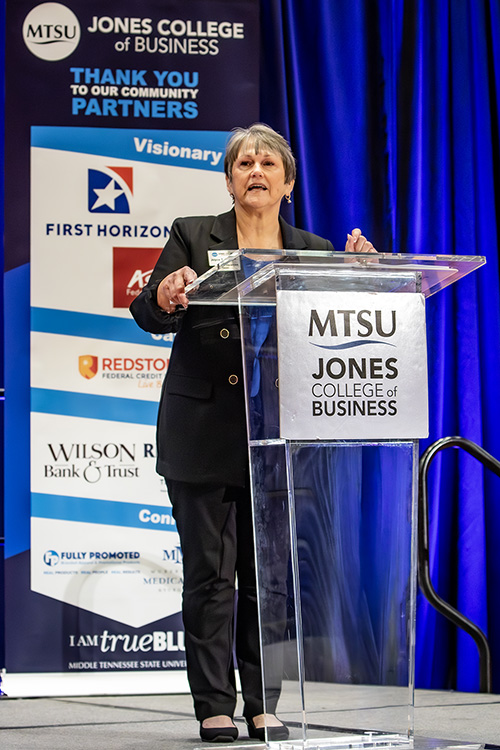
Before Matthews’ keynote remarks, Jones College of Business Dean Joyce Heames recognized student winners who participated in the Innovative Leadership Challenge, a contest coordinated by management professor Leigh Anne Clark in the Management and Leadership program that included an on-site poster presentation at the summit.
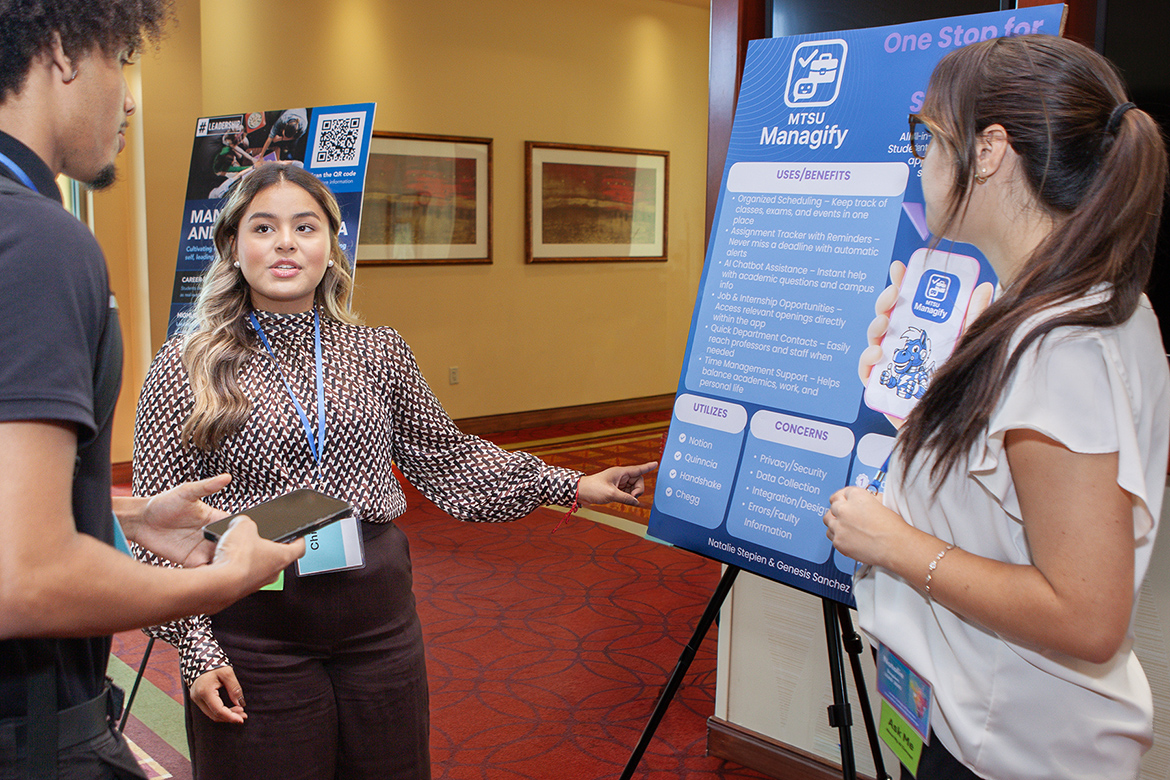
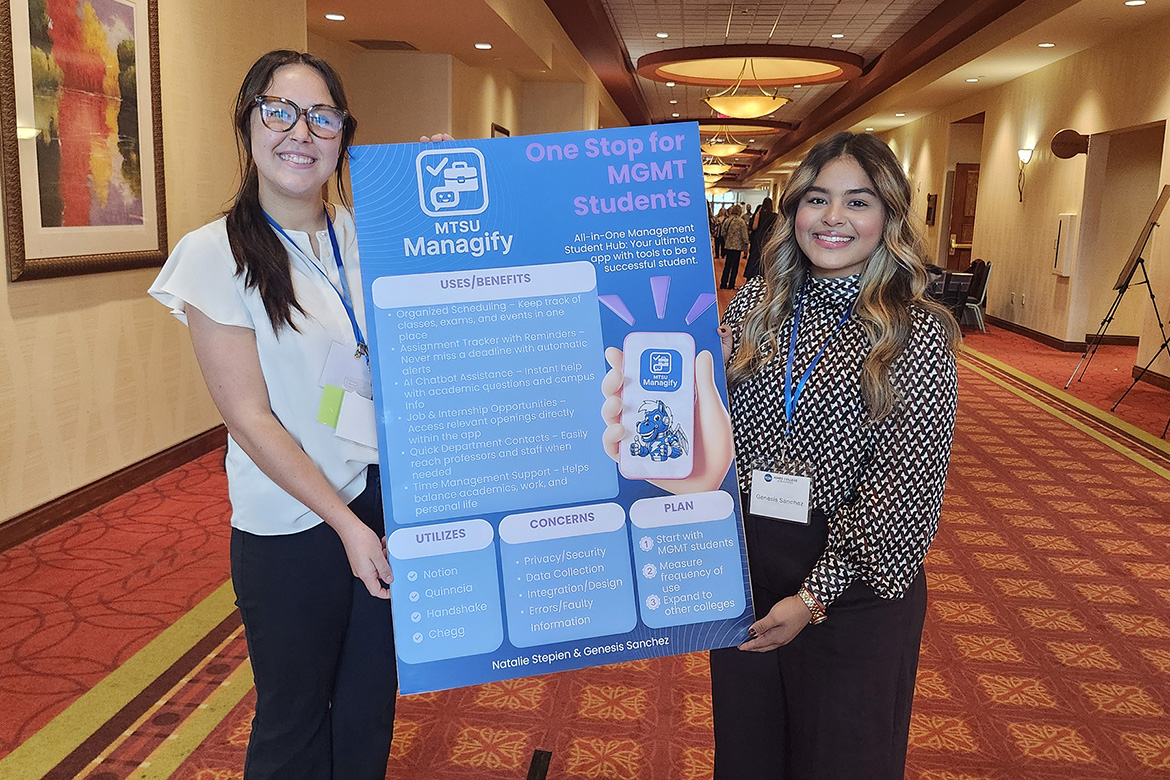
Jones College students Natalie Stepien, a human resources major from McMinnville, and Genesis Sanchez, a management and leadership major with a minor in business administration from Honduras, won the award for Best Concept and a $250 stipend for their app concept for MTSU Managify, an all-in-one management hub where students could organize class schedules and events, track assignments with reminders, tap an AI chatbot for assistance, and other features.
Stepien enjoyed Matthews’ talk, taking a snapshot on her phone of a concept shown on the large video screen: A pivot is a change in strategy without a change in vision.
“I really like that, because you don’t necessarily have to start brand new, but maybe just change the way you’re doing things to get accomplished what you want to get done,” she said.
Teammate Sanchez said her biggest takeaway was “to never give up and take it … What was the term she said? Take it ‘personally.’ So, when you take it personally, I think we encourage ourselves to meet that goal.”
“For example, right now, for this project, we met our goals. We didn’t create the app to come out for real, but we’re really encouraged right now to (bring it) to the App Store because it will help our university,” she said. “And we’re true Blue Raiders. We love MTSU.”
Students Kendal Magrum, Isaac Rue and Adin Heathcott won the award for Student Favorite Concept for their messaging app idea called Linknote that would auto-enroll students into class groups that would then allow messages that would stand out as an alert rather than look like a traditional email.
— Jimmy Hart (Jimmy.Hart@mtsu.edu)




COMMENTS ARE OFF THIS POST