
MURFREESBORO, Tenn. — Artificial intelligence, renaming of Forrest Hall, DEI changes and food insecurity were among the topics fielded by Middle Tennessee State University administrators during the annual Student Government Association joint meeting held on campus recently.
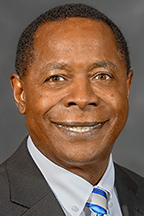
Members of the Student Government Association Senate and freshman council gathered in the Parliamentary Room recently to hear from MTSU President Sidney A. McPhee and Provost Mark Byrnes on several student-related issues.
“President McPhee’s candor and honesty on the hardest issues facing our university is what makes it a can’t-miss opportunity each year. It helps us all keep an open line of communication with campus administration and students,” said SGA President RJ Ware, who presided over the meeting.
Other administrators attending included Joe Bales, vice president for University Advancement; Drew Harpool, interim vice president for Business and Finance; Yvette Clark, vice president for Information Technology; and Danny Kelley, interim vice president of Student Affairs and dean of students.

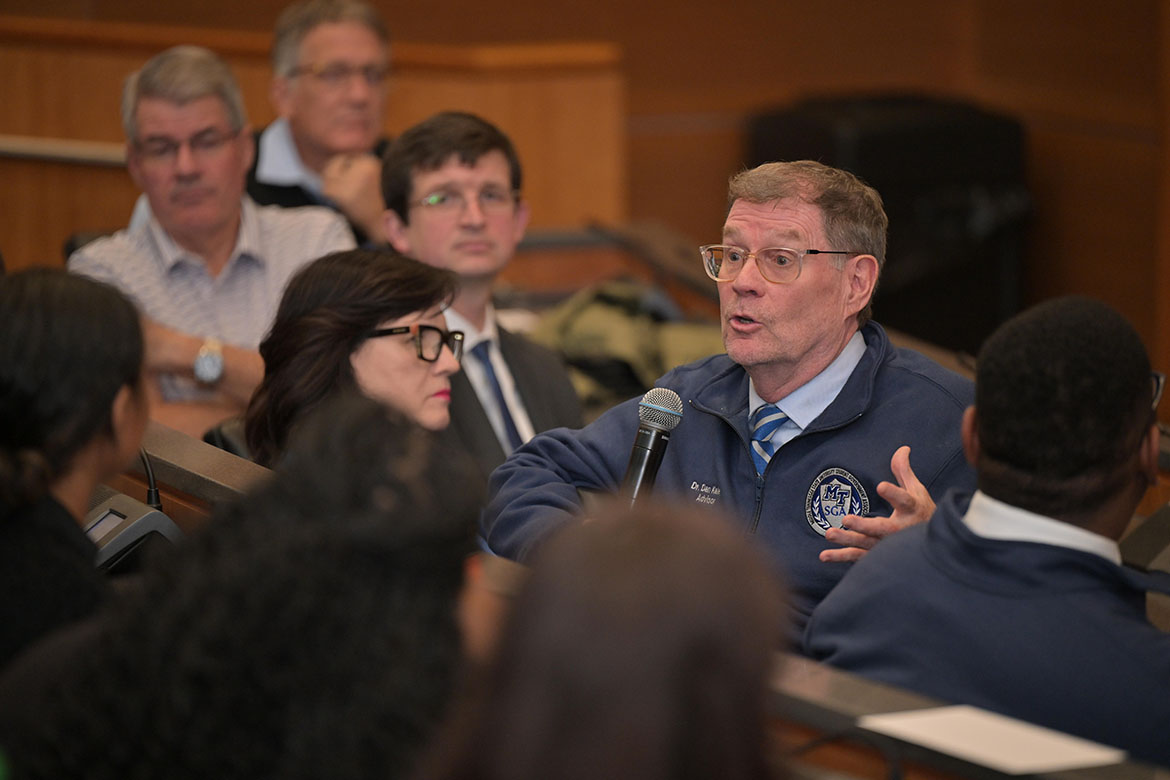
After an introductory remarks about the state of the university, McPhee opened the floor for questions from students.
Will ROTC building name ever change?
Jenene Grover, a journalism major from Murfreesboro and managing editor for the student media outlet, Sidelines, kicked off the questioning to ask for an update on whether the ROTC Building that bears the name of Confederate Gen. Nathan Forrest would be changed.
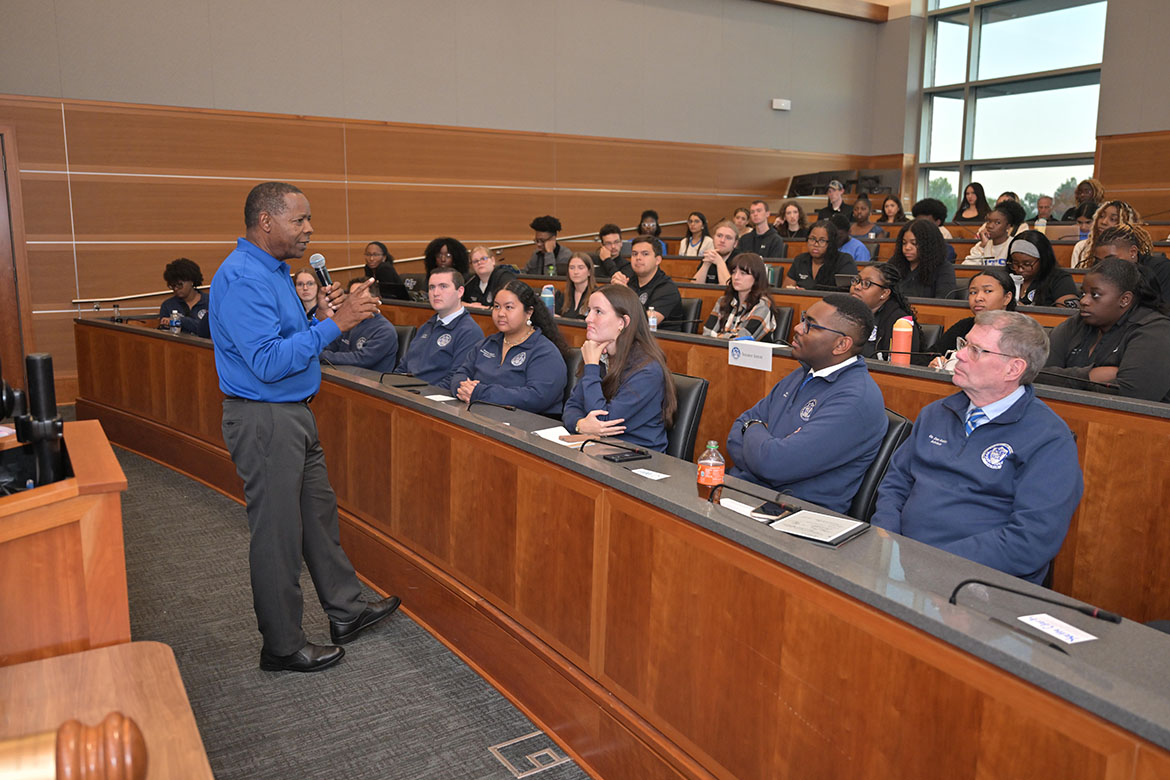
“My response to you is, at this point in time, in our history and the current political environment that we are in, I don’t see that being a possibility right now,” McPhee told the audience. “That doesn’t mean that we don’t want to continue to have it removed.”
Over McPhee’s 25-year tenure at MTSU, the university has petitioned the Tennessee Historical Commission three times to change the name, but the governing body has not granted the request, he noted.
Is MTSU ready for AI?
Gavin Palmer, a political science major from Murfreesboro, is concerned about what the university is doing to prepare students for a job market that is increasingly impacted by artificial intelligence, or AI.
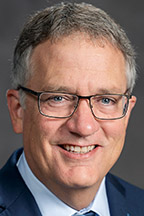
Provost Byrnes responded and said a task force that is focused on addressing AI recently produced a report with recommendations on how the university can respond. Academic programs are in the development phase, he said.
“What can we do in the classes? Well, ultimately, that’s up to the faculty members. And I know there is a lot of activity, because I’ve talked to the deans and the chairs,” Byrnes said. “We don’t have it totally figured out, but just to be clear about that, we’re not ignoring it.”
Student food insecurity sees uptick
Amiracle Willingham, a forensic science major from Memphis who works in the Student Food Pantry on campus, expressed concern about the uptick in food insecurity among students.
“We are on top of it and we’re doing the best we can,” McPhee said, referencing a $150,000 donation from Experience Community Church in Murfreesboro to help students in need. The pantry also recently received a $5,000 grant from Publix Charities that helped replenish supplies during the fall.
Diversity, equity, inclusion changes
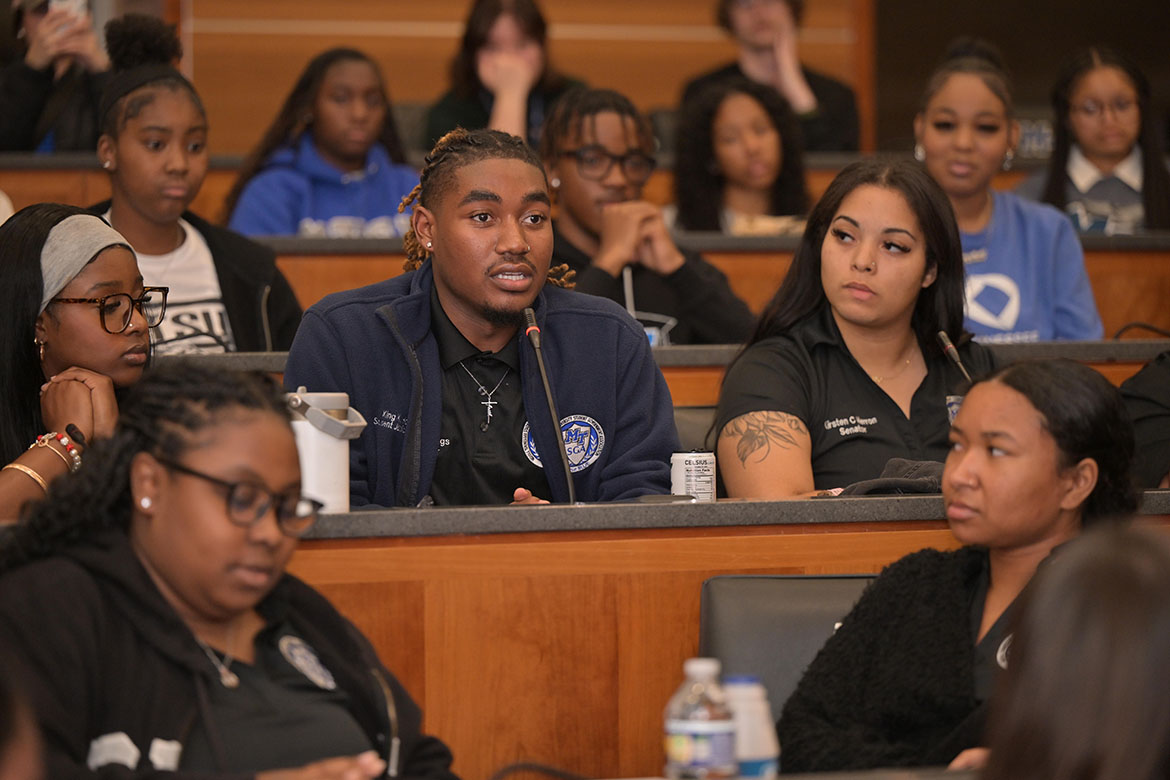
Jaeda Jackson, a social justice journalism major from Chattanooga, asked why diversity, equity and inclusion, or DEI, programs were “removed so quickly over the summer without communication.”
Earlier this year, federal and state mandates required the university to discontinue all programs and initiatives related to DEI as outlined in those mandates.
“We have sent out communication to the campus; we didn’t immediately eliminate,” McPhee said. “In fact, we had some discussion of how we should phase those programs out, and what kinds of programs that we should or opportunities we should put in place that would not conflict with the law.”

However, McPhee emphasized that, as a state institution, the university was required to follow the law, including the “Dismantling DEI Departments Act” passed by the Tennessee General Assembly in the spring.
“The reason why we had DEI programs and initiatives is because we believe, based on our values, that that’s an important part of what we do. But we are a state institution, and we are required by law to follow what those legislations say. So we had no choice but to eliminate those programs.”
If the university did not comply with mandates, federal funding would be taken away, and students could potentially lose academic grants, McPhee said. Staff who were employed in those DEI programs were reassigned to a newly established Office of Student Care and Conduct, which provides support to students regardless of gender, race, etc., he added.
International student community
On the heels of the DEI question, Honduran food science major Anna Salinas Seaman expressed concern over the international student community.
“During this entire year, there has been an evident decrease in international students coming in because of the political stance,” Seaman said. “In what way do you stand with the international student community?”
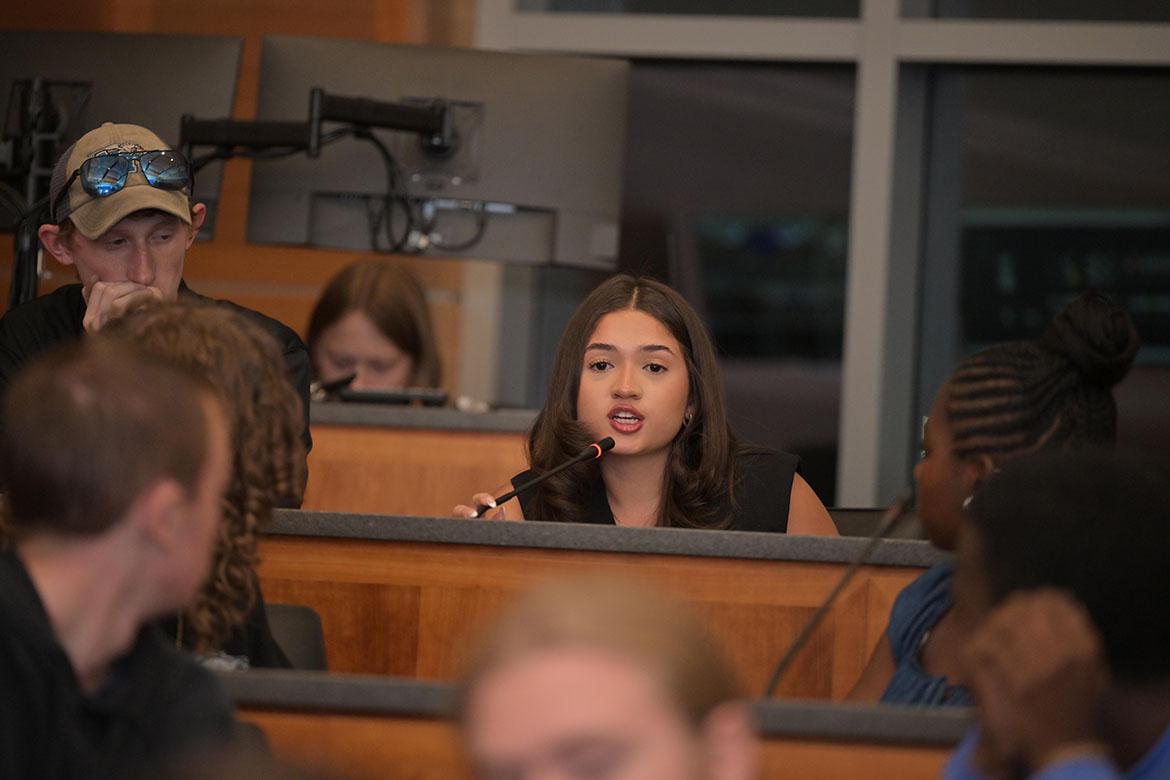
McPhee assured Salinas that MTSU is “still committed” to welcoming and adding international students, despite the federal government’s proposed cap on undergraduate enrollment.
“With the students we have, we have to make sure that we provide the support for them to be successful, and we do that through our Office of International Affairs that reports to the Provost’s Office,” McPhee said.
Other topics included the Big Career Fair held each fall, low attendance at MTSU football games and other athletic events, the weekend closure of Farmers Market dining hall, scholarship funding, and the process of dispersing funds from the Tennessee General Assembly.
Ware said he was pleased with the Nov. 6 meeting and Q&A.
“There were a lot of really insightful questions,” Ware said. “Our students took advantage of the opportunity to gauge the president’s thoughts on the most important issues facing our campus. I think that is admirable, and proof of why our Student Government Association continues to serve our fellow students at a high level, and ranks among the nation’s best.”
— Nancy DeGennaro (Nancy.DeGennaro@mtsu.edu)




COMMENTS ARE OFF THIS POST