

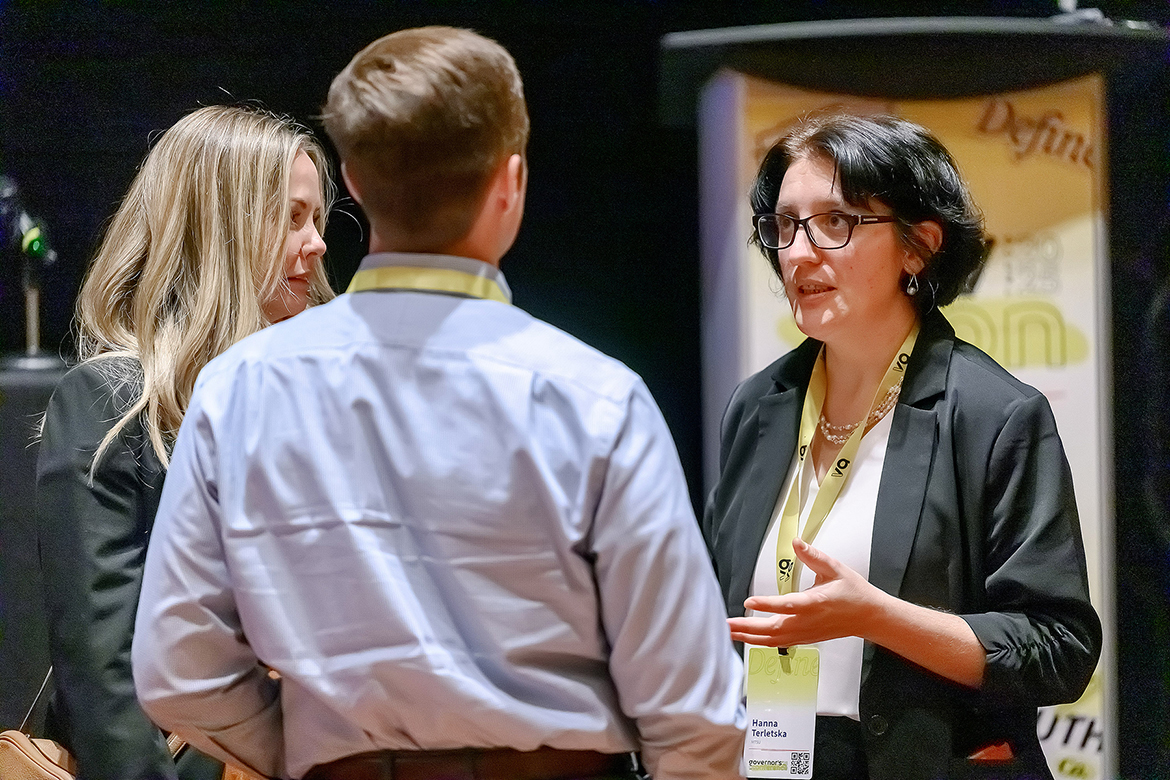
MURFREESBORO, Tenn. — Middle Tennessee State University’s Hanna Terletska recently joined a statewide trio of innovation experts during a key research-related panel discussion as part of the Tennessee Department of Economic and Community Development’s annual Governor’s Conference 2025.
“It was a great opportunity to share MTSU’s quantum research and workforce development efforts and to learn from the impressive innovations across Tennessee universities,” said Terletska, an associate professor in the Physics and Astronomy Department and director of the new MTSU Quantum Research Interdisciplinary Science and Education Center, better known as QRISE.
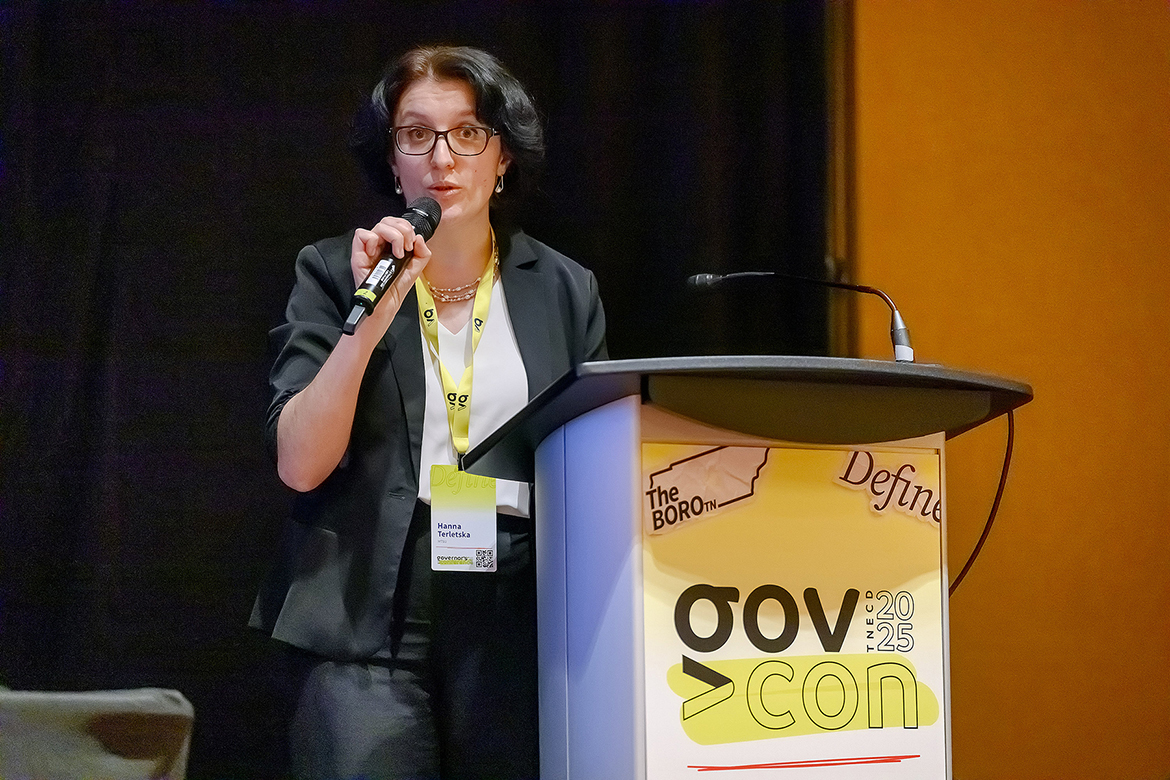
The “Research in Action: Partnering with Industry for Economic Growth” panel discussion held Tuesday, Nov. 4, at the Embassy Suites By Hilton Murfreesboro, featured MTSU, Vanderbilt, Tennessee Tech and University of Memphis experts highlighting their specializations — cybersecurity, smart cities, quantum and more — and demonstrating how their work can support businesses statewide.
Joining Terletska on the panel were Muhammad Ismail, director of the Cybersecurity Education, Research and Outreach Center at Tennessee Tech University; Jasbir Dhaliwal, executive vice president for research and innovation at the University of Memphis; and Padma Raghavan, vice provost for research and innovation at Vanderbilt University.
It was part of the sold-out, two-day event featuring topics such as ecotourism in rural communities, marketing strategies, how artificial intelligence and nuclear are shaping Tennessee, music as an economic driver, and more. Gov. Bill Lee attended the conference, which was organized by the TNDEC Office of Innovation, created earlier this year.

“The panel underscored that close collaboration among higher education, industry and government is essential to strengthen Tennessee’s research ecosystem and drive economic growth,” Terletska said. “I’m grateful for the governor’s leadership and the Office of Innovation’s support in building partnerships that speed technology adoption, create high-skill jobs and prepare our students for the future workforce in Tennessee.”
During the hourlong forum, Terletska told the audience that for her and fellow faculty to reach middle school and high school students with the opportunity of pursuing quantum science that you “must be creative, hands-on and funny — and make sure education and training are available.”

MTSU’s presence
Supporting Terletska’s participation were MTSU Provost Mark Byrnes, Physics and Astronomy Chair Ron Hendersonand Joe Bales, vice president for University Advancement.

“It shows how important quantum is from not only a scientific standpoint but also an economic development standpoint,” Byrnes said. “We’ve got a lot of work to do to figure out what that looks like, but the possibilities are really exciting.”
Byrnes added that Terletska’s “on the cutting edge of this quantum effort in Tennessee, and I think there are a lot of potential benefits for the state and the nation.”

Mentioning MTSU being “on the same scale” with Vanderbilt, Tennessee Tech and University of Memphis, Henderson said, “MTSU is at a competitive level so that we’re peers with these other institutions” in the efforts to drive research quantum and artificial intelligence.

Patrick Cammack, senior vice president of economic development with the Rutherford County Chamber of Commerce, said to have the conference “in Murfreesboro first is a great thing, but to have MTSU as a main partner of the event, both supporting it and with multiple panels, is great to show the state what is happening at MTSU.”
State driving innovation

Panel moderator Nathan Buttrey, senior adviser to the commissioner in the Office of Innovation, said through research and development capabilities, they “know we can create a flywheel with those universities, where the universities are spinning off IP (intellectual properties) in companies to generate more opportunities and more business and more investment, which is better for Tennesseans.”
Buttrey added that the Office of Innovation provides “a commitment to promise, essentially, a commitment to dollars through grants and incentives and programming, but also to a regulatory and legislative environment that’s going to support innovation.”
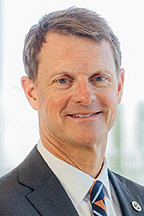
Stuart C. McWhorter, deputy governor and TNECD commissioner, said that “innovation continues to power Tennessee’s momentum, and we’re committed to connecting our partners in higher education, industry and local communities to spark new ideas and drive collaborative solutions.”
McWhorter visited MTSU in late March, learning about quantum efforts and MTSU’s Concrete Industry Management program, in one of his #McWhorterOnTheMove trips across Tennessee.
To learn more about QRISE, visit https://quantum.mtsu.edu or call 615-898-2792.
— Randy Weiler (Randy.Weiler@mtsu.edu)




COMMENTS ARE OFF THIS POST