
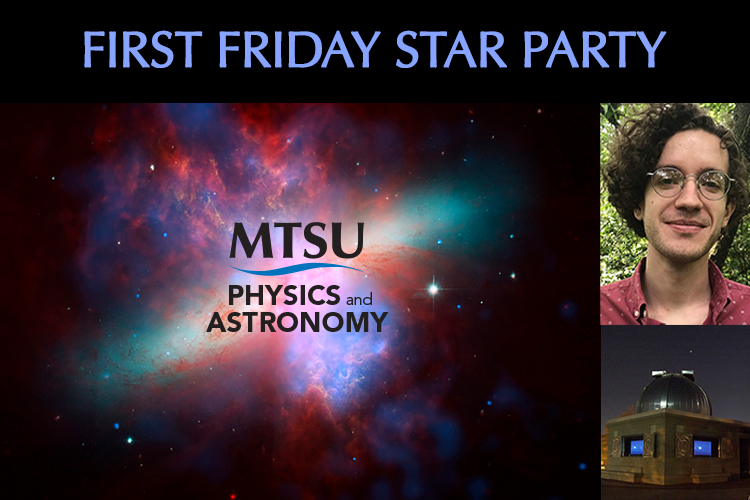
MURFREESBORO, Tenn. — For fans of the Milky Way, Erik Monson, a first-year lecturer in Middle Tennessee State University’s Physics and Astronomy Department, will discuss “How to Build a Galaxy” during the next Star Party.
Monson’s talk will start at 6:30 p.m. Friday, Oct. 3, in Room 102 of Wiser-Patten Science Hall.
All Star Parties are free and open to the public, and children are welcome.
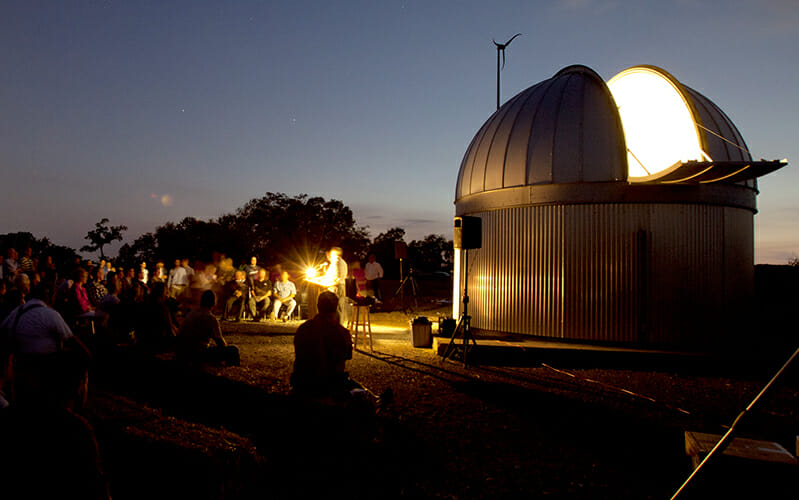
The format is a 45- to 60-minute lecture followed by a telescope viewing at the nearby MTSU Observatory, weather permitting.
Typically held on the first Friday of the month during the semester, the Physics and Astronomy Friday Star Parties feature an assortment of interesting astronomy and physics topics from faculty members.

“My talk is about the different components that make up galaxies like our Milky Way, the way that we study them and what we can learn about our own galaxy from observing the way matter cycles through different phases in nearby galaxies,” said Monson, a postdoctoral scholar at Penn State University for two years before joining the MTSU faculty in August.
“Our current generation of observatories, including JWST (James Webb Space Telescope), gives us an incredibly detailed view of stars, gas and dust in the nearest galaxies, which we can use to gain new insights on how these building blocks of galaxies interact,” he added.
Monson said he’s an astrophysicist and researcher “with years of experience in data science and Python software development. My research has focused on the growth of galaxies and black holes from the early universe to the present day, using techniques including Bayesian statistical analysis (a method for updating existing beliefs with new evidence to form a posterior belief using Bayes’ theorem), image processing and high-performance computing.”
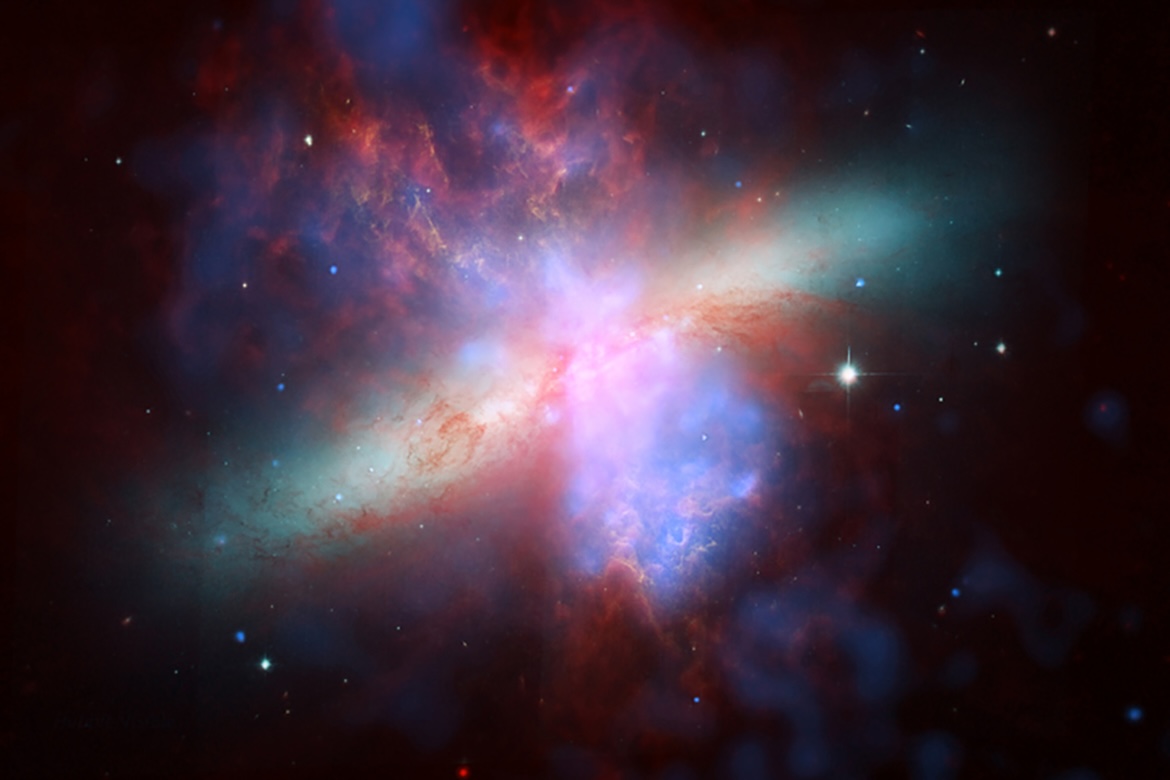
Much of his recent work is related to observations of nearby galaxies with the Chandra X-ray Observatory as part of the PHANGS-Chandra survey, studying the hottest phase of the interstellar medium and the X-ray emission from stellar remnants, he said.
Monson, who earned his doctorate at the University of Arkansas, where he was both a research and teaching assistant, said he has collaborated on developing multiple software packages for inferring the physical properties of distant galaxies and has worked with many large, complicated datasets.
“I’m interested in making the jump from academia to industry and leveraging my experience in scientific research, data analysis and software development for new projects, especially those related to topics in the public interest like climate change, conservation and science outreach,” he added.
The rest of the fall Star Party schedule:
• Nov. 7 — Instructor Irina Preevalova, discussing “Black Holes and Us.”
• Dec. 5 — Lecturer Gregg McPherson, discussing “The Incredible Physics Implications of Santa’s Sleigh Ride.”
Free parking after 4:30 p.m. can be found in the Judd-Sims lot, James E. Walker Library lot, and other nearby lots located on the north side of Alumni Drive between North Baird Lane and Womack Lane.
For more information about Physics and Astronomy, one of 11 College of Basic and Applied Sciences departments, call 615-898-2130.
— Randy Weiler (Randy.Weiler@mtsu.edu)




COMMENTS ARE OFF THIS POST