
MURFREESBORO, Tenn. — Long before she became a statewide leader in physician assistant education, Marie Patterson was a little girl sitting in the stands at Middle Tennessee State University, cheering on the Blue Raiders alongside her father.

“I’ve been here in Murfreesboro since I was 5 and I love, love Murfreesboro,” said Patterson, a physician assistant and founding director of MTSU’s Physician Assistant Studies program in the College of Behavioral and Health Sciences, or CBHS.
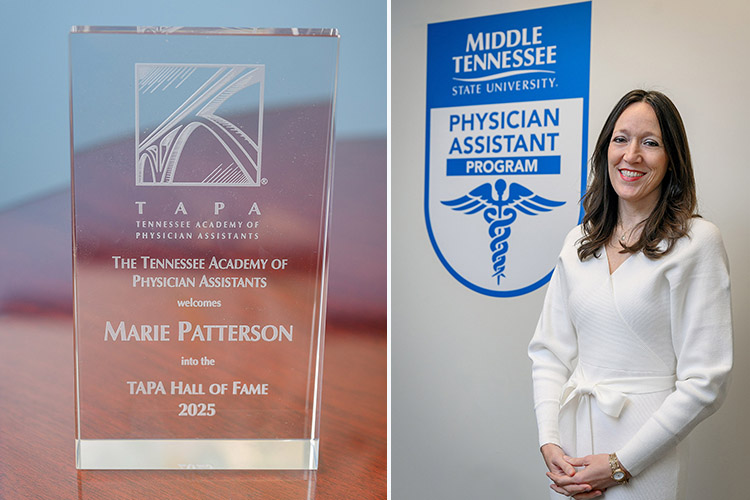
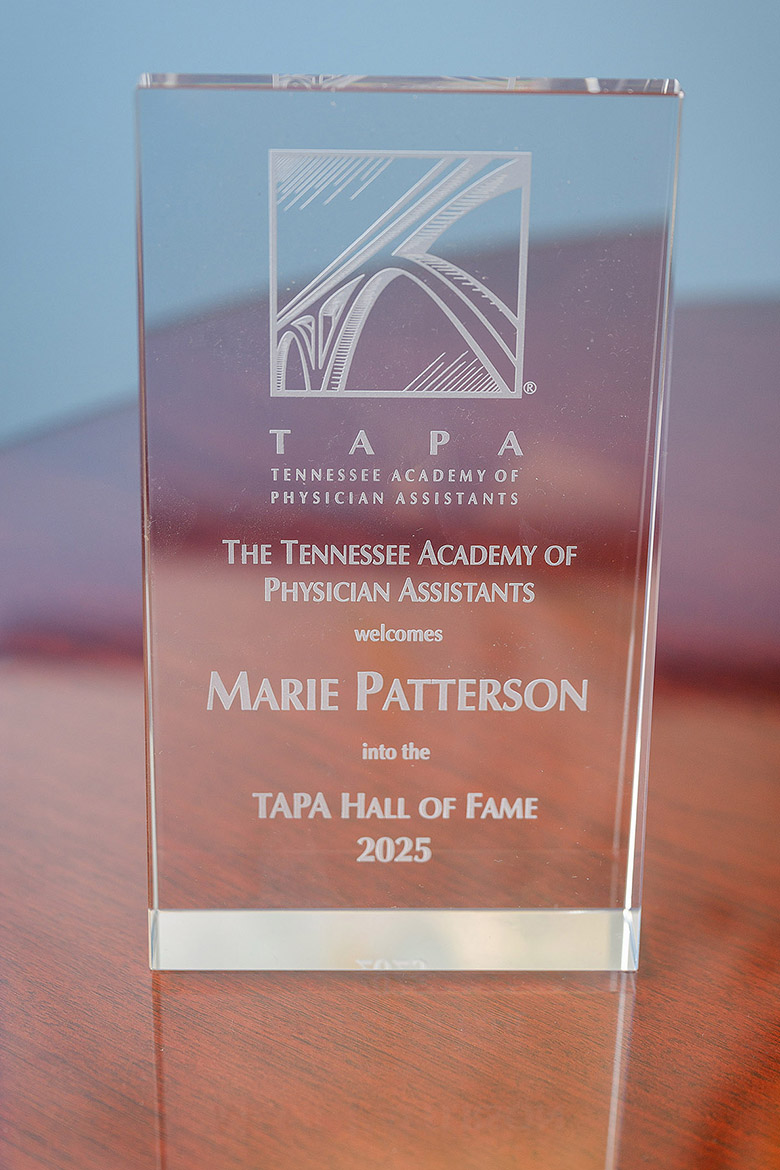
That hometown pride came full circle this year when she was inducted into the Tennessee Academy of Physician Assistants Hall of Fame — an honor recognizing her decades of service, advocacy and innovation in the PA profession.
“Marie Patterson embodies the very best of what we strive for in the College of Behavioral and Health Sciences — deep community roots, visionary leadership and a lifelong commitment to advancing health care,” said Peter Grandjean, dean of CBHS. “Her impact on physician assistant education across Tennessee and her dedication to service make this Hall of Fame recognition both fitting and well-deserved.”

In addition to starting the PA studies at MTSU, Patterson helped launch the PA program at Lipscomb University in Nashville. She also served as president of the Tennessee Academy of Physician Assistants, currently serves as chair of the Tennessee Board of Physician Assistants and is the Tennessee delegate to the National PA Compact Commission.
“I look at the gifts I’ve been given and think about what I can do with those gifts, because I don’t want to have any regrets that I didn’t help when I had the opportunity,” Patterson said. “So that’s why I do a lot of volunteer work in the PA profession, trying to move the profession forward.”

A calling that started in childhood
As the child of former missionaries, helping others was ingrained in Patterson’s life. But she knew her professional ministry — even as a young child — was somewhere in the health care field.
A high school anatomy class piqued her interest further, and by college, she was on the pre-med track. But discovering the PA profession changed everything.
She was enticed by the profession’s flexibility, generalist training, and the ability to move between specialties without returning to school. “What drew me in was definitely work-life balance, but also the idea of being able to transition laterally to any job,” Patterson said.
She applied to one PA program — Trevecca Nazarene University in Nashville — and was accepted. Within weeks, she graduated college, started PA school and got engaged. After graduating from PA school, she earned her doctorate.
“I wanted to get all my education out of the way before I started having children,” said Patterson, the mother of eight and wife of a high school baseball coach.
From rural ERs to campus clinics
Patterson’s early clinical work was in a rural emergency room in West Tennessee, followed by a return to Middle Tennessee, where she worked in urgent care and later at MTSU’s Student Health Clinic.
She spent a decade caring for students, building relationships and deepening her connection to the campus community. But after the birth of her seventh child, she “did some soul searching.” She had always envisioned moving into PA education — and the timing finally felt right.
Patterson joined Lipscomb as founding faculty for its PA program, helping shepherd it through accreditation and early development. Her experience there prepared her for what came next — an opportunity she hadn’t expected.
Building a program from the ground up
MTSU was preparing to launch its own PA program. Before applying, Patterson met with university leaders to gauge their readiness — and hers.

“I was very pleased when I walked away from that conversation … because I knew they had done their homework about starting a PA program and were making very wise decisions,” said Patterson, who left the meeting energized.
“Dr. Patterson’s vision and determination were essential in the successful launch of our PA program. Because of her and her colleagues’ work, MTSU is preparing highly skilled providers who will step directly into the workforce,” said MTSU Provost Mark Byrnes. “I’m proud to see this program meeting the needs of our community and our state. And I’m always happy to see a fellow native of Murfreesboro succeed!”
She accepted the role of founding director in the spring of 2020, just as the pandemic hit.
Patterson was all in and navigated state approvals, accreditation requirements and the monumental task of securing clinical preceptors when in-person visits were impossible. She credits medical director Dr. William “Dunk” Eastham with helping open doors during a time when most were literally closed.
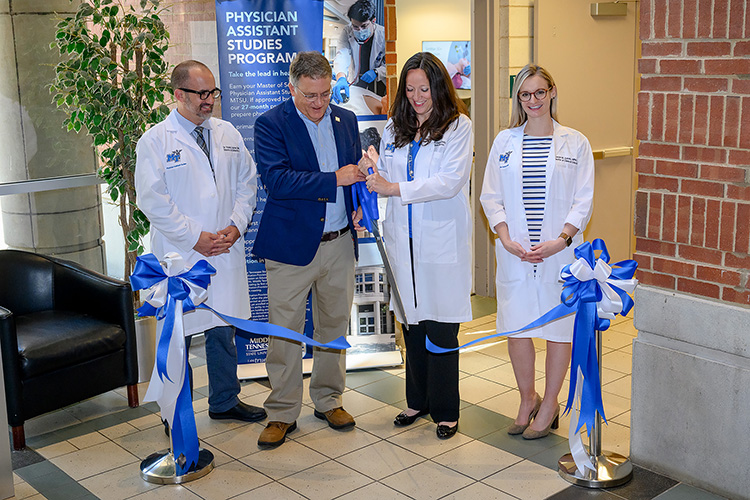
Under Patterson’s leadership, the program quickly distinguished itself. She secured both cadaver lab access and two state-of-the-art Anatomage tables, which serve as interactive digital cadavers.
“Not many schools have both,” noted Patterson, who also expanded simulation and procedural training with high-fidelity mannequins and specialized task trainers.
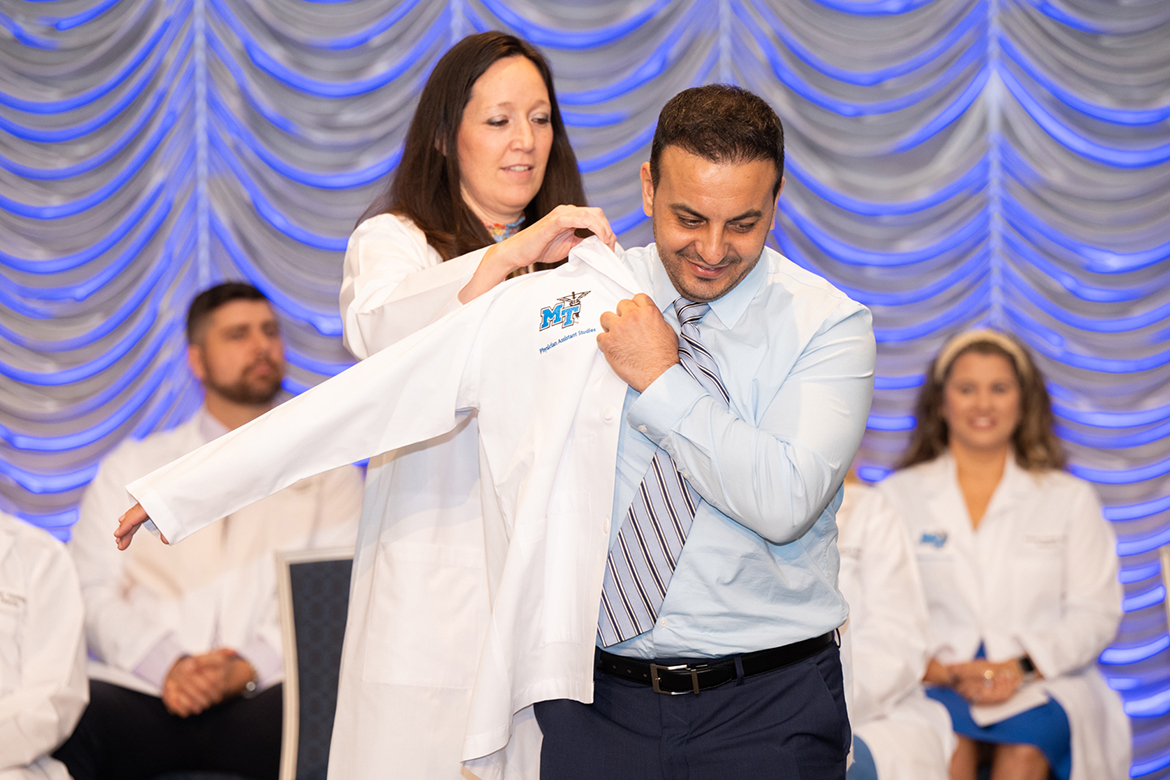
But her boldest move was integrating point-of-care ultrasound devices throughout the curriculum. MTSU became the first PA program in the nation to provide these handheld devices to every student. Students now train with them from day one and graduate with the device in hand.
“Our students have a leg up. It helps them be more competitive, and then they can fit right into those harder specialties to get into right out of school, such as ER and ICU,” Patterson said.
To learn more about the Physician Assistant Studies program, visit https://bit.ly/4uZwoWq.
— Nancy DeGennaro (Nancy.DeGennaro@mtsu.edu)




COMMENTS ARE OFF THIS POST