
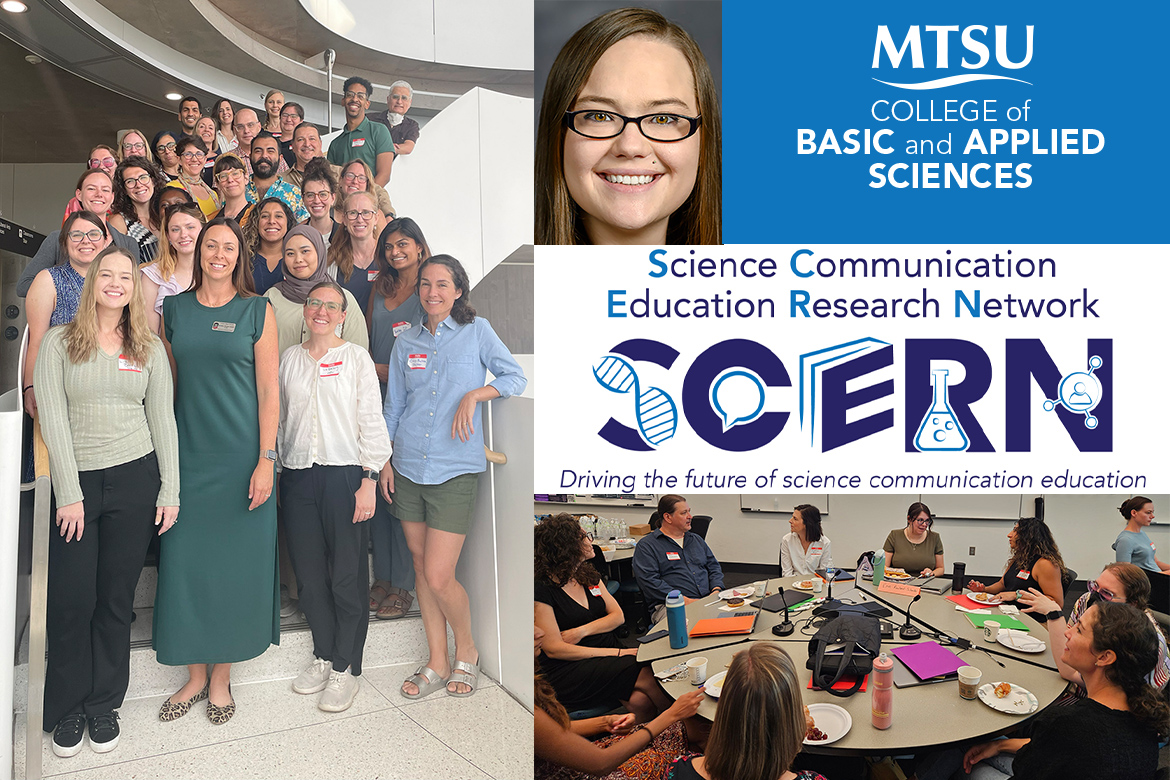
MURFREESBORO, Tenn. — Middle Tennessee State University associate biology professor Liz Barnes knows good science is inseparable from good communication. Neither students nor the public can deeply engage with critical yet contentious science issues like climate change or vaccine safety if having to first overcome an insensitive or even condescending delivery.
“People tend to trust scientists, which is great,” Barnes said, herself an instructor of undergraduate science classes. “They see scientists as wanting to contribute positively to society. But people also say that scientists are not the best communicators. They can come off as cold and use inaccessible language that alienates people.
“We want to change this, to bridge this divide by teaching undergraduate science students — the next generation of science communicators — to be more relatable and collaborative with the public. We need a scientific workforce that builds a positive relationship between science and society to collaboratively solve the issues that face us today.”
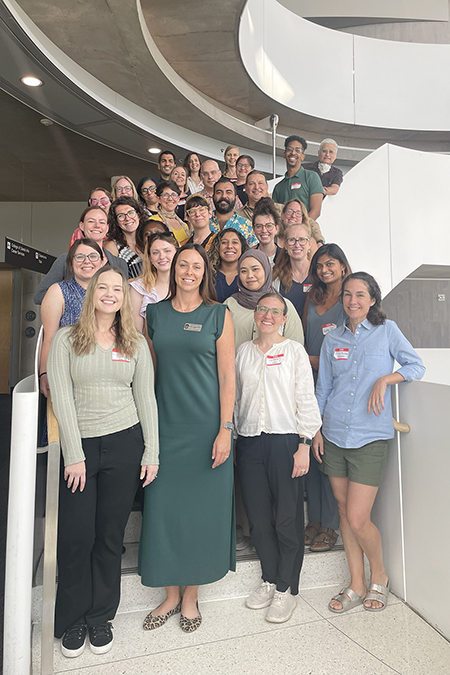
Barnes recently took another step to further the field through earning a $75,000 National Science Foundation grant for developing the Science Communication Education Research Network, or SCERN, with colleagues from the University of Minnesota, Colorado State University and Northern Illinois University to gather more than 30 other researchers in the field from across the country.
The grant funded the team to craft “a year’s worth of network activities to build this network of promising researchers who want to contribute to a more cohesive field and body of research going forward to figure out how to effectively teach science communication to undergraduate science students,” Barnes said.

This translated into multiple virtual meetings, academic journal discussion and book clubs, a lecture series featuring field experts, a major in-person conference, and an essay to be submitted to the prestigious Proceedings of the National Academy of Sciences, or PNAS, academic journal with an urgent call-to-action for advancing this field to improve current and future science communication.
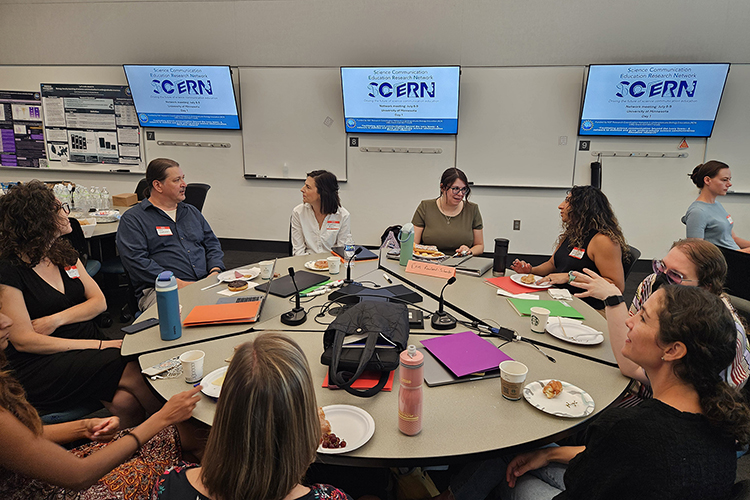
An MTSU research team joined the efforts and accompanied Barnes to the network’s inaugural, in-person meeting this summer at the University of Minnesota in Minneapolis, Minnesota, comprised of postdoctoral researchers Erin Rowland-Schaefer and Mary Foley, doctoral students Kate Coscia and Rahmi Aini, undergraduate student Jadyn “J.” Hayes and associate communication professor Natalie Hoskins, who was recently appointed as the assistant director of MTSU’s general education curriculum True Blue Core.
Communication and education
Over the past decade of her career, Barnes has emerged as a leader in the growing field of science communication education — and not only in the classroom. She has an ever-expanding catalog of research, currently totaling over $3 million in funding from multiple prestigious grants, and produced data-backed instructional recommendations to help undergraduate science instructors teach their students to be impactful science communicators.
It was Barnes’ communication research that first brought MTSU team member Rowland-Schaefer, whose background in land management and conservation had given her firsthand experience on the importance of effectively communicating with a community, to the Blue Raider campus for her postdoctoral research.

“I knew immediately that I wanted the opportunity to work with her and the community at MTSU,” said Rowland-Schaefer, who encountered Barnes’ work on how to bridge divides about evolution among communities of faith. “As I read more of what she was doing, I fell in love with the work.”
The St. Peters, Missouri, native was the main point of contact for SCERN, helped the leadership team decide on the year’s programming, led the book club, handled several of the logistics for the in-person conference and more.
“I gained so much through my participation in SCERN, and I really enjoyed getting to take on such a big and challenging task,” said Rowland-Schaefer, who will go on to be an assistant professor of biology at the University of Nebraska, Omaha this fall. “I’ve gained so much experience in event planning, field knowledge through working with this wide range of experts and built a really great network — including people close to where I’ll be working as a professor.
“I plan on continuing to be involved with SCERN for as long as it exists!”
J. Hayes, a rising senior studying biology, was already working with Barnes in her Social Perceptions of Science Lab as a mentee when she joined the SCERN project.

“I attended the virtual journal and lecture series,” said Hayes, originally from Jackson. “I helped set up for the Minnesota conference, participated in group discussions and presentations during which I was so inspired and made several memorable connections, and presented and received feedback on my own research.”
Hayes said several attendees offered suggestions for her future academic plans, shared contact information, recommended graduate programs and more.
“I was able to talk with people who actively have the kinds of jobs I want, which has demystified them for me and reinforced my plans for what I do and don’t want to do — decisions that could’ve taken me years of trial and error to make,” she said. “I also just love my job and community…. I feel a genuine sense of belonging and purpose at my workplace that fills me with hope that I actually can make a difference in the world.”

Natalie Hoskins, associate communication professor, served in an advisory capacity to bring in relevant communication scholarship. Hoskins also highlighted the far-reaching impacts of SCERN’s work across curriculums.
“As SCERN continues to work on projects that reduce barriers to effective science communication, I expect to see the development of pedagogical tools that will have applications in any course, including True Blue Core courses, where students are expected to communicate about difficult topics,” she said.
Barnes said the network will next submit their call-to-action essay to the PNAS academic journal within the month to see if it is accepted for publication and continue to build the SCERN network as a catalyst for the growing field of science education communication researchers.
Learn more about research opportunities at MTSU’s Office of Research and Sponsored Programs website at https://research.mtsu.edu/.
— Stephanie Wagner (Stephanie.Wagner@mtsu.edu)




COMMENTS ARE OFF THIS POST