
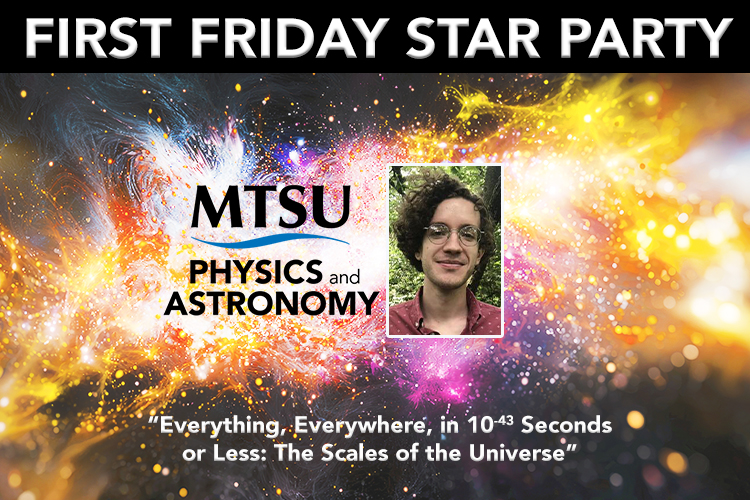
MURFREESBORO, Tenn. — Learn what the earliest moments of the universe were like at the next First Friday Star Party, set for 6:30 p.m. Friday, April 3, in Room 102 of Wiser-Patten Science Hall at Middle Tennessee State University.

Physics and Astronomy Department lecturer Erik Monson will give a presentation on “Everything, Everywhere, in 10⁻⁴³ Seconds or Less: The Scales of the Universe,” to discuss what happened in the wake of what is known as “the big bang.”
“People might know that the universe initially looked quite different to the way it does now,” said Monson, “but this talk will give an introduction into the early history of the universe, and how it expanded into its current state.”
In the first 10⁻⁴³ seconds — known as Planck time — the universe was so hot and dense that physical laws as we know them did not yet exist.
To put this unit of time into perspective: a heartbeat is 1 second; a camera flash is 10⁻³ seconds; the fastest particle interaction that can be measured is 10⁻²³ seconds; and Planck Epoch — the time unit after the big bang — is an unimaginably short 10⁻⁴³ seconds.
“The universe operates on scales of space and time both larger and smaller than anything we’re used to thinking about in our everyday lives,” said Monson, whose research background involves studying the evolution of galaxies and supermassive black holes with X-ray observations. “Together, we’ll look at how those scales have evolved.”
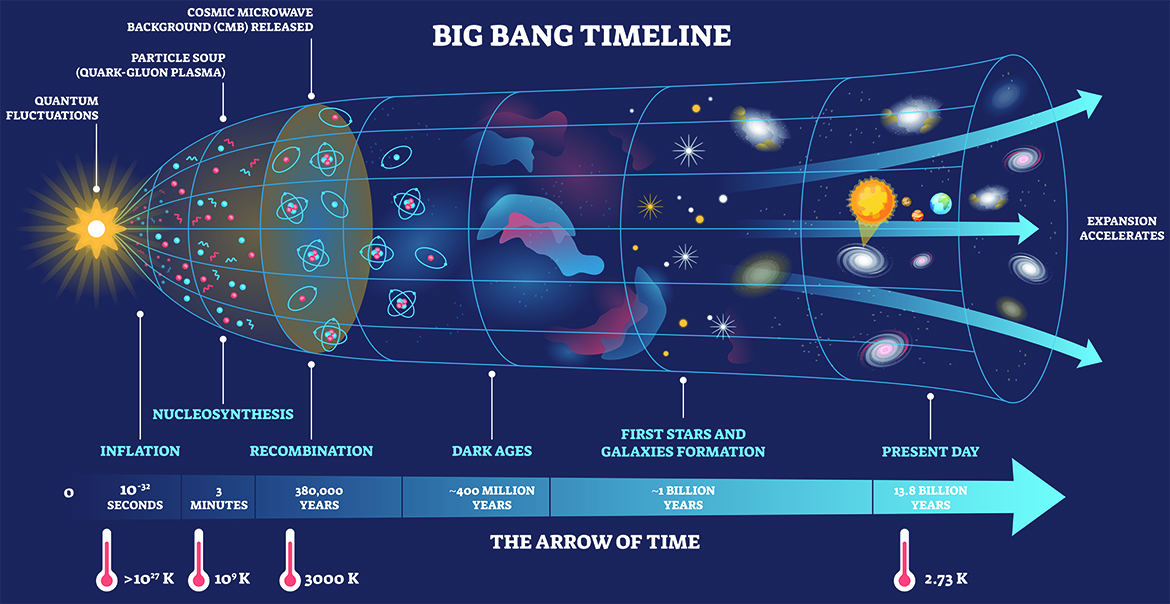
Monson’s presentation will guide audiences through the universe’s earliest moments, tracing its rapid evolution and growth. Along the way, he will outline a timeline of cosmic history and highlight the innovative methods scientists use to measure and understand the fundamental processes that shaped our Universe.
Hosted through the Physics and Astronomy Department and held on the first Fridays of the month, the two-hour Star Party events feature a faculty presentation related to astronomy followed by a telescope viewing at the nearby MTSU Observatory, weather permitting.

The MTSU community and the public, including children, are welcome to enjoy all Star Parties at no cost. Complimentary parking is available after 4:30 p.m. in the adjacent Judd-Sims lot, the James E. Walker Library lot, or other nearby lots on the north side of Alumni Drive between North Baird Lane and Womack Lane.
Physics and Astronomy professor Chuck Higgins kicked off the spring Star Party season on Feb. 6 on the topic of “Who Speaks for Outer Space?” followed by the March 6lecture March 6 on “Archeoastronomy: What did Ancient People Know About the Sky?” by John Wallin.
The final Star Party of the semester will take place May 1, featuring instructor Irina Perevalova, who will discuss a topic of the audience’s choice, to be determined.
This month’s topic was requested by a Star Party patron, and ideas for future lectures are welcome. Email Higgins at chuck.higgins@mtsu.edu.
After-hours parking is free, and a searchable campus parking map is available at bit.ly/2026parkingmap.
Learn more about the Friday Star Parties at https://www.mtsu.edu/observatory/star_parties/. Learn more about the Physics and Astronomy Department at https://physics.mtsu.edu/.
— Nancy DeGennaro (Nancy.DeGennaro@mtsu.edu)




COMMENTS ARE OFF THIS POST