
By DeAsia Powell and Robin E. Lee
MURFREESBORO, Tenn. — MTSU proudly leads the Southeast with 40 participants over the last 10 years in the Japan Exchange and Teaching, or JET, program, a competitive opportunity that attracts over 5,000 global applicants and showcases the university’s commitment to global engagement.
Tye Ebel, JET Program coordinator at the Consulate-General of Japan in Nashville, credits MTSU’s success to dedicated faculty and staff who promote the program and foster a strong JET culture on campus.


“This has resulted in the creation of a strong JET culture on campus, wherein many students have direct connections to current JET participants. As a result, the JET Program is top of mind when students consider post-graduate opportunities, and applicants can put their best foot forward in the competitive selection process,” he said. “I look forward to continuing to develop these connections and support the campus’s JET culture in the years to come.”
With the establishment of the Consulate-General of Japan in Nashville in 2008, the connection has grown substantially. Undergraduate Fellowships Specialist Laura Clippard admires the thorough support system students have, which enables them to succeed in the program.
“MTSU stands out for its hands-on preparation and campuswide support,” said Clippard. “Faculty, alumni and departments work together to ensure students are confident and well-prepared.”

Founded in 1987, JET promotes cultural exchange by placing participants in Japanese schools as English teachers or coordinators for international relations. The prestigious program allows students to live and work in Japan while teaching English as an assistant language teacher or serving as a coordinator for international relations, such as a translator or interpreter.
The program has been thriving for decades, with high participation from the United States, and is recognized as the only teaching program administered by the Japanese government.
MTSU’s relationship began when the university’s Department of World Languages, Literatures, and Cultures established a strong emphasis on Japanese culture through curriculum like advanced language courses. Then, the University Honors College, the Undergraduate Fellowships Office, and the Office of Education Abroad strengthened JET’s prominence by providing campuswide access to exchange programs and sending large groups of students to Japan over the years.
This collaborative approach yielded a heightened interest in and understanding of the Japanese language and culture, resulting in a notable record of regional leadership.

Students are immersed in Japanese culture when they are placed at multiple schools in villages and cities across the country. Rebecca Clippard, who taught in six elementary schools in Kagoshima Prefecture, described her experience as peaceful and rewarding. She is currently pursuing her master’s degree in English teaching at a Japanese university in Tokyo.
“Japan is a wonderful country with kindness around every corner. If I were ever lost, someone always reached out to help me. Living in Japan definitely takes a certain amount of adaptability, but the rewards are well worth it,” Rebecca said.
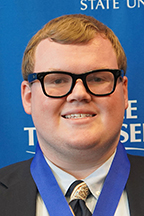
John Tate, a video and film production alumnus, teaches at Shirogane Elementary School and sees JET as a path to Japan’s broadcasting industry.
“My biggest takeaway has been to keep doing difficult things,” he said. “Moving to Japan while barely being able to speak the language has been difficult, and teaching has been difficult; but, through it all, I think I have grown as a person and have a sense of satisfaction and accomplishment that comes with it.”
MTSU continues to build its global reputation through programs like JET.
“All majors are welcome,” Clippard said. “Students receive guidance from exploration to interviews. For those curious about Japan, JET is a transformative next step.”
For more information on the JET program, visit https://jetprogramusa.org or contact Laura Clippard at Laura.Clippard@mtsu.edu.
— DeAsia Powell, journalism major, (dap6c@mtmail.mtsu.edu) and Robin E. Lee, Honors College (Robin.E.Lee@mtsu.edu)




COMMENTS ARE OFF THIS POST