
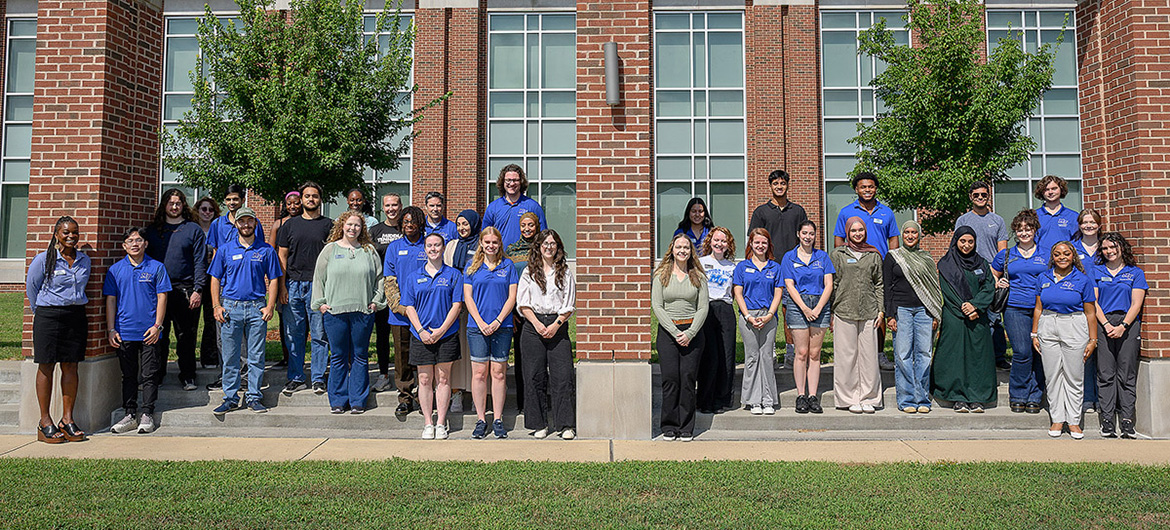
MURFREESBORO, Tenn. — Middle Tennessee State University is helping students succeed in first-year STEM courses with one of its most abundant and effective resources — their fellow Blue Raiders.

First launched at MTSU in 2023, the Learning Assistant program works with students who have already completed these entry-level courses, such as biology, chemistry and math, to serve as embedded peer supports, better known as “learning assistants,” for current students tackling the challenging coursework.
“When I got to MTSU, the Chemistry Department was already interested in trying a learning assistant program,” said Katy Hosbein, the program director and assistant professor of chemistry, adding the University of Colorado, Boulder kicked off the influential peer-support approach in 2007. “So, I teamed up with Liz Barnes, associate biology professor, to roll it out at MTSU.”

The True Blue version of the Learning Assistant, or LA, program includes selecting learning assistants, or LAs, through an initial screening process, preparing them with weekly instructor meetings and trainings, and returning them to these courses to better support student learning.
“It’s unique because LAs serve as a personal resource who can connect with students, understand them and relate to them on a different level than other supports on campus,” Hosbein said. “Our LAs have been through these courses before; they know how to guide students through struggles both from their personal experience and their training.”
Additionally, Hosbein and Barnes further strengthened the program by securing a $50,000 Tennessee Board of Regents grant and formally establishing it within the university’s Office of Student Success.
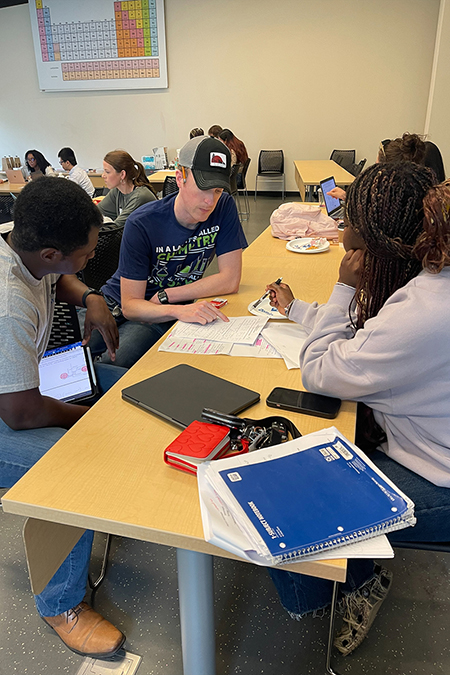
“Before this commitment, Dr. Barnes and I were fundraising each year to ensure the program continued,” Hosbein said, noting that this was in addition to prior internal funding from the College of Basic and Applied Sciences and the biology and chemistry departments. “This new grant helped to sustain the program for the 2024-25 academic year and is still supporting some LAs this fall. Further, the added support from the Office of Student Success has made a huge difference in the sustainability of the program, making it even more possible to expand it into more courses going forward.”
A little help from a friend
Hosbein and Barnes said they have seen the program’s impact firsthand on students, who report that it has bolstered their success in college, making them feel more capable and empowered to reach their academic goals.
Katherine “Kat” Hyder, a junior criminal justice student, said working with learning assistant Isaac Rippy was “life-changing” to get her through first-year STEM courses.

“I don’t think I would’ve passed my chemistry class without the help of my LA,” said Hyder, who is from McMinnville. “He never made me feel stupid for any question, and if I still didn’t understand, he would take the time to walk back through a concept with me. He also always uplifted my spirits and reminded me I was capable of anything I put my mind to.”
Thus far, 57 students have served as LAs, said Hosbein, with 20 active this semester in select sections of general biology and chemistry courses. LAs often serve for multiple semesters, allowing courses to benefit from the combined support of new and returning LAs. And even though the program was built to facilitate success for those taking the courses, LAs report that the experience is transformative for them too.

Donye M. Asberry, a junior studying biochemistry, returned for the third time this fall as an assistant for General Biology 1.
“As a first-generation student learning the ropes of college, getting hands-on experience communicating with students and serving as a bridge between professors and students was a big deal for me,” said the Murfreesboro native.
“I have been able to make students feel more comfortable, provide feedback to professors, and act as a bridge between students and faculty,” said Asberry, who plans to pursue the rigorous dual-certification M.D.-Ph.D. degree. “It’s (also) helped me develop the ability to explain complex concepts clearly, understand diverse perspectives and strengthen my communication skills. I want to serve as a bridge between patients and providers to make health care and STEM education a more welcoming and inclusive environment, which I’ve been able to start now as a learning assistant.”
Research-backed support, expansion
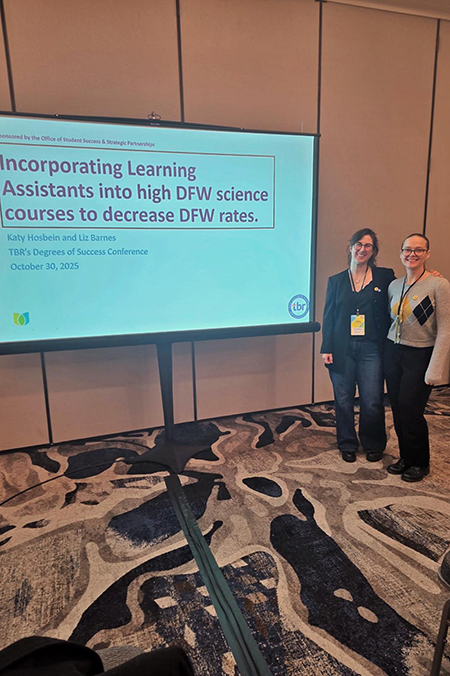
Hosbein and Barnes not only launched the program itself, but they have also been collecting data on the program throughout to gauge its success.
“We’re looking at how the program affects not just students, but also faculty and the LAs themselves,” Hosbein said.
The research is being led by Hosbein and conducted in collaboration with MTSU students: undergraduates Mera Ishak and Neelo Rasuli, and graduate Math and Science Education students Rahmi Aini, Tomi Mafe and Monsour Zakariyah.
Barnes said the data the team has gathered so far showed multiple preliminary findings. Courses with LAs had up to half the failure and withdrawal rate as courses without them. In a controlled study comparing the same course and instructor with and without LAs, students in courses with LAs scored half a letter grade higher on their tests compared to students without LAs. Further, student reflections indicated that LAs not only helped students with the course material but also helped students feel as if they could persist in science.
Additionally, said Hosbein, the data indicates LAs help faculty reflect on their teaching and give them insight into how to be more effective with their students. LAs themselves benefited from strengthening their own learning and getting a “peek” into the teaching side of the education equation.
It was this proactive data collection, said Hosbein, that helped secure the $50,000 grant from the Tennessee Board of Regents.
“We put the proposal together and were excited to find out we’d been selected,” Hosbein said. “The more in-depth data is still being analyzed, so watch out for those results in the future!”

Jonell Hinsey, associate vice provost of the Office of Student Success, is also helping to further bolster the program by providing it with a home in her office.
“Any initiative that enhances learning and strengthens student-centered approaches sits at the heart of my leadership,” said Hinsey, who is originally from Nassau, Bahamas. “Championing the Learning Assistant program at MTSU is a natural extension of that commitment — I see it as a sustainable way to ensure students are supported and empowered to thrive.”
As Hosbein and Barnes move toward growing the program into other courses, disciplines and colleges, Hinsey said she helps align LAs where they are needed most: in other first-year “gateway” courses and those with historically high failure and withdrawal rates to better ensure students’ success at these critical entry points to their curricula and courses of study.
“The long-term goal is that, eventually, any instructor who wants to work with LAs will be able to,” Hosbein said. “By having LAs in more classrooms, we can have more intentional opportunities for students to interact, giving them built-in peer mentors they might not otherwise find on their own. Not every student has the time or energy to seek out those connections outside of class, so my biggest hope is that every student in a class with LAs has someone they feel comfortable turning to when it really matters.”
To learn more about the Learning Assistant program, visit its website at https://studentsuccess.mtsu.edu/learning-assistant-program/.
— Stephanie Wagner (Stephanie.Wagner@mtsu.edu)




COMMENTS ARE OFF THIS POST