
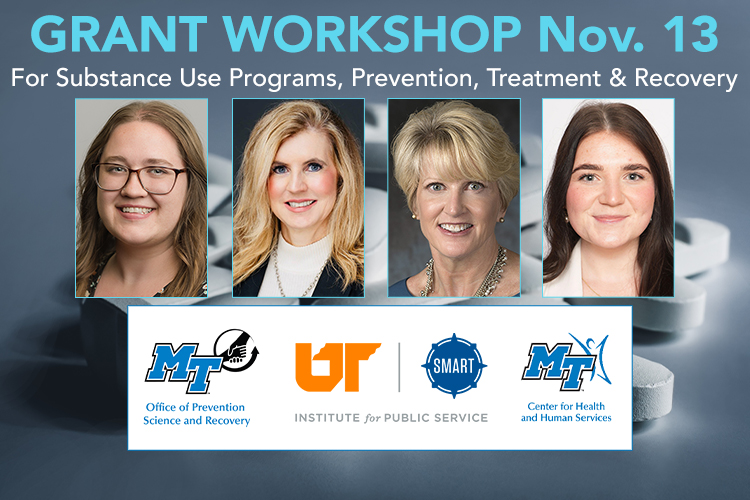
MURFREESBORO, Tenn. — As Tennesseans continue to confront the opioid crisis, Middle Tennessee State University and UT SMART Initiative are joining forces to help local nonprofits and government agencies make the most out of resources and funding for lasting change in their communities.
A free grant workshop for county opioid officials and substance use programs will be held on campus from 10 a.m. to 3 p.m. Thursday, Nov. 13, in the Student Union Ballroom, 1768 MTSU Blvd.

The event is a collaborative effort between MTSU’s Center for Health and Human Services, or CHHS, MTSU’s Office of Prevention Science and Recovery, or OPSR, and the University of Tennessee’s Substance Misuse and Addiction Resource for Tennessee, or UT SMART, under the umbrella of the UT Institute for Public Service.
“We started with this mission to educate and increase the capacity of county officials and community stakeholders across the state to identify, apply for and manage federal, state and local grant funding to address substance use issues within their communities,” explained event organizer Gabiral Cathey, statewide project coordinator for CHHS.
The workshop will host speakers to address best practices and opportunities, how and when to use data for grant writing, networking for resources and partnerships, with an optional session for Q&A on grant guidance.
Attendees of this event will have free parking available in a designated lot by the Student Union Building. Registration is required and can be made at https://bit.ly/4nH34yO.

“We’ll unveil the mystique of grant writing for some folks and discuss the application process,” said Karen Pershing, UT SMART Initiative implementation consultant, who has coordinated the event alongside UT SMART program associate Channie Cretsinger.
MTSU’s CHHS partners with nonprofits and agencies to identify and implement public health-focused grant programs. In 2023, CHHS and MTSU’s Data Science Institute launched the OSPR to provide expertise and technical assistance to the Rutherford County Opioid Board, which facilitates the disbursement of local grant funding.
The Center for Health and Human Services announced plans for three abatement council grants totaling $9.1 million, including funding that will support infrastructure expansion for OPSR.
UT SMART focuses on supporting local governments by assisting with identification of funding strategies, developing plans for spending local settlement funds, creating processes for funding community organizations, applying for external state and federal funding, and monitoring program outcomes. UT SMART’s work for this event is not affiliated with the CHHS contract with the Opioid Abatement Council and is supported by the Institute for Public Service.
Together the two entities can help programs across the board throughout the state.

“Engaging with our county officials is where local policy changes happen,” Cathey said. “It was also important to bring in our community stakeholders who are the boots-on-the-ground experts, making change happen every day throughout the substance use continuum, prevention, treatment and recovery.”
Working together, community leaders and nonprofits can make the biggest impact, Cathey said.
For more information on the office as well as MTSU’s Center for Health and Human Services, visit www.mtsu.edu/chhs or email Cynthia Chafin at Cynthia.Chafin@mtsu.edu.
Learn more about the UT SMART initiative by visiting https://smart.ips.tennessee.edu/.
— Nancy DeGennaro (Nancy.DeGennaro@mtsu.edu)




COMMENTS ARE OFF THIS POST