
NASHVILLE, Tenn. — What began as a mistake in the lab more than 300 years ago has become one of the most widely used pigments.
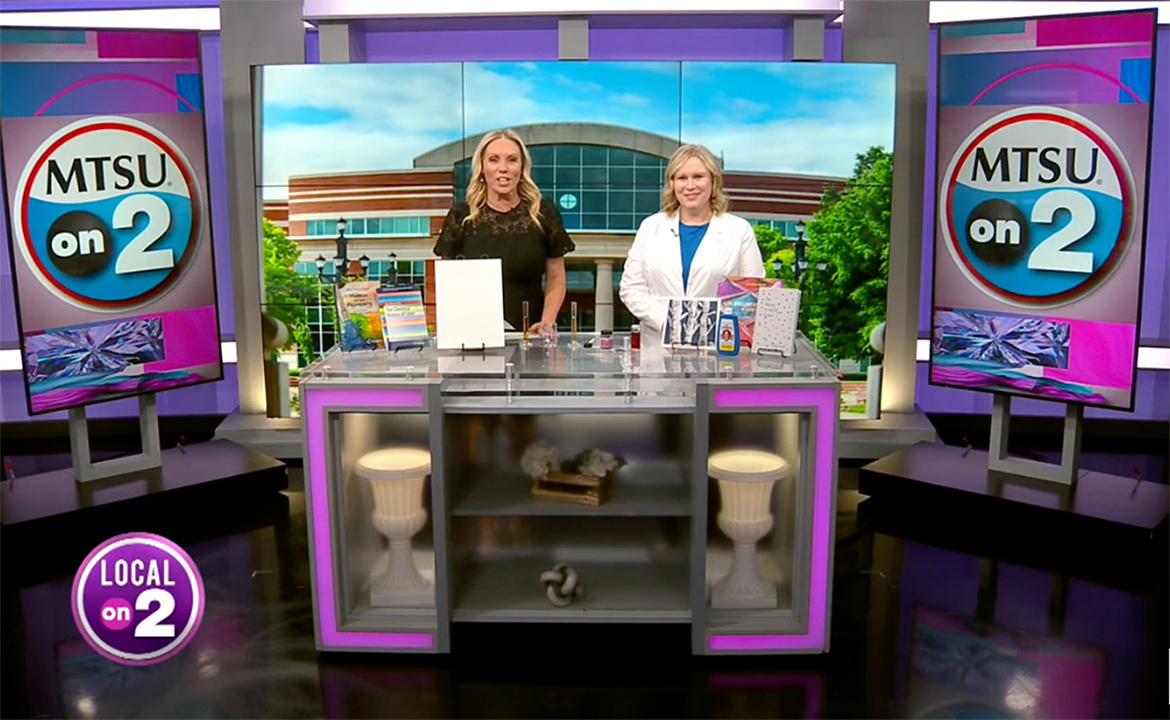
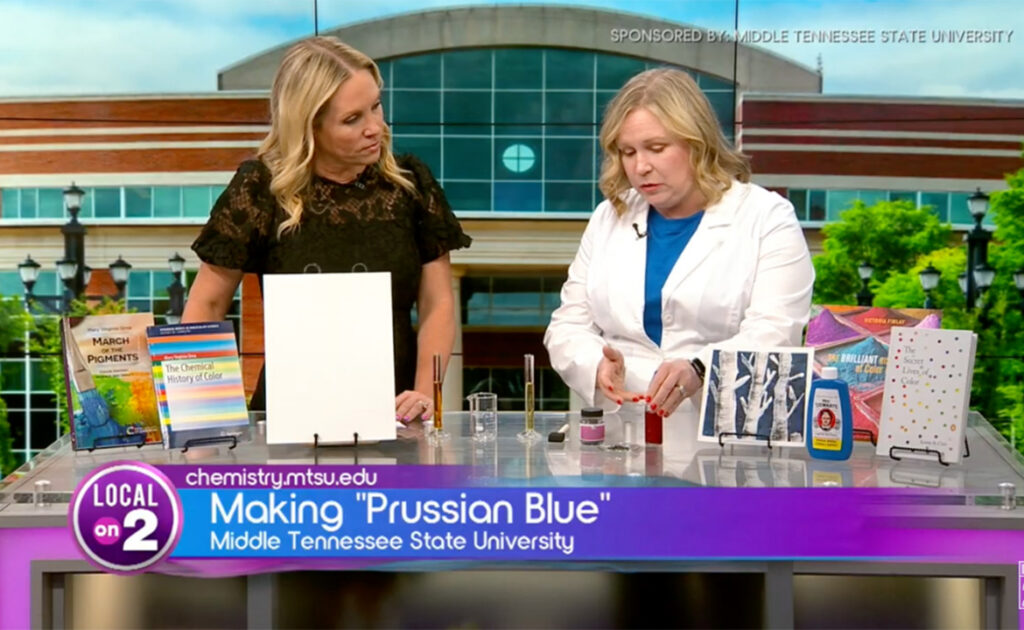
On Friday, June 19, Sarah Pierce, a chemistry instructor at Middle Tennessee State University, appeared on the “MTSU on 2” segment from WKRN-TV’s Nashville studios to talk about the unique history of Prussian blue and its many uses.
You can view the segment below:
Prussian blue was discovered by accident in the early 1700s by dye-maker Johann Jacob Diesbach and alchemist Johann Konrad Dippel, who were attempting to make a pigment called red lake. Instead, a chemical reaction produced a deep blue, now known as Prussian blue, and it became one of the first modern synthetic pigments.

“The synthesis of Prussian blue is very exciting. We mix two yellow solutions, ferric chloride and potassium ferrocyanide, and a beautiful, dark blue solution of iron ferrocyanide forms quite quickly,” Pierce explained. “I can’t imagine how surprised Diesbach and Dippel must have been.”
Prussian blue can be used for many things, including counteracting radiation poisoning, mixing paints, blueprinting, aligning heavy machinery, laundry bluing and more. One of its most recognizable uses is in artist Vincent van Gogh’s “The Starry Night,” painted in 1889 and now owned by the Museum of Modern Art in New York City.
“Prussian blue revitalized the art of Japanese woodblock printing. The Great Wave is an example of these types of prints. Vincent van Gogh saw the Japanese woodblock prints in Paris in the 1880s, and it greatly influenced his paintings and inspired him to use Prussian Blue,” Pierce said.

Pierce teaches chemistry for consumers-art, organic chemistry and introductory chemistry classes.
“Our topics in consumer chemistry class is a True Blue Core course designed for our students who are not science majors,” she explained. “The goal of the class is teaching chemistry in a way that is topical and exciting to the students. Topics that we offer include art, cosmetics, history, crime, food and the environment.”
To learn more about the undergraduate programs offered in MTSU’s Department of Chemistry, visit https://chemistry.mtsu.edu/.
— DeAnn Hays ([email protected])




NO COMMENT