
MURFREESBORO, Tenn. — Tennessee’s housing market remained relatively stable in the first quarter of the year, with home prices continuing to rise, while housing permit activity weakened across all sectors from the previous quarter, according to the latest statewide report from Middle Tennessee State University.

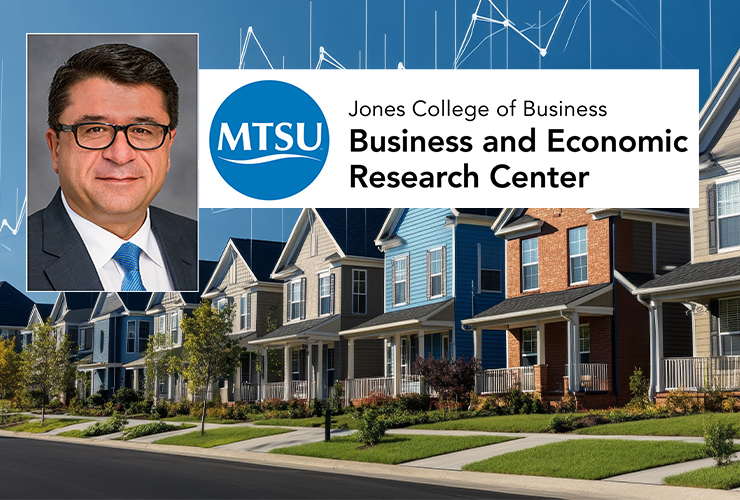
“Tennessee’s housing and labor markets remained generally stable during the first quarter of 2026 despite signs of modest slowing in several sectors,” noted Murat Arik, director of the MTSU Business and Economic Research Center in the Jones College of Business and author of the Housing Tennessee report.
See the full report and more detailed breakdowns, including housing permits, foreclosures and delinquencies, inventories and employment data, at https://www.mtsu.edu/berc/housing/.
Home prices keep rising
• Quarterly: Home prices continued to increase across both Tennessee and the U.S., with quarterly gains remaining modest. Home prices in Tennessee increased by 0.82% during the quarter, slightly outpacing the national increase of 0.7%.
Most Tennessee metropolitan areas recorded positive quarterly home price growth, while only a few markets experienced slight declines, reflecting generally stable housing market conditions across the state, Arik noted.
The quarterly trends for metropolitan areas are:
• Strong growth areas: The Clarksville MSA recorded the strongest quarterly increase in home prices, rising 3.6%, followed by the Morristown MSA, which posted a 1.35% increase. The Nashville MSA and Johnson City MSA also experienced solid quarterly gains of 1.1% and 0.92%, respectively.

• Moderate growth areas: The Chattanooga MSA, Knoxville MSA, and Jackson MSA recorded moderate quarterly increases of 0.85%, 0.8%, and 0.2%, respectively, indicating continued but slower price appreciation.
• Declining areas: A small number of MSAs experienced slight quarterly price declines. Home prices in the Cleveland MSA remained essentially unchanged, declining just 0.01%, while the Kingsport-Bristol MSA decreased 0.22%. The Memphis MSA recorded the largest quarterly decline, with home prices falling 0.5%.
• Annual trends (Q1 2025–Q1 2026): On a year-over-year basis, home prices increased by 3.3% in Tennessee, slightly exceeding the national increase of 3.25%. All Tennessee MSAs recorded positive annual home price growth. The Clarksville MSA posted the strongest annual gain at 8%, followed by the Johnson City MSA at 6% and the Morristown MSA at 5%. Jackson MSA also recorded a strong annual appreciation of 4.4%, while home price growth remained more modest in the Memphis and Kingsport-Bristol MSAs, suggesting relatively stable housing conditions.
About the report
BERC’s report is funded by the Tennessee Housing Development Agency, or THDA. The quarterly report offers an overview of the state’s economy as it relates to the housing market and includes data on employment, housing construction, rental vacancy rates, real estate transactions and mortgages, home sales and prices, delinquencies and foreclosures.
The Business and Economic Research Center operates under the Jennings A. Jones College of Business at MTSU. For more information, visit http://mtsu.edu/berc/.
About THDA
THDA is the state’s housing finance agency committed to expanding safe, sound, affordable housing opportunities for low- and moderate-income Tennesseans. This is achieved through a robust home loan program, competitive funding for local nonprofit and municipal agencies, and the administration of nine federally funded programs.
THDA publishes research on affordable housing, THDA programs, and beneficiaries. THDA also coordinates state planning for housing through the Consolidated Planning process, annual Action Plans, and annual Performance Reports. See http://thda.org for more information.
— Jimmy Hart ([email protected])




NO COMMENT