
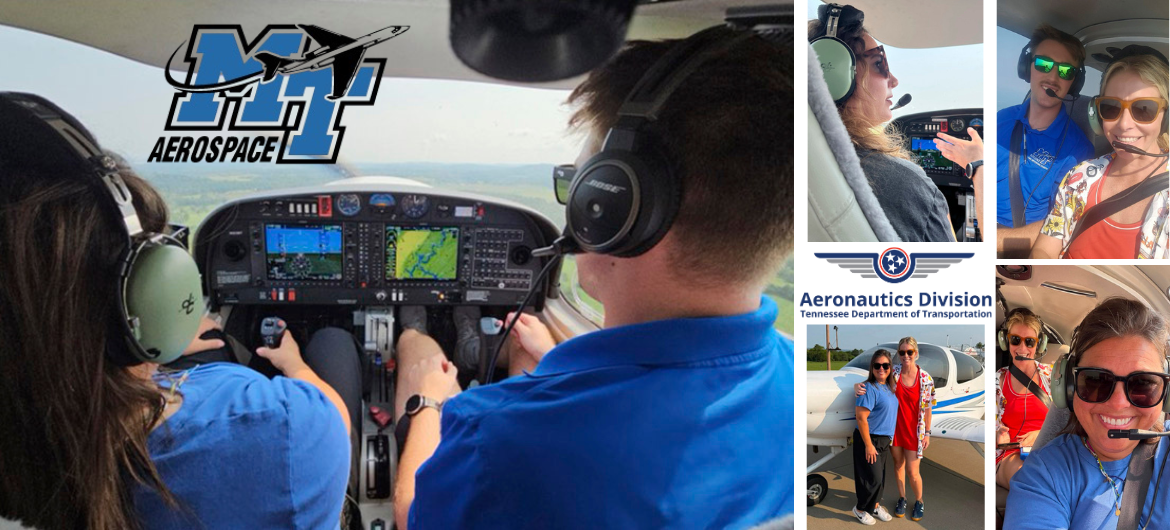
DAYTON, Tenn. — Teachers get up to all sorts of fun shenanigans during summer break, perhaps enjoying a well-deserved vacation or family road trip. Some might even board a plane to their destination. Rarely, if ever, does the plane come to them — and seldom are they in the pilot’s seat afterward.
But when East Tennessee educators Connie Jones, Kelli Lane and Kirsten Barley from Rhea County Schools and Tiffany Stinson and Paige Eakins from Dayton City Schools in Rhea County all signed up for the Tennessee Aerospace Education Workshop, that’s exactly what happened. And this wasn’t just a joy ride.
Every year, teachers from across the state gain graduate-level flight school credit through the Tennessee Aerospace Education Workshop, a partnership between Middle Tennessee State University’s Aerospace Department and the Tennessee Department of Transportation’s Aeronautics Division dating back to 1961. It is the longest continuously running aerospace education workshop in the U.S.
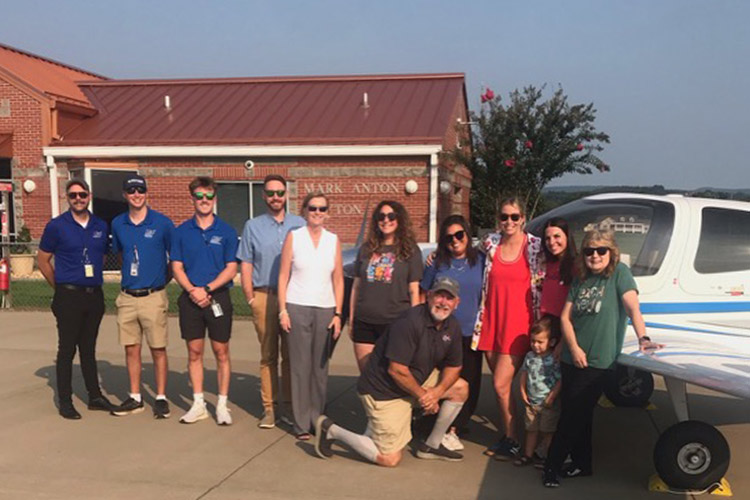
While a portion of the workshop is web-based and asynchronous, flying a plane for the first time requires boots on the ground — or in this case, the air. Having this cohort of teachers hailing from school systems within the same county provided a unique opportunity.

“Rather than have all five of those teachers travel to Middle Tennessee to take their Discovery Flight, MTSU Aerospace Department Chairman Dr. Chaminda Prelis suggested that we fly to them,” said Paul Craig, an aerospace professor who is also an alum of the workshop. “Our decades-long partnership has a new twist this year. TDOT funded the discovery flights, while MTSU funded the flights over to Mark Anton Airport and return.”
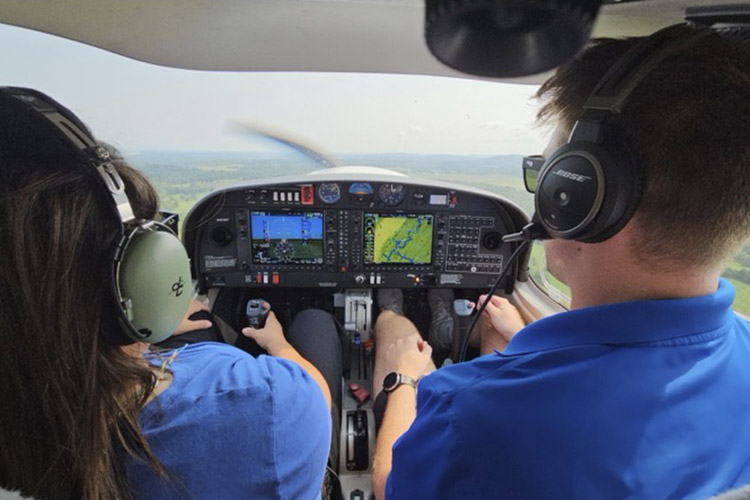
Millions of Americans have never flown even commercially, Prelis pointed out, and far fewer have flown in a small aircraft. A “discovery flight” allows teachers to go up in one of the university’s DA40 single-engine trainers with a senior flight instructor.
Accessibility played a role in the decision to meet teachers on their own turf.
“I wanted to make sure everyone had an opportunity to experience this,” said Prelis, who leads an MTSU Aerospace Department recognized as among the best in the nation while educating more than 1,400 students to become pilots and aviation professionals. “Now they get to experience it personally. It gives them an idea of what it feels like from a student perspective. … “Our mission is to get people excited and energized.”
Depending on the flight instructor’s comfort level, teachers may even steer the craft.
MTSU flight instructors piloted the university’s planes to Mark Anton Airport in Dayton in late July. The teachers, accompanied by Amie W. Lonas, Rhea County director of schools, were waiting.
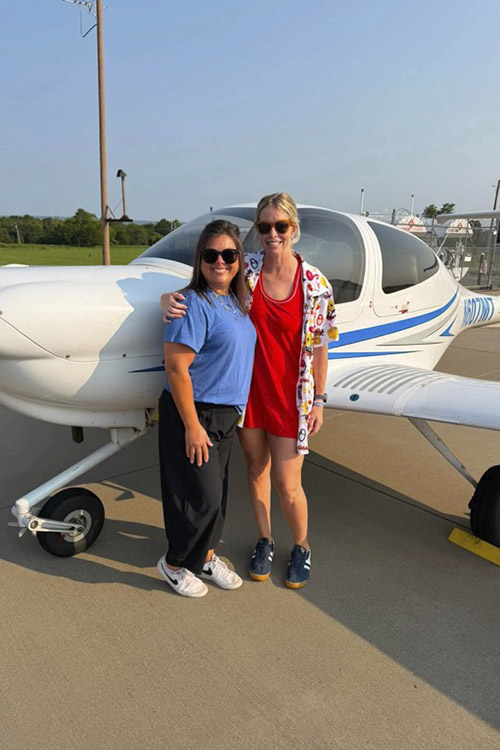
“These opportunities strengthen teacher knowledge while helping students connect classroom learning to real-world opportunities,” said Lonas. “Institutional partnerships are essential to providing teachers with meaningful opportunities for professional growth and continuing education, particularly in rural districts where access may be more limited. The Tennessee Aerospace Education Workshop is an excellent example, providing hands-on learning and exposure to aerospace education and career pathways.”
For the teachers, this memorable experience opened up a world of educational opportunities to share with students.
“Our school looks really cool from the air,” said Rhea Central Elementary educator Connie Jones, calling her first time steering a plane “fun, but a little nerve-wracking.”
“I totally get why there’s so much training. It’s a lot to pay attention to.”
The experience was a great icebreaker on the first day of school. “We’ve had people go, ‘That was really cool. Did you really fly a plane?’”
Jones is bringing what she learned back to her classroom. She plans to incorporate aerospace into her STEM (science, technology, engineering and math) lessons and introduce her students to the wide variety of careers in the field.
“There’s so many I never even thought of,” said Jones. “Drone piloting, air traffic control, airplane mechanics.”
One goal of this partnership is to make aerospace education accessible. By putting teachers in the cockpit, the Tennessee Aerospace Education Workshop is doing exactly that.
— Cat Curtis Murphy ([email protected])




NO COMMENT