
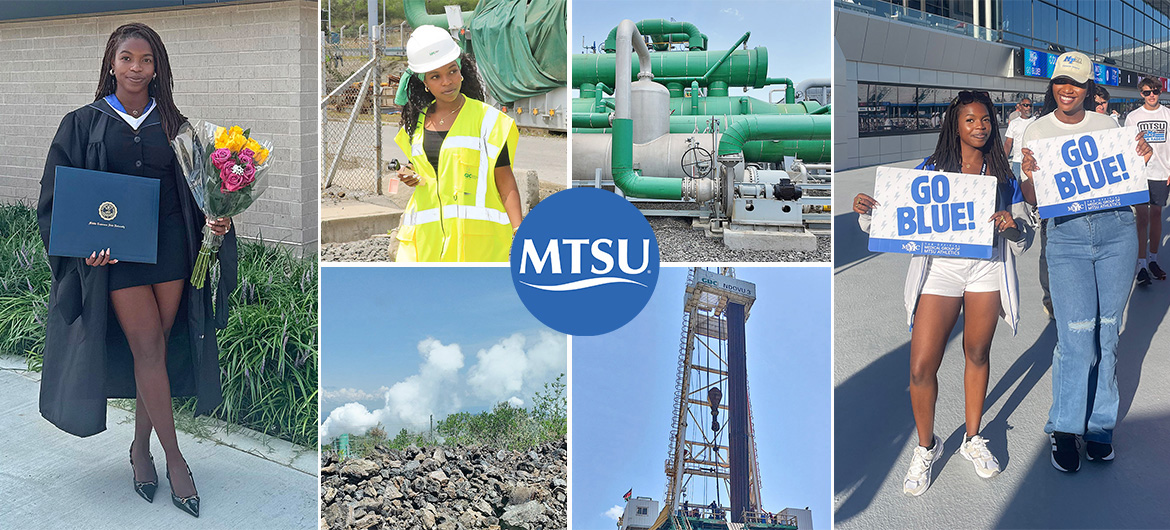

MURFREESBORO, Tenn. — Years before she arrived at Middle Tennessee State University, Nyasaina Kwamboka (nee-yah-sayee-na kwam-boh-kah) found herself captivated by the hydroelectric dams, wind turbines and renewable energy systems she encountered growing up in Kenya.
As MTSU celebrated its summer graduates on Saturday, Aug. 8, Kwamboka’s childhood curiosity culminated in a Master of Arts in International Affairs alongside a year of research focused on how energy policy shapes communities around the world.
The Kenyan native completed the degree in an accelerated timeline while maintaining a 4.0 GPA. As a graduate assistant in the Department of Political and Global Affairs, she conducted research on geothermal energy and human security, collaborated with faculty members across disciplines and continued leading the nonprofit organization she founded before arriving at MTSU.
Curiosity spurs interest in environmental, social issues
“As an economist with an environmental research background, my first intention was to pursue a master’s in energy and the environment,” Kwamboka said. “What I love about the MAIA program is the freedom to pursue your discipline of interest as it applies to international affairs.”
That curiosity first took root during childhood visits to hydroelectric power dams and through everyday experiences on her family’s farm, where solar energy, biogas and other renewable technologies were part of daily life. As Kwamboka continued her education, her interests expanded from how energy is produced to how energy decisions influence economic development, environmental sustainability, public health and international relations.
Before enrolling at MTSU, Kwamboka founded the African Environmental Youth Advisory, a nonprofit organization that promotes environmental education and collaboration between researchers in Africa and the United States.
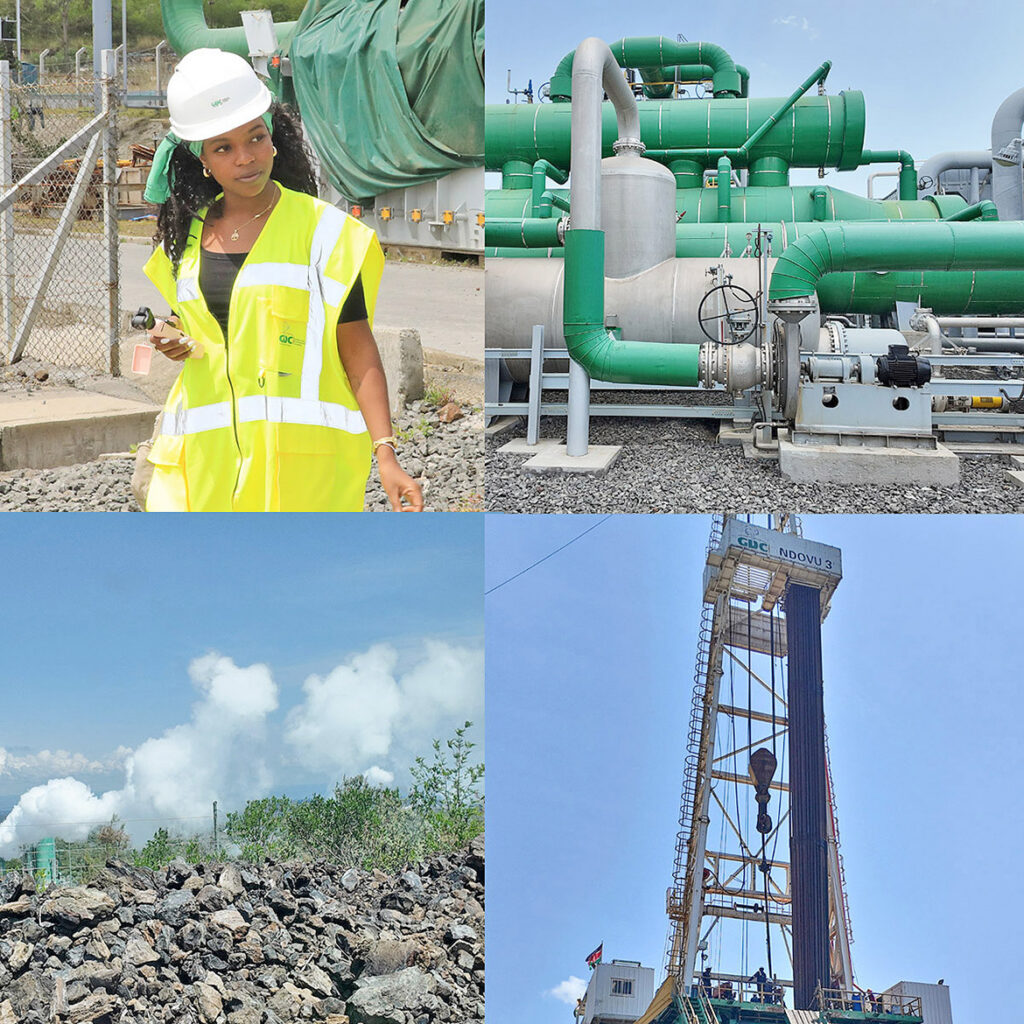
She and her team have completed field research at wind and solar energy stations, geothermal development projects, mangrove restoration, and mining sites, collaborating with local engineers and other leaders.
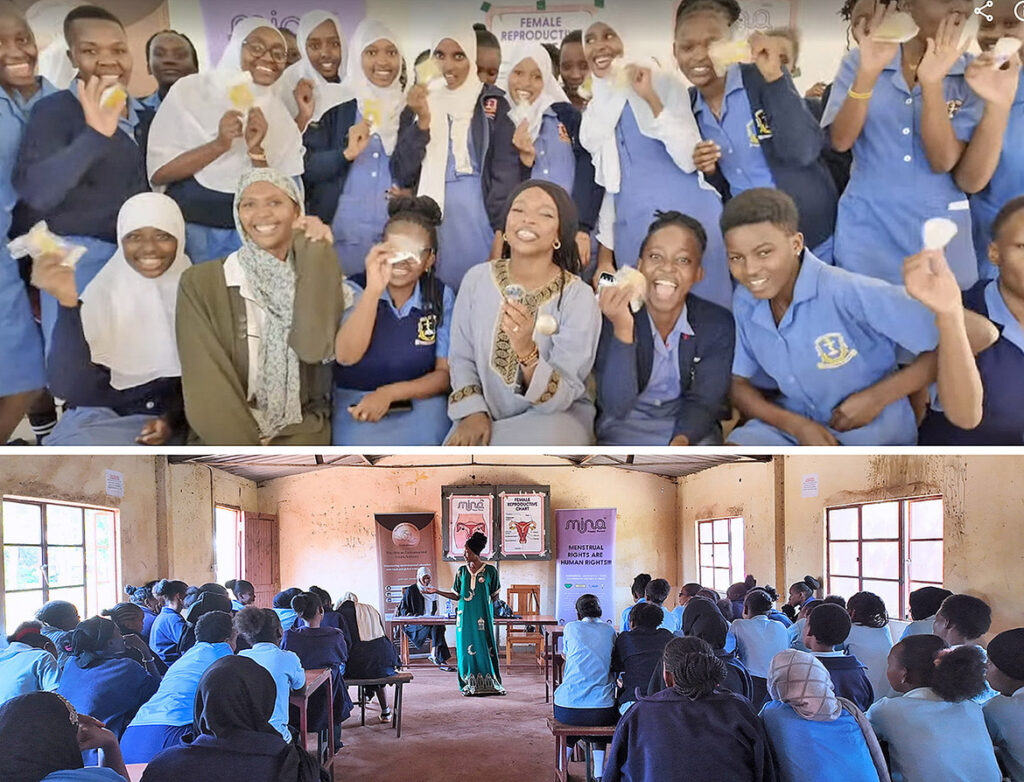
Through one of its initiatives, the organization has also helped hundreds of young women in rural Kenya access reusable menstrual products, allowing them to remain in school while reducing waste from single-use products.
MTSU takes career pathway to ‘next stage’
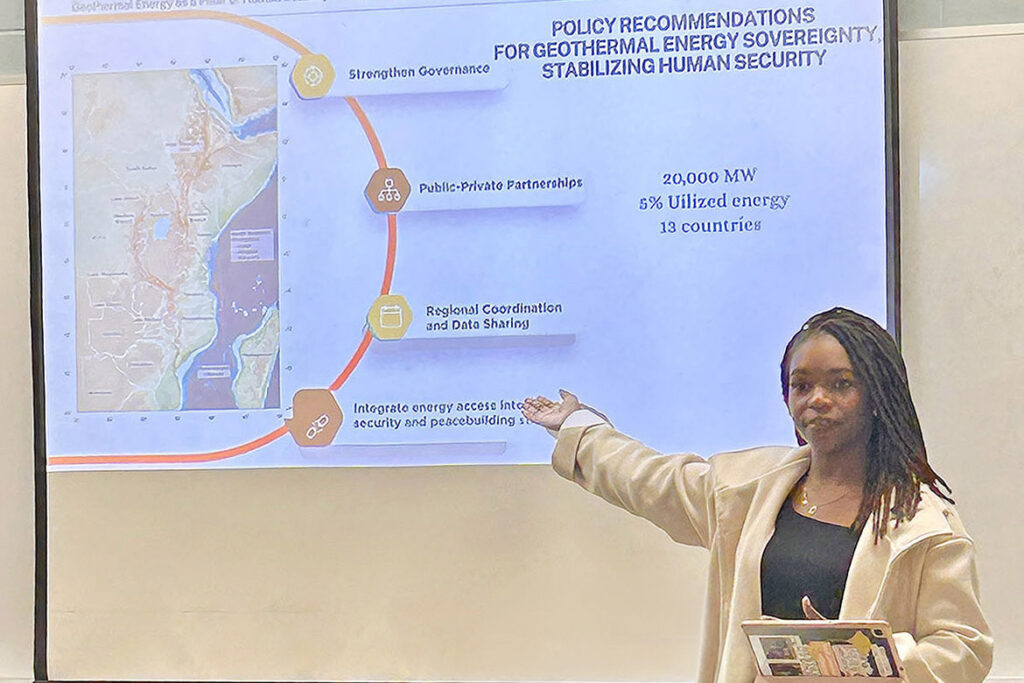
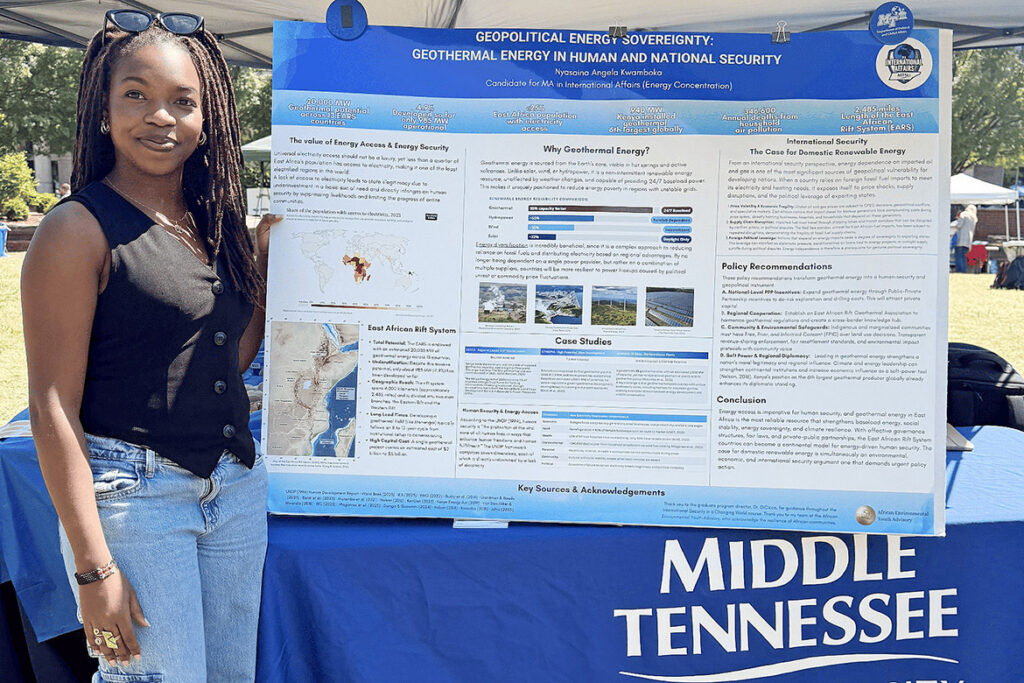
At MTSU, Kwamboka focused her graduate research on advancing geopolitical energy sovereignty and human security through geothermal energy in East Africa’s Rift Valley by examining how renewable energy development intersects with economic growth, environmental stewardship and public policy.
“The East African Rift System contains an estimated 20,000 megawatts of geothermal potential, yet only about 5% has been developed,” Kwamboka said. “This research is important because it demonstrates that energy is about how countries balance economic development, environmental stewardship, energy security, biodiversity conservation and international investment, which ensures that the needs of civil society are met with the necessary electricity access.”
Her research culminated in a white paper, formal presentation and research poster presented during MTSU’s Earth Day celebration. Kwamboka was also selected to serve on the College of Liberal Arts Student Advisory Committee and collaborated with faculty members on interdisciplinary research projects.

One of those collaborations paired Kwamboka with Christabel Devadoss, professor of geography, on a research project examining rural communities in the American Midwest. Kwamboka assisted with qualitative data analysis, interview coding, mapping and preparation of a forthcoming peer-reviewed book chapter.
“Nyasaina is an exceptional researcher and has contributed to an academic book chapter in a peer-reviewed book,” Devadoss said. “She has also assisted extensively in a large-scale National Science Foundation-recommended research project over the past year, writing reports, conducting qualitative data analysis, transcribing and coding interview data, and creating maps on related climate issues.”
Those experiences reinforced a principle that guides her work.
“People who have lived in the same community for decades could identify environmental changes that satellite imagery or science alone cannot define,” Kwamboka said. “The triangular interaction between civil society, scientific research, and policymaking is incredibly important.”
With her master’s degree complete, Kwamboka is looking ahead to the next stage of her career.
“My goal is to work at the intersection of energy, economics, data, environment, climate finance, research, or public policy,” Kwamboka said. “And I am always motivated to work so that I may pour back into my community too.”
— Mike Davis ([email protected])




NO COMMENT