
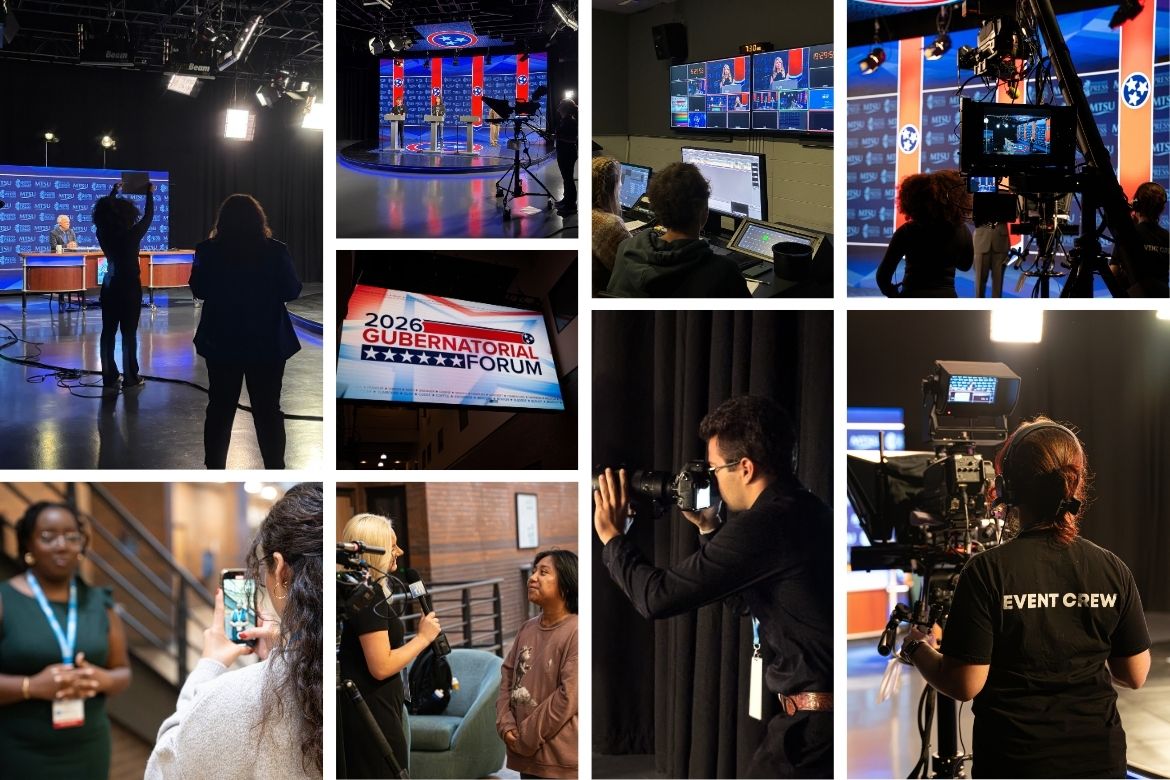
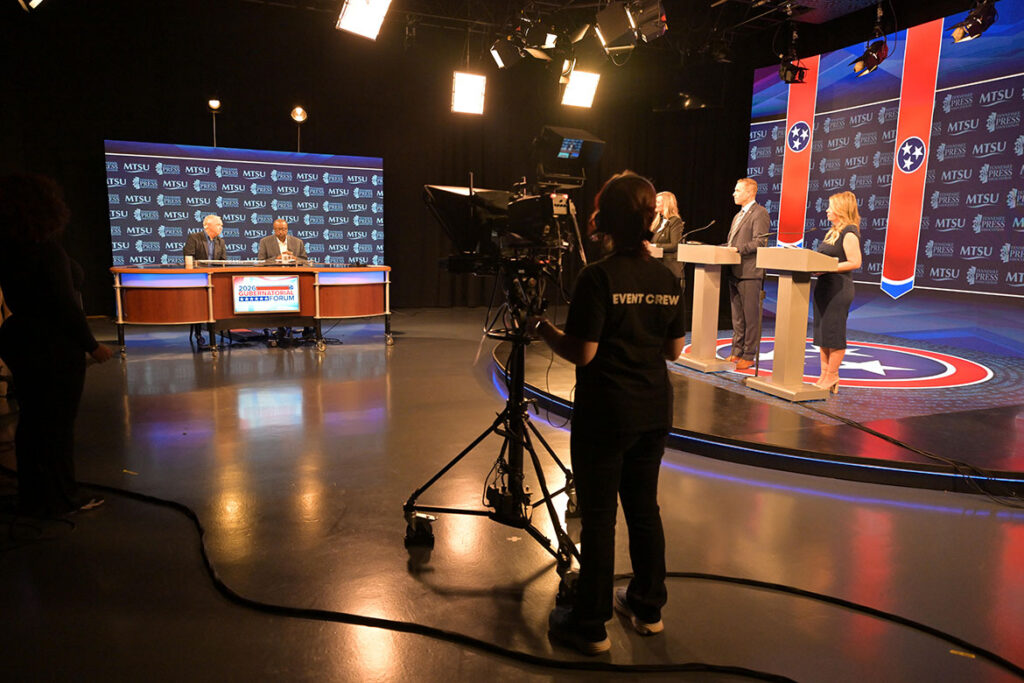
MURFREESBORO, Tenn. — When Middle Tennessee State University recently hosted a gubernatorial forum in its television studio, students from the Scott Borchetta College of Media and Entertainment took on nearly every aspect of the production, putting their classroom skills to work in a live broadcast environment.
From motion graphics and lighting to cameras, stage management and journalism, students put their skills to work throughout the live event, presented by MTSU and the Tennessee Press Association. Students helped create the visual experience, prepare the studio, operate cameras, manage the stage and control room, support audio and capture the event through photography, journalism and social media coverage.
For video and film production student Cali Dickey, serving as technical director meant making sure the production was ready before airtime and that every video source was selected at the right moment during the broadcast.
“My first responsibility as technical director was to make sure all the cameras were framed correctly and set up,” Dickey said. “Then, during the livestream, I had the responsibility to make sure the right sources were selected at the right time according to the director.”
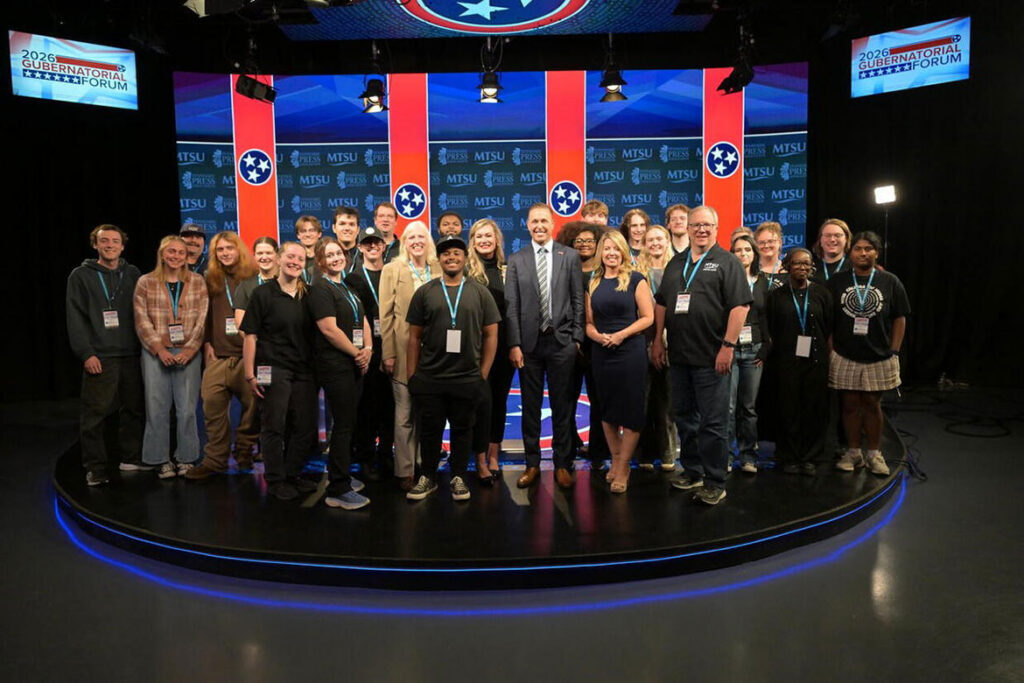
Dickey worked alongside director Curt Casassa, an adjunct media arts professor, in the days leading up to the forum, preparing the equipment and making sure the correct sources were programmed into the video switcher.
“The production runs smoothly when there is pre-production done that gets everyone on the same page to run the show smoothly,” Dickey said. The forum was Dickey’s first live production at that scale.
In addition to serving as technical director during the broadcast, Dickey helped with lighting during pre-production, gaining a broader understanding of the coordination required to bring a large production together.
“It takes a lot of people and a lot of components to run a show like this that not everyone knows about,” Dickey said. “This experience encouraged me about moving forward as live production being my career path. Technical directing is a nerve-racking but fun job. The best part is doing my job with my team, though!”
Managing a host of moving parts
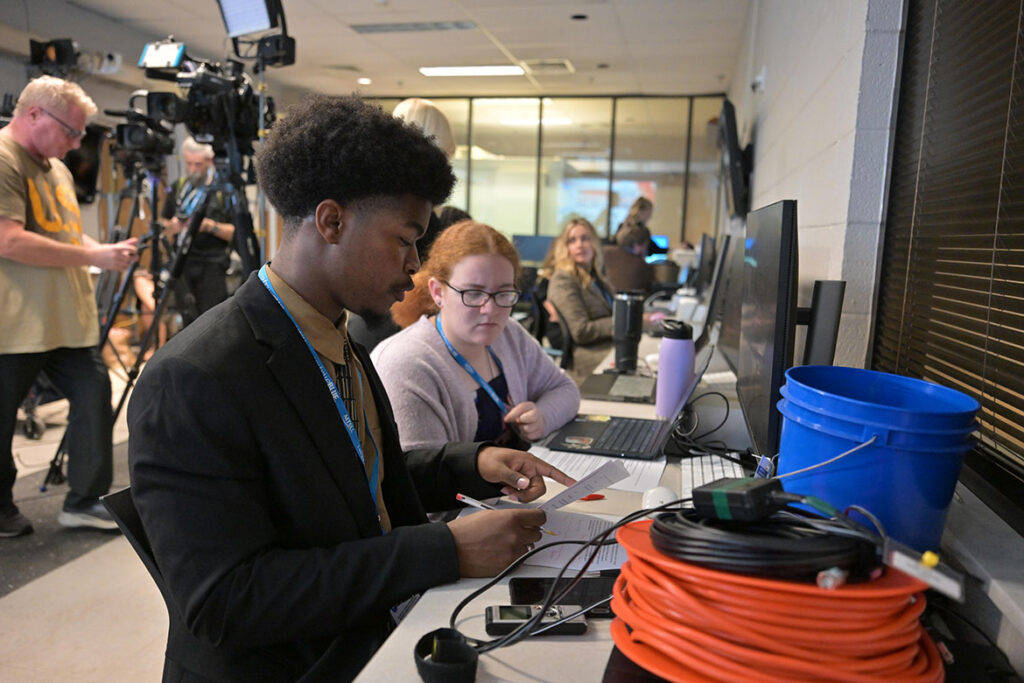
Video and film production student Sabriya Mosby served as a stage manager, acting as the connection between the control room and the studio floor. Her responsibilities began well before the broadcast, from marking camera and talent positions with Casassa to making sure crew members had what they needed and everyone was prepared.
During the production, Mosby communicated cues to those on set and helped keep the show on schedule.
“Since the director is in a separate room, the stage manager really has to be the eyes and mouthpiece of the director in the studio,” Mosby said.
The final minutes before going live brought the greatest pressure.
“I think people underestimate just how many moving parts there are in a production of this scale,” Mosby said. “More moving parts mean more people, and more people means more questions, conversations and responsibilities coming your way all at once. At one point, I genuinely had five conversations going on simultaneously, no exaggeration!”
For Mosby, the experience reinforced the importance of preparation, communication and teamwork while giving her the kind of hands-on experience she hopes to build on in a career in live production.
“There’s an adrenaline that comes with live production that I absolutely love,” she said.
‘It was a really proud and exciting moment’
The work behind the scenes also included creating the visual environment audiences saw throughout the broadcast.
Motion design students in Aiken Pierce’s class developed the opening, broadcast and set graphics, combining individual concepts into a cohesive design for the studio.
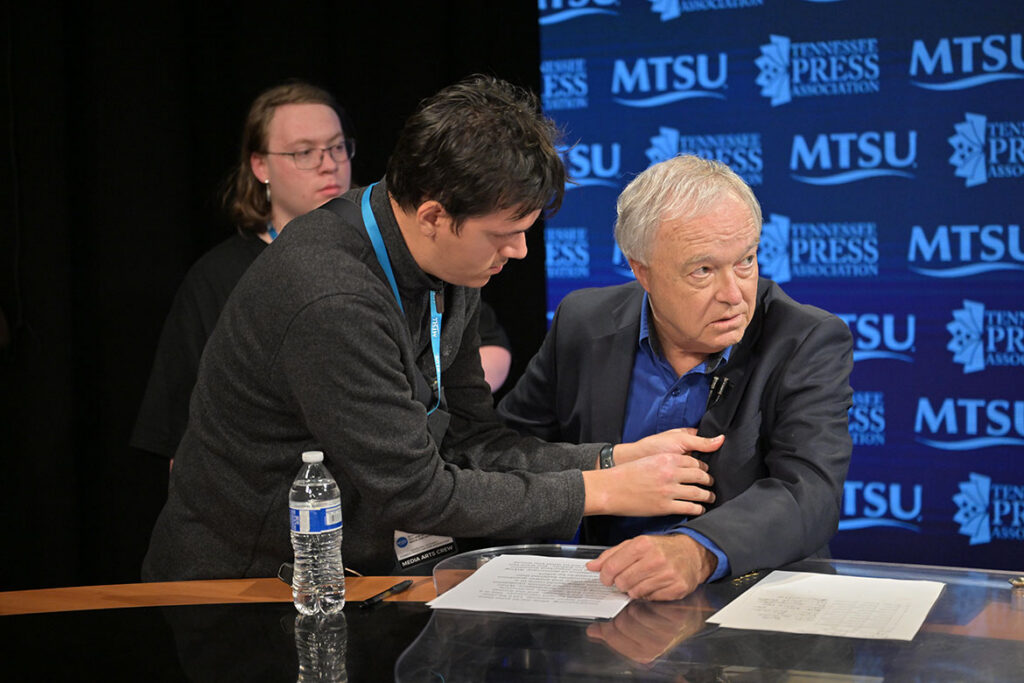
Student Mari Leonard was a part of the team who designed the main backdrop behind the candidates and she animated the flowing vertical banners harkening to the Tennessee state flag amid a blue-themed step-and-repeat background featuring logos for MTSU and the Tennessee Press Association. The work required students to think beyond a traditional screen, creating visuals that would move naturally across the studio’s LED wall, floor and ceiling.
“Designing for an extended reality space was a particular challenge as we had to ensure the visuals flowed naturally across the LED wall, floor and ceiling so that the stage had real depth on camera,” Leonard said.
Students began by developing their own concept art before meeting with Pierce to combine their ideas. They divided the work and regularly shared progress and feedback to refine the graphics and make adjustments along the way.
Because the graphics were part of a live forum, Leonard said the animation needed to add movement without distracting from the people onstage or competing with the studio lighting. She created and tested animation loops using Adobe Illustrator and After Effects.
“We were all a bit nervous leading up to airtime, but seeing the final environment on the live feed just absolutely looked good,” Leonard said. “It was a really proud and exciting moment for the team and a real pleasure to have been part of it.”
Students in Robert Hickman’s lighting class lit the set, while Casassa directed the production with video and film production students serving as crew.
Faculty and staff members Curt Casassa, Bob Gordon, Mike Forbes and Charles Scudder helped support the production. Student contributions extended beyond the studio.
Student media provide coverage
Students handled event photography and live social media coverage. Journalism students in Matthew Leimkuehler’s class wrote stories for distribution through the Tennessee Press Association, while student media outlet Sidelines covered the event and Middle Tennessee News students interviewed attendees in the public viewing room. Both outlets joined representatives from multiple external media outlets to cover a post-forum press availability with the moderators and two of the three candidates.
In addition, Sidelines Managing Editor Jaeda Jackson briefly joined forum moderators Ken Paulson of the Free Speech Center at MTSU and Otis Sanford, professor emeritus of journalism at the University of Memphis, to kick off the forum with the first question about affordability to the three gubernatorial candidates, Jerri Green, David Hatley, and Lauren Pinkston, following the candidates’ opening statements.
Together, students from across the college brought their skills into one large-scale production, collaborating across disciplines and taking responsibility for the many details required to make a live event happen.
For Dickey, Mosby and Leonard, the experience offered an opportunity to work alongside their peers, solve problems in real time and see how their individual contributions fit into a much larger production.
— Stacey Tadlock ([email protected])




NO COMMENT