
MURFREESBORO, Tenn. — Middle Tennessee State University biology professor and researcher Liz Barnes’ mission to improve communication and trust between scientists and the larger community shows no signs of slowing, most recently with two published articles in a top scientific journal detailing her research-backed approach of “conflict-reducing” science communication to better convey polarizing science topics.

“I’m always looking to get the word out about how the scientific community can reduce conflict and build trust with the wider public, and these publications are a great way to do that,” said Barnes about the work she squeezes in between million-dollar research projects, the multiple biology courses she teaches and the lab on campus she oversees.
“Our work leaves me hopeful about future generations and our ability to bridge divides and have better conversations about science,” Barnes said. “Students really want to reach across the aisle on contentious issues in an effective way and reduce the combative norms we have seen in recent public discourse on science.”
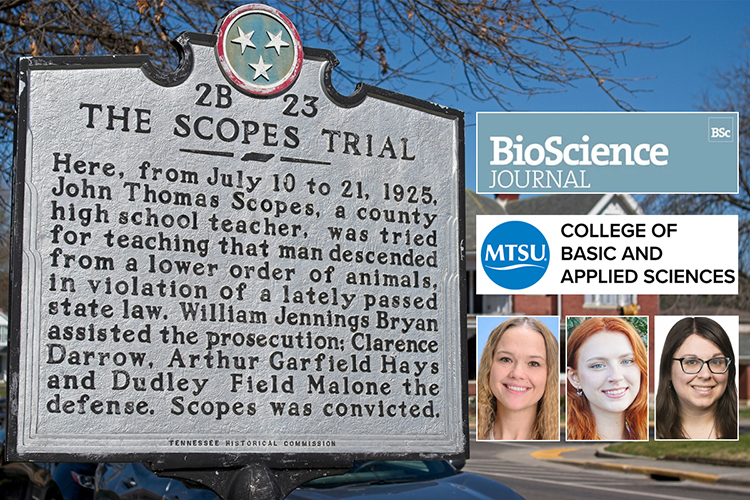
Barnes’ articles not only detail this approach but also tie into one of science’s many animating debates and the first topic that spurred Barnes’ science communication work: evolution. They were released in time for this year’s 100th anniversary of the Scopes Monkey Trial, which adjudicated whether Tennessee teacher John Scopes could legally teach human evolution in public school and put the separation between church, state and academic freedom into the national spotlight.
Research-backed hope for science communication
Barnes’ recent articles were published in BioScience this summer, the journal considered one of the preeminent for overviews of current biology research.
Barnes’ first publication details her decade of work developing a model of “conflict-reducing practices” in evolution education with long-time collaborator Sara Brownell, a biology education researcher at Arizona State University.
“Our model encourages instructors to practice what we call ‘religious cultural competence,’ which includes respectfully engaging with students of faith, gaining a self-awareness of their own biases, connecting with these students in ways that invite connection and reflection, presenting examples of evolutionary biologists who are people of faith, discussing how learning evolution does not require rejecting a belief in God, and others,” Barnes said.
Their research shows this instruction is consistently an effective, non-alienating approach that increases evolution acceptance among religious students and decreases the “perceived conflict” between religion and evolution among non-religious students.

“We’ve tested these practices among tens of thousands of students in hundreds of classrooms around the nation,” Barnes said. “We know this works, and we are slowly moving and encouraging instructors to adopt this approach.”
Barnes put together her second BioScience publication with Erin Rowland-Schaefer, assistant professor of biology at the University of Nebraska at Omaha, which identified a barrier to the conflict-reducing approach: the attitudes of some biology instructors.
“Of the 217 biology instructors we surveyed, most did not discuss the way religious beliefs and evolution acceptance can coexist, and half did not think a student could fully accept evolution if they thought a higher power was involved,” Barnes said. “Conflict-reducing practices are effective, but instructors are not using them, and we concluded with calling for future research to understand why.”
Despite remaining hurdles such as these, however, Barnes and her colleagues, such as Rowland-Schaefer, remain optimistic — Rowland-Schaefer motivated by her own experience with a conflict-reducing instructor.
“I went to college fully not accepting evolution, coming from a conservative religious upbringing,” said Rowland-Schaefer, who had spent a previous year at MTSU as Barnes’ postdoctoral student. “It wasn’t until a professor at my Christian college sat us down during undergrad and explained that, first, there are Christians who accept evolution and, second, there’s a middle ground where we can exist without sacrificing either of our spiritual or scientist identities that I realized I could.”
Barnes also highlighted the important, encouraging advances society has made in science communication overall.
“First, let’s acknowledge we are no longer living in a time when it’s illegal to teach human evolution like it was for John Scopes,” she said. “In addition, we are living in a time where we know it is possible to effectively convey these scientific topics like evolution to students of faith and non-religious students alike. We continue to observe through our research an openness to science communication that is more about building trust and relationships, particularly from our students, and they are the future of science communication.
“And this ‘trust-centered’ approach is not just applicable to evolution. It’s a model that we have applied effectively to other contentious scientific issues such as climate change and vaccinations. That continues to give me hope.”
From ‘trust-building’ skeptic to believer
When J. Hayes stepped into Barnes’ General Biology 1 course as a freshman three years ago, she had never heard of a “trust-centered” science communication approach.
“I was definitely in the ‘deficit approach’ camp,” said the now Ph.D. student in biology education within MTSU’s Math and Science Education program. “I thought anyone who disagreed with me about a controversial issue, like climate change, must simply not know the facts that I know, and if I could only break down all the science for them or show them a pretty infographic, they’d certainly be convinced to agree with me.”
It was successfully applying Barnes’ approach when discussing climate change with her father that cemented Hayes’ belief in the model.

“I also got to witness my classmates process it (the approach) at the time,” Hayes added. “We were all fairly receptive to her teaching, and findings from some follow-up interviews she has conducted with students after they completed her course suggest that they experienced longer-term impacts similarly to me.”
Hayes said it is safe to say she “caught the bug” for science communication, and it has largely informed her academic trajectory.
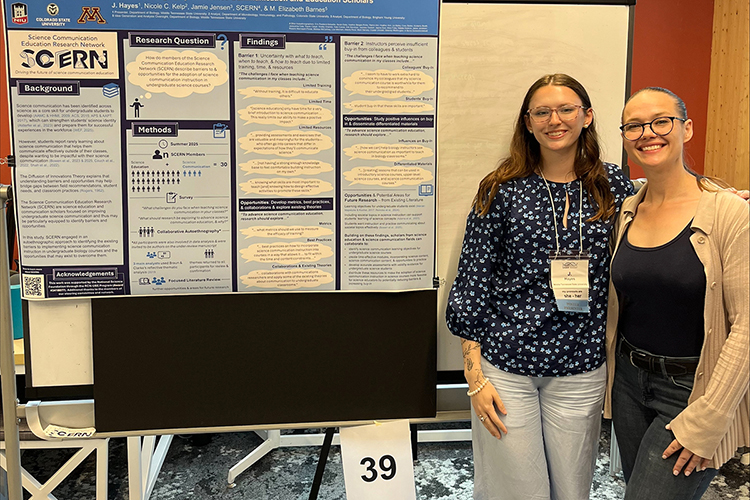
“This fall I transition from an undergraduate researcher to a Ph.D. student in Dr. Barnes’ Social Perceptions of Science Lab, and I’m continuing my work as the community organizer of SCERN.” SCERN is an acronym for the Science Communication Education Research Network, a grant-funded project spearheaded by Barnes that connects dozens of science education researchers across the country.
Hayes, too, feels optimistic about the growing science communication education field and other students’ interest in it.
“I see our efforts and I believe they have an impact, and I also think … this influence can then have a ripple effect on changing society at large. We may be focused on making change in education, but students have the power to use their education to change the world, just through their everyday conversations.”
Learn more about getting involved in science communication education by reaching out to Barnes at [email protected] about opportunities in her lab. Prospective graduate students can also learn more about the Biology Education Concentration within the Mathematics and Science Ph.D. program at https://tinyurl.com/mwm2ye36.
Additionally, Hayes welcomed anyone to reach out to her at [email protected] with questions.
— Stephanie Wagner ([email protected])




NO COMMENT