
By Katelynn Liedtke
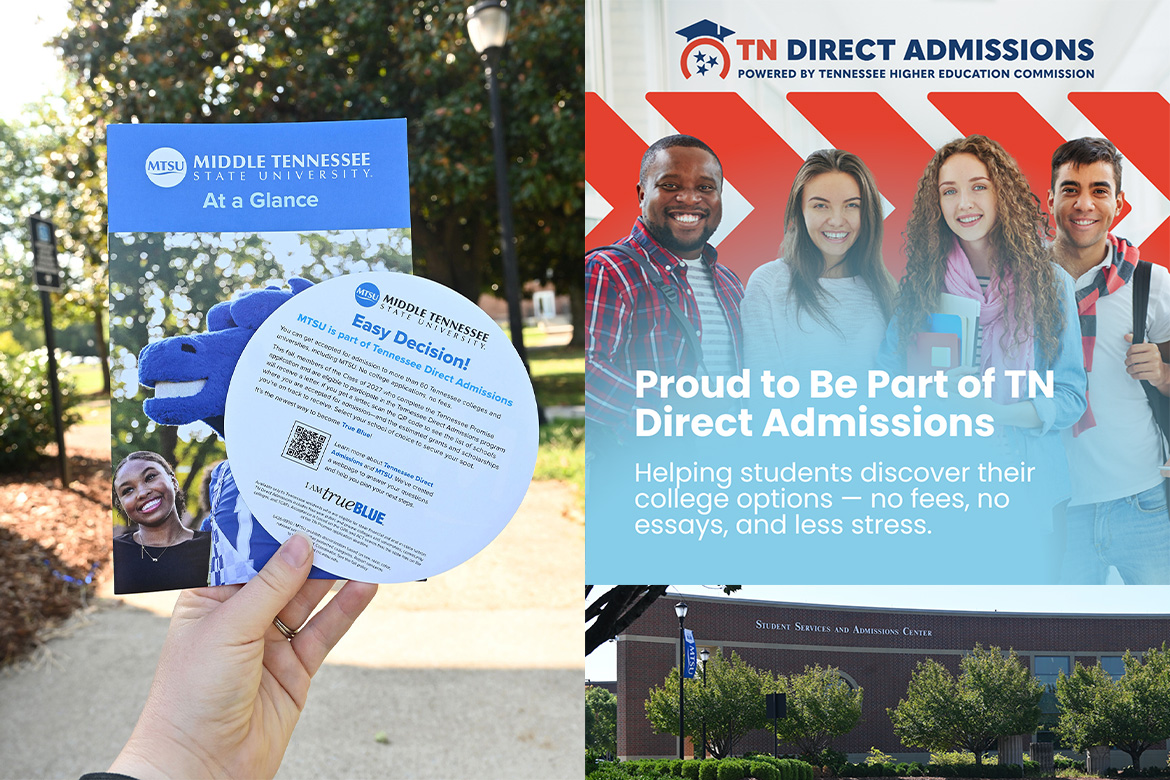
MURFREESBORO, Tenn. — Starting this fall, Middle Tennessee State University is participating in TN Direct Admissions, a program created by the Tennessee Higher Education Commission, or THEC, to simplify the college application process by not requiring a traditional long-form application or application fee.
The program started with a pilot study for the 2025-26 school year. According to the TN Direct website, the pilot program was used to determine the impact of proactively admitting students to participating colleges and providing information on the financial aid available to them. This year, MTSU is getting involved.

MTSU Director of Undergraduate Recruitment Kristen Janson said that once high school seniors complete the TN Promise application, the information will be used to inform students on what four-year and two-year colleges they have been pre-accepted to based on their academic achievement. MTSU is among more than 60 colleges and universities currently participating.
“What happens is the students fill out this Tennessee Promise application, and then starting next week, they will get letters sent to their house, they will get letters in their TSAC (Tennessee Student Assistance Corp.) portal, which is where all their financial aid is, and then their high school counselor will also get a letter,” said Janson.
Brett Gipson, THEC’s chief college access officer, and Mark Photivihok, the direct admissions project manager, said that they have been receiving very positive feedback from students, parents, and counselors about the TN Direct Admissions program.
“Like top to bottom, where the students in the middle are saying, ‘I had no idea that this many schools wanted me.’ That’s what a lot of the qualitative research that we’re getting, the quotes back from students who did their survey are, ‘I had no idea that I was this wanted,’” said Photivihok.

Photivihok said that a major goal of the program was to reach students with the potential to attend college but who had never tried because they didn’t think they would be accepted.
From the survey results thus far, Photivihok said approximately 80% of students felt more competent after receiving their letter because of the number of schools they were pre-accepted to.
Gipson also said that they have had six more universities join the program and have lost none from the pilot year, despite some hiccups during the start-up.
‘It’s accessibility’
Tennessee is the first state to combine direct admissions with financial aid, allowing students to know how much money is available to them. Gipson said that direct admissions is not a new concept and that schools have been utilizing it for 12 to 13 years in different parts of the country. While this increased enrollment and the number of students in the admissions process, they were still struggling to reach their target student audience.
“Those that they knew could be successful but for whatever reason, the culture or whatever, weren’t completing the applications and that when it got to the point of paying, like, got sticker shock,” said Gipson. “It’s not that there might not be money for them — a lot of times there was help and other things — it just put them off. It scared them.”
THEC wanted to test whether including financial aid information in the letters would make a difference.
By using the Tennessee Promise application, ACT scores, and GPAs, they could send letters with financial aid information to practically any student.
“They wanted to do about 2,500 students,” Gipson said. “We decided we would run this RCT (Randomized Controlled Trial) of 70,000 students. So, 45,000 got the letter instead of 2,500.”

After receiving their letters, students will choose from the list of schools they would like to attend and claim their spots at up to five colleges. Institutions will then reach out to the student to request any additional information needed, such as a supplemental enrollment form and ACT scores. Students will then begin their onboarding with the university like normal, without ever having to complete a traditional application.
“That is the whole point behind Tennessee Direct Admit. It’s accessibility. There are over 70,000 high school seniors in the state of Tennessee. I think in this first round, there are close to 20,000 who have already done their applications and will start making their selections this month. We are really excited about the possibility of it,” Janson said.

Janson said that the ease and accessibility of the Tennessee Direct program can be important in reaching students who may not have access to helpful technology. Janson said many students don’t have internet at home and rely on their phones. Some college applications can be lengthy and extremely tricky to navigate on a cellular device.
“I’m very optimistic in how it’s going to go for us because to me, there’s always going to be students that don’t think they can go to college for whatever reason — whether it’s finances, whether it’s academics. I think this will just open the eyes of some of those students, especially first-generation college students whose parents did not attend a college or university,” said Janson.
Gipson said they do not see the program stopping. Once the process is finalized, the program will cost the state approximately $1 per student.
“I mean, I’m a taxpayer. If they said, ‘OK, we’re going to spend a little less than $100,000 a year to get a letter to every high school senior with specific information about where they can go and the money they can get.’ I’d say, ‘Here, I’ll give you the dollar,’” said Gipson.
Journalism major Katelynn Liedtke is a practicum student in the Office of News and Media Relations. Reach her at [email protected].




NO COMMENT