

The family of the legendary Dean Hayes, who helped integrating the University, adds to his legacy with a major donation
by Bill Lewis, Drew Ruble, and Randy Weiler
The family of legendary MTSU track and field coach Dean A. Hayes recently established a permanent scholarship to honor the philosophy of their iconic patriarch and the nine original Blue Raider Pioneers of the athletic department of the late 1960s and early 1970s.
Over nearly six decades at MTSU, Hayes became one of the most accomplished and respected figures in collegiate athletics as well as in national and international track and field.
But his impact extended far beyond the track.
In fact, he single-handedly forged the path for integrating MTSU’s athletic department, famously awarding Jerry Singleton the first varsity scholarship to go to a Black athlete at the University. Singleton was one of the original Pioneers, along with Art Polk, Lonnell Poole, Terry Scott, J.W. Harper, Raymond Bonner, Ed Miller, Mary “Beanie” Secrest, and Willie Brown.
“Dean Hayes wasn’t just a coach—he was a mentor, an educator, and a trailblazer,” MTSU President Sidney A. McPhee said. “This endowment embodies his lifelong commitment to providing access to education to all and opening doors to success in life, and we’re honored his family and friends have chosen to continue his legacy in this meaningful way.”

Hayes, the Blue Raiders’ legendary track coach of 57 years, died in January 2022 at age 84.
The endowment was made possible through a generous gift from his beloved wife and daughters—Janice C. Hayes, also a former faculty member at MTSU, and their children, Kara L. Hayes and Erin E. Hayes.
“Our father poured his heart into MTSU and believed deeply in education, community, and opportunity,” Kara and Erin Hayes said in announcing the gift.
This new endowment supports awards for student-athletes and their families affiliated with MTSU’s Blue Raider athletic program, with a particular focus on former athletes returning to complete their degrees.
Additional awards may support graduate study, athletic competition on the international stage, and emergency grants to student-athletes facing unforeseen financial hardships.
“Words can’t express what Dean Hayes has meant to MTSU, the MTSU track and field program, international track and field, and thousands of people whose lives he has impacted through his work,” Director of Athletics Chris Massaro said.
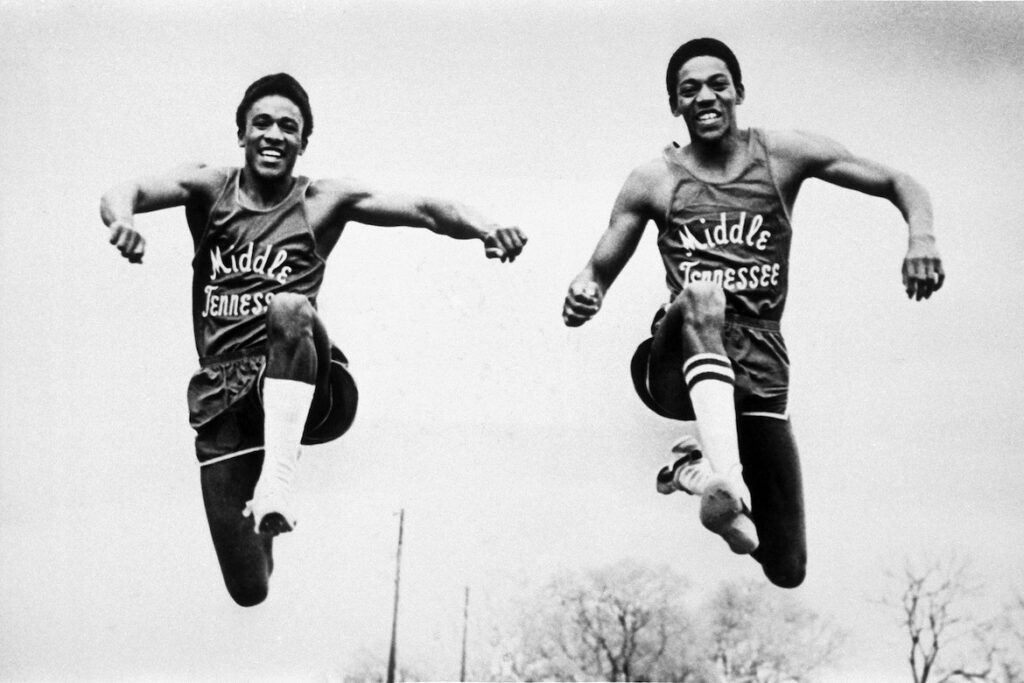
Sporting Legend
Hayes earned his Bachelor of Arts degree at Lake Forest College in Illinois, where he competed in the 800 meters, the long jump, and the triple jump. He was an NCAA qualifier in the triple jump.
After earning his master’s degree in education at Northern Illinois, Hayes began his coaching career at the high school level in Chicago, where he coached for three years followed by one year in Minneapolis.
He then jumped to the collegiate ranks at his alma mater, Lake Forest, before coming to MTSU in 1965.
Hayes initially served as the head coach of MTSU’s men’s track and field and cross country teams before also taking on leadership of the women’s program in 1978.
Throughout the recent history of MTSU track and field, there were two constants—Hayes and a legacy of championship performances.
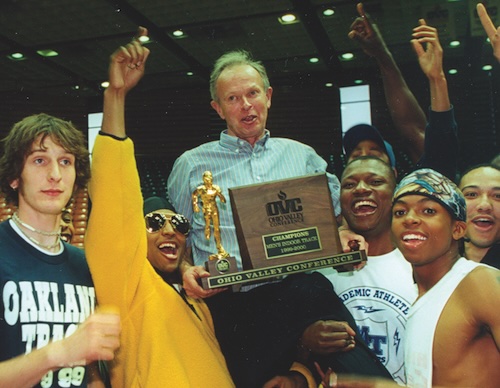
He earned 34 Coach of the Year honors—four in CUSA, 15 in the Sun Belt, and 15 in the OVC, which included 10 in a row from 1977 to 1986.
Following the 1981 season, the Division I Track and Field Coaches Association (TFCA) voted Hayes the NCAA Outdoor Coach of the Year. Hayes then served as TFCA national president in 1982–83.
Hayes held leadership roles in U.S. national and international athletics, including the Olympic Games and World Championships, and served as a coach for Team Ghana. He has been inducted into the Blue Raider Sports Hall of Fame, Illinois Sports Hall of Fame, and Tennessee Sports Hall of Fame.
Fifty-two of his student-athletes earned a total of 125 All-America honors. Five became national champions six times, and 24 competed internationally in the Olympic Games, World University Games, World Championships, Goodwill Games, Pan-American Games, and African Championships.
Hayes’ most successful student-athletes competed in the NCAA triple jump, an event in which Hayes specialized. He coached NCAA champions Tommy Haynes (1974) and Barry McClure (1972, ’73), as well as NCAA high hurdle champion Dionne Rose (1994). In 2003, he coached national champion Mardy Scales, who won the 100-meter dash. His most recent national champion was Kigen Chemadi, who captured the 3000-meter steeplechase in 2021.
Because of Hayes’ international success, numerous international athletes over the years sought out MTSU as their college of choice.
A Champion for Change
MTSU’s track and soccer stadium is named for Hayes, but the greatest monument to his accomplishments is not a structure; it’s the diversity of the students who come to the University.
When Hayes first stepped onto the campus in 1965, almost all of the 5,500 students enrolled were white.
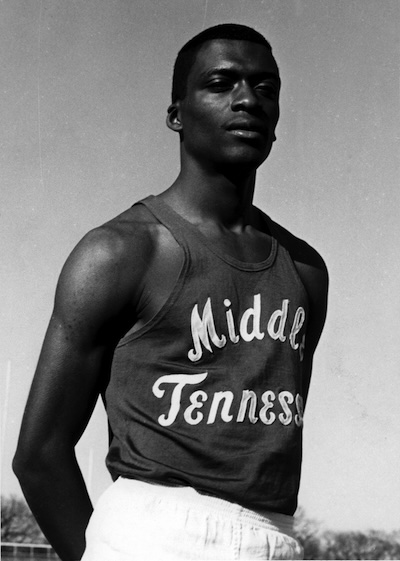
Olivia Woods, the University’s first Black student, had graduated. A few Black athletes played sports, but no scholarship athlete competing on a varsity team was Black.
The campus offered no Black fraternities or social organizations. A plaque with a likeness of Confederate general Nathan Bedford Forrest, the first grand wizard of the Ku Klux Klan, still stood on campus.
As he took on the task of recruiting the best athletes possible, Hayes unconsciously took on another role—as an agent of social change who participated in breaking the color barrier.
“When I got down here [from Chicago], they were still fighting the Civil War,” Hayes recalled during a 2003 interview for the MTSU Oral History Collection, archived at the Gore Center. “I blundered through it,” he said of the process of integrating his teams. “It wasn’t much of an issue for me.”
Decades later, the campus looks like America. More than 15% of students at MTSU are Black. Others are Hispanic, Asian, Native American, or members of other minority or ethnic groups.
It all started with a phone call Hayes made soon after being hired as MTSU’s track coach.
The young man who answered the phone, Jerry Singleton, became the first Black varsity scholarship athlete at MTSU.
Others followed as their quietly competitive coach made more phone calls.
When those athletes arrived on campus, so did their girlfriends, sisters, brothers, and friends.
“I never thought much about it because I didn’t do it on purpose, but it changed the complexion because it allowed minorities to have acceptance on campus,” Hayes once told MTSU magazine. “It has consequences you don’t think about.”
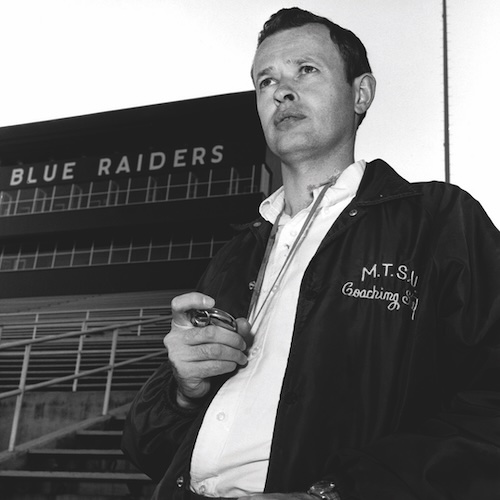
Hayes’ reputation for competitiveness (he was known for throwing away second-place trophies) and fairness attracted other Black athletes to MTSU.
Black athletes felt welcome in Murfreesboro, but trips to events deeper into the post-Jim Crow South revealed a different reality.
Before road trips with his teams, Haynes, who retired as a major after a distinguished career in the U.S. Army, mapped out restaurants and motels that were known not to discriminate.
Meanwhile, times were changing with the arrival of more Black students on campus. Kappa Alpha Psi, a Greek letter fraternity with predominantly Black membership, began a chapter at MTSU.
Hayes was the fraternity’s first advisor, a fact that commonly confused later pledges who had to memorize the original members’ names. They wondered whether the white coach was really one of the chapter’s founders.
As time passed, a hound dog named Ole Blue replaced a Forrest lookalike on horseback as the University’s mascot. And one day, then-President Sam Ingram walked out of his office and took down the plaque.
“If you didn’t live through those times, I don’t know how much you’d appreciate it,” Hayes previously told MTSU magazine.
What is appreciated is Hayes’ seminal role in making MTSU the diverse environment it is today.
The new Dean A. Hayes Family Pioneers Endowment cements that legacy.

Honoring Coach Dean Hayes
“He was a champion in so many ways: as a father, mentor and role model, a world-class recruiter, and a winning coach at the highest echelons. Dean was a living legend.”—MTSU President Sidney A. McPhee
“This endowment will ensure doors continue to open for the next generation of Blue Raider Pioneers.”—Daughters Kara and Erin Hayes
“He is on the Mount Rushmore of Middle Tennessee, and not just athletics. Coach Hayes was a pioneer and an institution at MTSU.”—Chris Massaro, MTSU director of athletics
How to Give
To contribute to the Dean A. Hayes Family Pioneers Endowment or learn more, contact the MTSU Development Office at 615-898-2502 or visit mtsu.edu/give.




NO COMMENT