
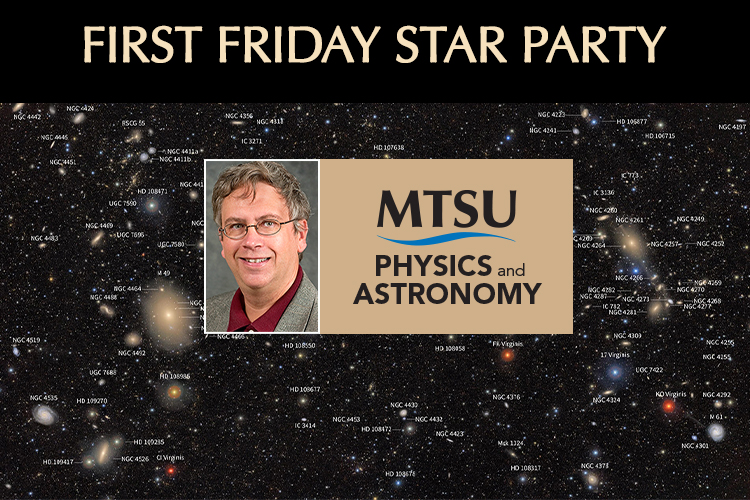
MURFREESBORO, Tenn. — Middle Tennessee State University Physics and Astronomy professor John Wallin’s discussion of “First Light on the Rubin Observatory” will kick off the fall Star Party season.
Wallin’s talk will start at 6:30 p.m. Friday, Sept. 5, in Room 102 of Wiser-Patten Science Hall.

All Star Parties are free and open to the public, and children are welcome.
The format is a 45- to 60-minute lecture followed by a telescope viewing at the nearby MTSU Observatory, weather permitting.
Typically held on the first Friday of the month during the semester, the Physics and Astronomy Friday Star Parties feature an assortment of interesting astronomy and physics topics from veteran faculty members.
“In this talk, we will explore an extraordinary new instrument for studying the cosmos —the Vera Rubin Observatory,” Wallin said. “Unlike most telescopes, which capture only a small patch of the sky at a time, this telescope will survey the entire night sky every three nights.
“Over the course of its 10-year mission, it will create an unprecedented ‘movie’ of the dynamic universe, revealing how the heavens change over time. The Rubin Observatory will detect and measure comets, asteroids, supernovae and variable stars with remarkable precision.”
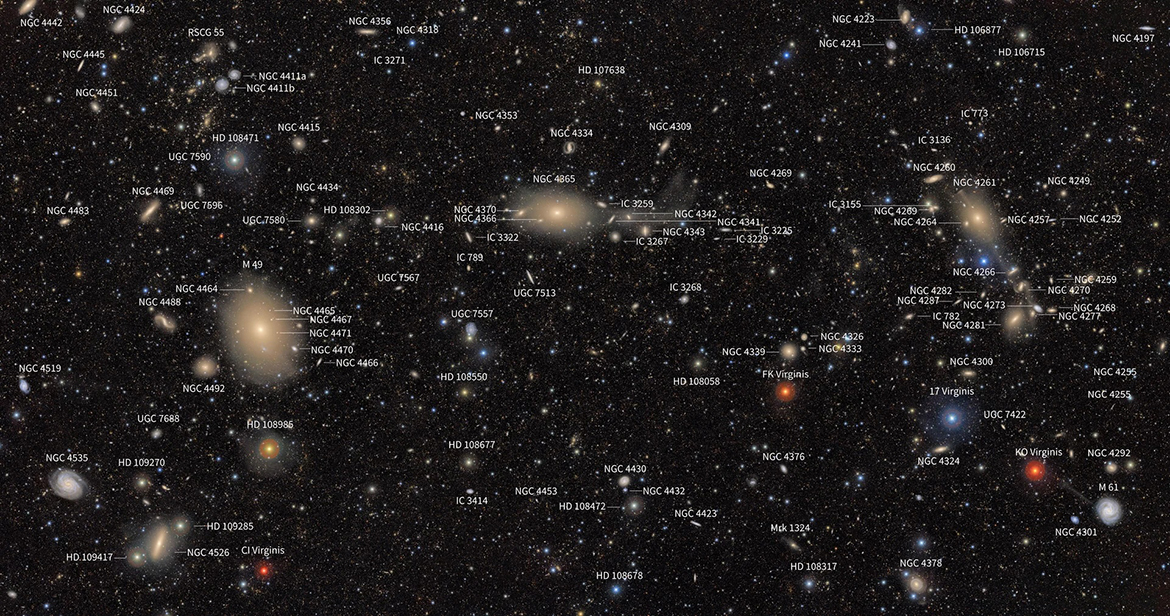
Wallin, who is director of the computational and data science Ph.D. program, said “first light occurred this summer, and we will highlight some of the earliest discoveries already emerging. Finally, we’ll consider why this telescope is poised to transform our understanding of the universe in profound ways.”
In just over 10 hours in late June, the Vera C. Rubin Observatory in Coquimbo Region, Chile, captured millions of galaxies and Milky Way stars and thousands of asteroids — a small preview of the 10-year scientific mission to explore and understand some of the universe’s biggest mysteries.
“Over the course of its 10-year mission, it will create an unprecedented ‘movie’ of the dynamic universe, revealing how the heavens change over time. The Rubin Observatory will detect and measure comets, asteroids, supernovae and variable stars with remarkable precision.”
professor John Wallin
The new scientific facility is jointly funded by the U.S. National Science Foundation and U.S. Department of Energy.
The rest of the fall Star Party schedule:
- Oct. 3 — Lecturer Erik Monson, discussing “How to Build a Galaxy.”
- Nov. 7 — Instructor Irina Preevalova, discussing “Black Holes and Us.”
- Dec. 5 — Lecturer Gregg McPherson, discussing “The Incredible Physics Implications of Santa’s Sleigh Ride.”
Free parking after 4:30 p.m. can be found in the Judd-Sims lot or James E. Walker Library lot and other nearby lots located on the north side of Alumni Drive between North Baird Lane and Womack Lane.
For more information about Physics and Astronomy, one of 11 College of Basic and Applied Sciences departments, call 615-898-2130.
— Randy Weiler (Randy.Weiler@mtsu.edu)




COMMENTS ARE OFF THIS POST