
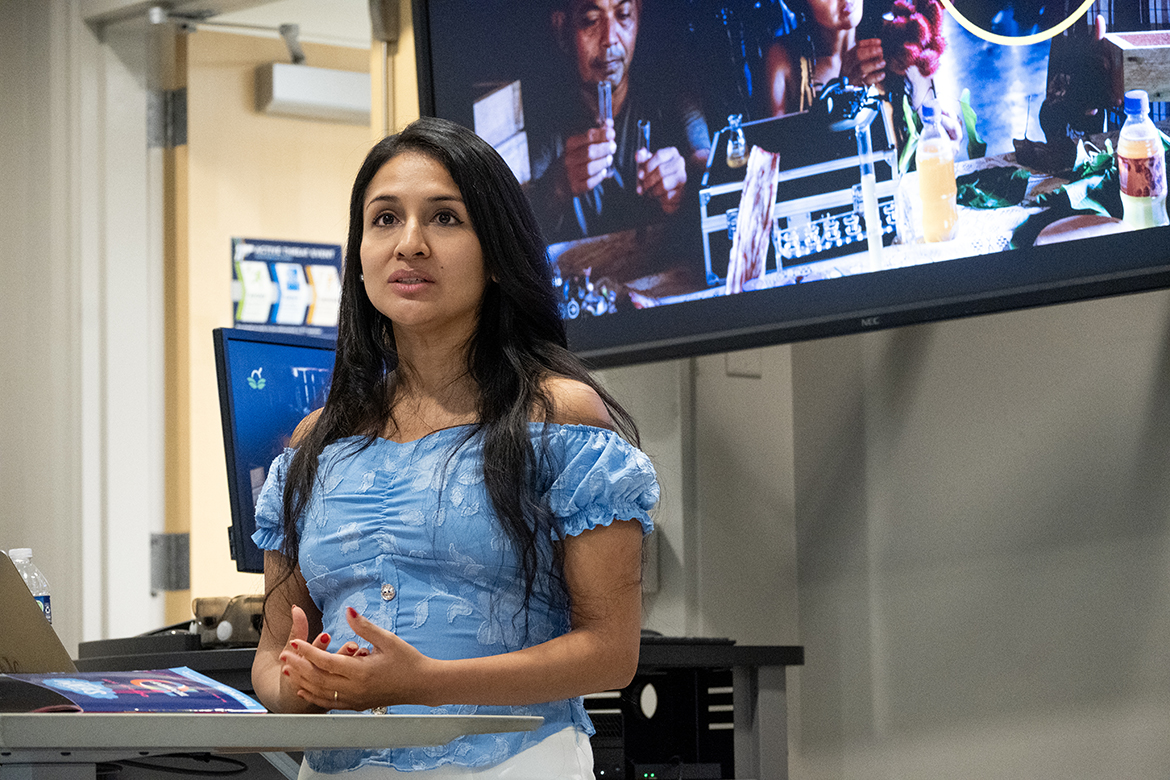
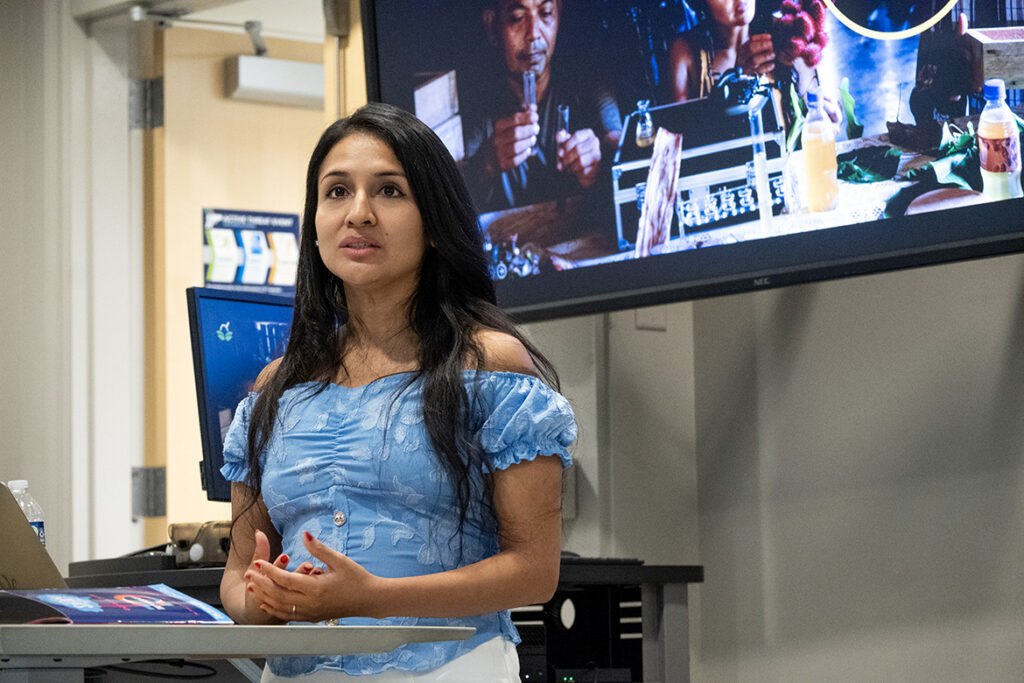
MURFREESBORO, Tenn. — Rosa Vásquez Espinoza’s curiosity has led her many places. From Peru to Tennessee to across the globe: Beijing, Michigan, the United Kingdom, and recently, to Middle Tennessee State University, where she spoke as honorary chair of the 10th annual Tennessee STEAM Festival.

But the award-winning author, chemical biologist and National Geographic Explorer’s journey began in a classroom much like those in MTSU’s Wiser-Patten Science Hall.
“I fell in love with science,” Espinoza recently told a group of MTSU biology students during a campus visit. “I just wanted to get in a lab. I didn’t care what I was doing.”
She wound up with a double major in biology and chemistry. The chemical equations reminded Espinoza of her grandmother’s traditional knowledge — how changing one molecule in a medicine could make a poison, how the preparation of a plant could be the difference between hurting and healing.
“My grandmother is a traditional healer,” said Espinoza, who grew up between the Andes Mountains and the Peruvian rainforest. “She didn’t have the chance to attend school, but she knows so much about plants. In her work, all the plants are medicine.”
Scientific research and ancestral knowledge go hand in hand for Espinoza, whose foundation, Amazon Research Internacional, fosters a reciprocal relationship between the scientific community and Indigenous communities in the name of conservation.
Sting(less) like a bee
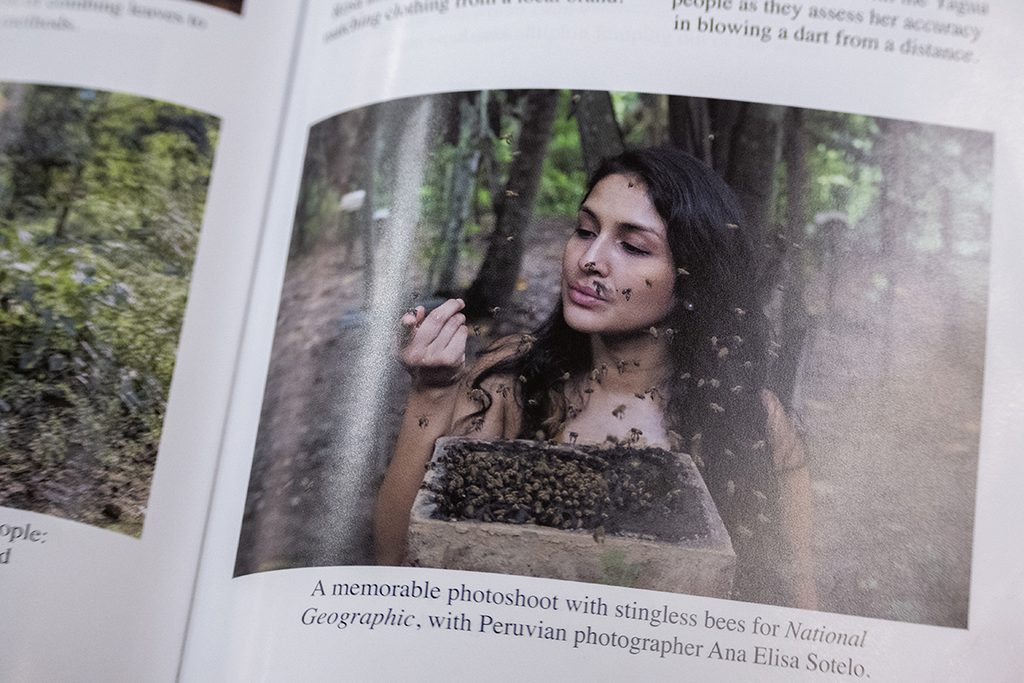
Her work with stingless bees is an apt example. This native pollinator is crucial to the survival of the rainforest and holds an important role as medicine in the Indigenous cultures of the Amazon. But outside of the bees’ tropical habitat, virtually no one had heard of them.
Espinoza’s research took her and her team deep into the rainforest. While some species of stingless bees will nest in boxes tended by beekeepers, others are found only in hollow trees. They tracked the elusive bees at night alongside guides from the Kukama-Kukamiria Tribe, who could follow the hum of the hives.
“We started to document (the bees’) importance for these cultures, and bringing that Indigenous perspective in through interview data that were published,” said Espinoza. “Maybe this is one route to resolution for the regeneration of the Amazon, plus also supporting (Indigenous beekeepers’) livelihoods.”
Legal rights for stingless bees
Conducting research, gathering data and leaving was not enough for Espinoza. From her perspective, it did little for the bees and less for the tribes who relied on and cared for them. She spearheaded a campaign petitioning the government of Peru to act, speaking with officials and leaders about the bees’ plight.
“A lot of them we thought didn’t really care when we talked to them,” said Espinoza. “But we had taken a lot of efforts to speak, whether it was with a secretary or somebody else.”
That determination led to a groundbreaking conservation win: legal rights for stingless bees.
“They became the first insect in the world to get legal rights recognized, though at a municipal level,” said Espinoza. They may not be the last. Other municipalities in the Netherlands, Bolivia and the United States have taken notice.
“We have conservation upfront; we have a bees’ rights perspective as well,” said Espinoza. “It’s not just serving humanity, but how can it also be serving the health of the bee population and the ecosystem?”

The scientist ponders this and many other questions in her award-winning book, “The Spirit of the Rainforest: How Indigenous Wisdom and Scientific Curiosity Reconnects Us to the Natural World.” It details not only her research into stingless bees, but also the Amazon’s boiling river, bioluminescence in the rainforest and even zoopharmacognacy — animals’ deliberate ingestion of medicinal plants.
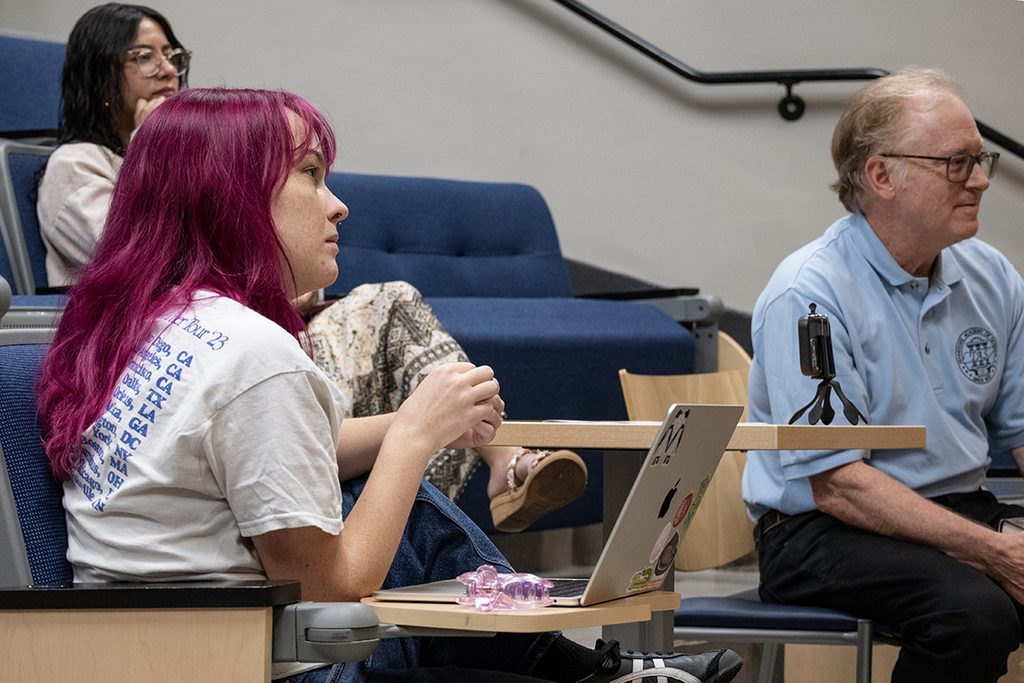
“I figured (the lecture) would be interesting,” said biochemistry student Aubrey Flatt, who looks forward to reading Espinoza’s book. “I would love to pick up a copy.”
Biology major Sabrina McKenna was excited to learn more about the stingless bees she encountered during professor Vincent Cobb’s study abroad course in Costa Rica.
“There was a huge nest,” said McKenna. “They’d been there for decades.”
Her own interest in tropical herpetology may overlap with Espinoza’s research, particularly in zoopharmacognacy.
“I had no idea about animals self-medicating,” said McKenna, who was elated by the research potential of the topic.
— Cat Curtis Murphy ([email protected])




NO COMMENT