
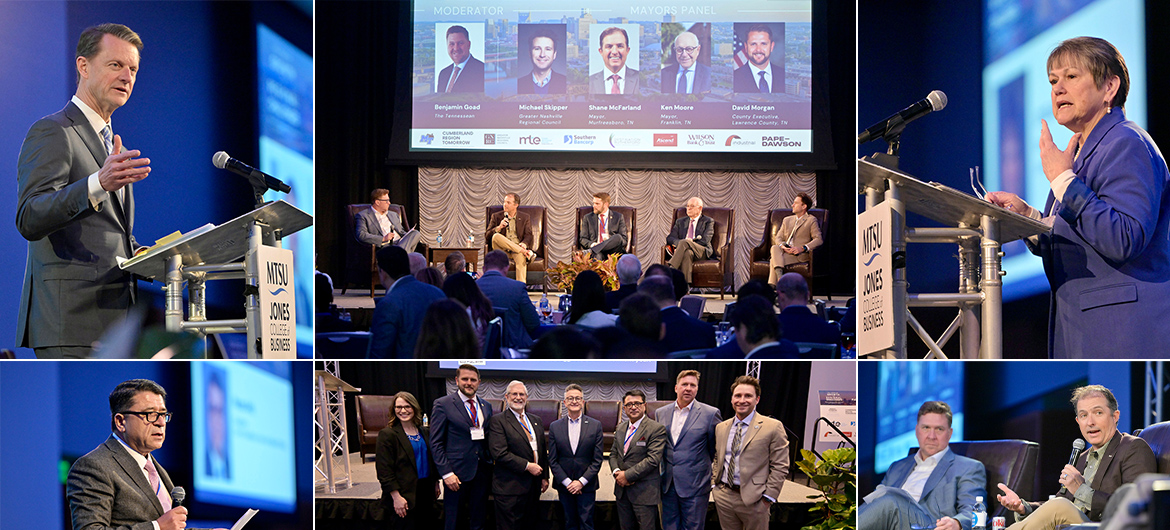
MURFREESBORO, Tenn. — Balancing growing infrastructure needs, competitive industrial recruitment, workforce development demands and rising housing costs were among the litany of topics at Middle Tennessee State University as state, regional and local leaders gathered for an annual forum to discuss these ongoing challenges in a region where explosive growth remains the norm.
Hundreds gathered inside the MTSU Student Union Building in late March for the 2026 Forum on Growth and Regional Challenges. Hosted by MTSU’s Business and Economic Research Center, the event featured keynote remarks by Stuart McWhorter, deputy governor and commissioner of the Tennessee Department of Economic and Community Development, and a panel featuring area mayors sharing their perspectives on how best to position their communities for sustained prosperity.
In welcoming forum participants and attendees, MTSU President Sidney A. McPhee noted the university’s critical role in supplying a talent pipeline to the region’s economy, producing roughly 5,000 new Blue Raider graduates each year, the majority of whom stay in the region and state.


“But our university is more, much more than sheer numbers. We must be responsive to the needs of our business and industry partners and provide the educational, research, and training needs required for their success,” he said, adding that MTSU continues to hone its entrepreneurial focus to meet regional workforce needs.
“Over the years, we’ve built programs in diverse fields of study, from mechatronics engineering to hospitality and tourism, and equine science to aviation. And most recently, we’ve added new programs in legal studies and quantum science, all created in response to business demands. And we remain committed to aligning academic programs with needs across the state and its economy.”
From local to global economy
McWhorter noted that in 2025, the state landed 75 new business projects, announced more than 8,000 net new jobs statewide, and saw companies invest just over $11 billion, including Korea Zinc’s “historic” $6.6 billion investment to build a metal refinery in Clarksville, the largest single announced capital investment in state history. Roughly 70% of the total investment came from foreign-based companies, the second year in a row at that level, he added.
“We have five international offices across the globe in Europe and Asia. We’re very intentional about the relationships that we build across the globe. We go to companies, we meet them where they are, and it’s a relationship-building business that we’re in,” McWhorter said.
“We know that they’re investing a significant amount of capital in our state, and we want to build those relationships and know the folks that we’re in partnership with. And yes, those trips require time and resources, but when those relationships lead to billion-dollar investment in our state and companies choose to call Tennessee home, it’s worth every penny and every minute we spend overseas.”


McWhorter also noted that nearly 60% of added jobs last year went to rural Tennessee, the highest percentage ever. “That matters because opportunity in Tennessee is no longer defined by your zip code. In fact, 85% of our population growth is now happening in rural Tennessee.”

“But the global landscape is changing. Competition in advanced industries is accelerating and is being driven by innovation, capital investment, and national priorities,” he said. “So while job creation will always matter, long-term success is going to be defined by something much bigger. It’s the capital investment, research development, resilient supply chains, and innovation capacity. And I believe Tennessee is not just ready to compete, we’re ready to lead.
“We already have strong momentum in industries like aerospace and defense, pharmaceuticals, biotech, quantum computing, and nuclear energy. These sectors don’t just drive economic growth. They’re essential to our national security and our country’s future. That’s why we’re doubling down on partnerships, especially between the public and private sectors,” he continued.
“We see incredible research happening at institutions like MTSU and across the entire state, and we want to better connect that innovation with industry. And right here at MTSU, exciting work in quantum research, which is helping position Tennessee at the forefront of emerging technologies.”
Housing, transportation, child care
Stephanie Coleman, president of the Nashville Area Chamber of Commerce, set the stage for the forum with a straightforward assessment: the biggest challenge facing the region when she started at the chamber almost two decades ago is no longer how to get Nashville on the map. The Nashville metro area is now home to more than 2 million residents and roughly 60,000 businesses, one of the nation’s “it” cities that continues to attract new residents daily.
“Today, the question has fundamentally changed. It’s no longer whether we can attract growth. It’s whether we can manage it,” Coleman said. “Whether this region can grow in a way that works for the people who are already here, not just the ones who are on their way. That shift from chasing growth to steering it is the most important strategic pivot of our generation.”

Coleman said that while the cost of living “still remains below the national average for major metros,” it is nonetheless noticeably rising and the fact remains, she said: “Growth is not the same as prosperity, and prosperity is not the same as livability.”
“A booming GDP is worth celebrating, and it should also translate into families being able to stay in the neighborhoods that they call home. A top 10 ranking is an important milestone, and it should go hand in hand with parents being able to find activities of child care,” Coleman continued. “Record-breaking airport traffic reflects strong momentum, and it should be matched by a commute that works for a worker traveling I-24 each day.”

Coleman said the chamber’s latest survey shows that housing affordability now tops the list of issues more important to its members, followed by transportation and child care. On the housing front, she noted that the median home price in Williamson County is now $875,000 while the home prices in Wilson County have doubled the past decades as examples of the growing challenge of housing affordability in the region.
“Housing has become unaffordable for many residents, and that’s having real personal impacts for families and economic impacts for our region. Businesses must be able to recruit employees to the area, and their current employees must be able to afford to stay,” Coleman said.
“We’re committed to advocating for policies, programs, and funding that ensure that housing is more accessible. And that means we do need to have hard conversations about zoning, density, and missing middle housing as well. And we need to support government and philanthropic funding programs that are essential to creating the housing that our region needs. It’s a both-and strategy. Not one sector alone can solve this problem.”
Capturing ‘regional economic pulse’
Coleman, along with Jones College of Business Dean Joyce Heames, announced that the Nashville Chamber has partnered with MTSU’s Business and Economic Research Center, led by Director Murat Arik, to launch the Nashville Regional Business Confidence Index, a quarterly index that will give insight on how Middle Tennessee business owners, executives and senior leaders feel about the future of their business and the region’s overall economic health.
Participants will answer questions about their outlook on issues such as sales growth, employment expectations, capital investment plans, access to credit, and profitability.

“We can give numbers all day long, but how do people interpret those numbers and what are our perspectives on the local issues that affect business performance? Things like infrastructure, housing costs, and the policy environment for business growth,” Heames said. “From these responses, our researchers will construct a business sentiment index that tracks business optimism or pessimism over time. Think of it as the regional economic pulse.”
Added Coleman: “Livability work ensures that growth translates into quality of life. And the confidence index gives us a way to know, in nearly real time, whether we’re actually delivering on the promise. These three things form a feedback loop: If we get livability right, confidence rises, which attracts more investment, which creates more growth, which demands more livability work.
“If we get it wrong, if housing stays unaffordable, if transit stalls, if child care remains out of reach, then confidence erodes, talent leaves, and the growth engine slows. The confidence index is in some ways our accountability measure. It turns the question, ‘Is Nashville still a great place to live?’ from a marketing slogan into a measurable proposition.”

The politics of explosive growth
Rounding out the forum was a wide-ranging discussion touching on some of those same issues, featuring Murfreesboro Mayor Shane McFarland, an MTSU alumnus, Franklin Mayor Ken Moore, Lawrence County Executive David Morgan, and Michael Skipper, executive director of the Greater Nashville Regional Council.
Moderating the panel was Benjamin Goad, executive editor of The Tennessean, who asked questions surrounding growth and competitiveness, housing affordability and quality of life, infrastructure investment and taxes, and collaboration between communities to promote economic development.

McFarland and Moore touted the highly regarded educational systems in their respective communities, including MTSU’s presence in Murfreesboro, as being very attractive to prospective industries, while Morgan noted how Lawrence County has leveraged the presence of Tennessee Technology Centers as well as the Tennessee College of Applied Technology to provide vocational training for its high school students that leads to good-paying jobs.
Added Skipper: “I think one of the things that we look at long term, based on some recent experiences, is just to make sure that there isn’t a growing gap between where the workforce lives and where those jobs are, the pressure that puts on our transportation system and other infrastructure to support those long commutes,” Skipper said. “I think something we’ll have to keep our eye on as we continue to create jobs across the region is to be mindful of how easy or difficult it is for people to live close to their jobs.”


Housing affordability was again a key topic of discussion, with Morgan calling it “a huge struggle” for his community, while Moore said new tools like infrastructure development districts now allowed by the state may provide a way to incentivize developers to provide a better mix of housing that isn’t just “mega homes,” but also more affordable options.

“We have a lot of density in Franklin, but we’ve chosen as we allow density to also make sure that we’re preserving land. For example, we have a concept called Village Green. Seventy percent of that development would be left open. The rest of it would be the density. So that’s one way to do it and still have that same area where people that live in that development have plenty of places to roam and activate. Also extremely important as far as community design that is just not a bunch of houses or apartments or townhomes but create that development in your community that’s walkable.”
“… the best development the community can have is closest to the core, where the infrastructure is already located. It’s also more economical for the developers if they’re developing closer to the core.”

McFarland said that in regard to Murfreesboro, “we’re in an extremely tough spot right now” where new residents are pouring into the region, driving up single-family housing prices as residents oppose density to provide more affordable options.
“The dirty word in Murfreesboro is ‘apartments.’ … We’re not building workforce housing because our community has said that they don’t want to see multifamily. So what we’re seeing, and I think it’s something that you saw 20 years ago, people who couldn’t afford to live in Davidson County that worked in Davidson County would drive to Murfreesboro. And now what you’re seeing, people who can’t afford to live in Murfreesboro are now moving to Bedford County, Cannon County, and Coffee County. So you’re seeing growth in those areas, which in turn kills our transportation issues because all those people now are driving back into our communities.
“So it’s going to be something I think globally that we all have to talk about … typically what we have seen is people move here, and they love this community, but they don’t want anyone else to move here. And I understand that. I think traffic in Murfreesboro in the morning, in the afternoon, it takes an hour to go from Murfreesboro to Murfreesboro. And so that’s something that we all are continually dealing with.”
All participants emphasized the importance of taking a collaborative, regional approach to growth and economic development because challenges don’t begin or end at city limits or county lines — landfill use, for example — and economic successes in one area of the region tend to ripple into others.
But the panelists also lamented the limited tools they have to address issues, such as expanding tax revenue and keeping up with infrastructure, such as roads, due to restrictions imposed by the state legislature.

‘We’re ready for it’
Murat Arik, BERC director and holder of the Jennings and Rebecca Jones Chair of Excellence in Urban and Regional Planning, wrapped up the forum by thanking attendees for helping the event grow
“Our speakers show us that growth brings challenges, but it also brings opportunity, especially when leaders work together. Your presence shows how much people in this region care about the future of Middle Tennessee,” he said. “Each year, the forum grows stronger, and each year, the conversation becomes more important. We no longer are just recruiting projects. We’re building ecosystems. We’re aligning capital, talent, infrastructure, research, and policy to create long-term success.

“Tennessee has a real opportunity to lead, especially as companies look to onshore critical industries and strengthen national competitiveness. With that growth will come challenges, as we know, as we’ve talked about — housing, transportation, education, utilities, all of which will be challenges — but we’re ready for it.”
Forum sponsors included Cumberland Region Tomorrow, Greater Nashville Regional Council, Middle Tennessee Electric, Southern Bancorp, Destination Rutherford, Ascend Federal Credit Union, Wilson Bank and Trust, Clarksville Industrial Development and Pape-Dawson.
The next forum is set for March 26, 2027.
About BERC
Since its establishment at Middle Tennessee State University in 1970, the Business and Economic Research Center, or BERC, has conducted research on the regional economy as a public service and on a contract basis for clients from the community. BERC has completed research projects for both MTSU and external clients on a variety of topics, including the economic impact of universities, regional population growth, and current trends in various industries.
For more information on BERC, visit berc.mtsu.edu.
— Jimmy Hart ([email protected])




COMMENTS ARE OFF THIS POST